Normal

Porque é que a Tradução Precisa de Metadados Impulsiona o SEO Global

MultiLipi
MultiLipi6/24/2025
20 Minutos ler
Imagem de capa do blogue

Banner visual com o título 'Importância das Meta tags para a Construção de Web sites Multilingues' para um Web site de SEO multilingue

Os motores de busca tratam os metadados traduzidos (tais como títulos de página e meta descrições) de forma ligeiramente diferente do conteúdo normal, e isto pode afetar significativamente a forma como o seu site multilingue se posiciona a nível global. Traduzir com precisão os metadados do seu website é essencial para uma tradução eficaz de websites e SEO multilíngue. Quando bem feito, melhora a compreensão dos motores de busca sobre as suas páginas e influencia diretamente os fatores de envolvimento do utilizador, como as taxas de cliques, impulsionando em última análise a visibilidade internacional. Por outras palavras, a tradução de metadados é um fator SEO fundamental que nenhum proprietário de um site global se pode dar ao luxo de ignorar – embora alcançar a precisão traga desafios. Neste guia, exploraremos porque é que a tradução de metadados é importante e como fazê-la corretamente para traduzir o seu site para um melhor alcance global.

Pontos Chave:

  1. Visibilidade de Pesquisa Melhorada: A tradução precisa de metadados ajuda os motores de busca a compreenderem melhor o seu conteúdo em cada idioma, melhorando diretamente a visibilidade e o posicionamento do seu site multilingue (weglot.com).

  2. Otimização Específica por Idioma: Cada idioma tem características únicas – as estratégias eficazes devem ter em conta as diferenças nas palavras-chave, no comprimento e no contexto cultural, em vez de utilizarem metadados padronizados para todos.
     
  3. Configuração Técnica de SEO: A implementação técnica adequada (por exemplo, etiquetas hreflang, estruturas de URL, sitemaps) é essencial para garantir que os motores de busca indexam e servem corretamente as suas páginas traduzidas ao público certo.
     
  4. A Abordagem de Tradução Importa: Pode traduzir site metadados de forma manual ou automática – uma abordagem híbrida que combine ambas oferece frequentemente o melhor equilíbrio entre escala e qualidade.
     
  5. Fluxos de Trabalho Otimizados com a Ferramenta Certa: A utilização de uma plataforma dedicada à tradução de websites multilingues pode simplificar a tradução de metadados, automatizando as traduções iniciais e permitindo refinamentos manuais fáceis. Por exemplo, a solução de tradução impulsionada por IA da MultiLipi automatiza a tradução de metadados, dando-lhe total controlo para editar e otimizar cada fragmento (multilipi.com)

Porque é que a tradução precisa de metadados impacta diretamente as posições de pesquisa global
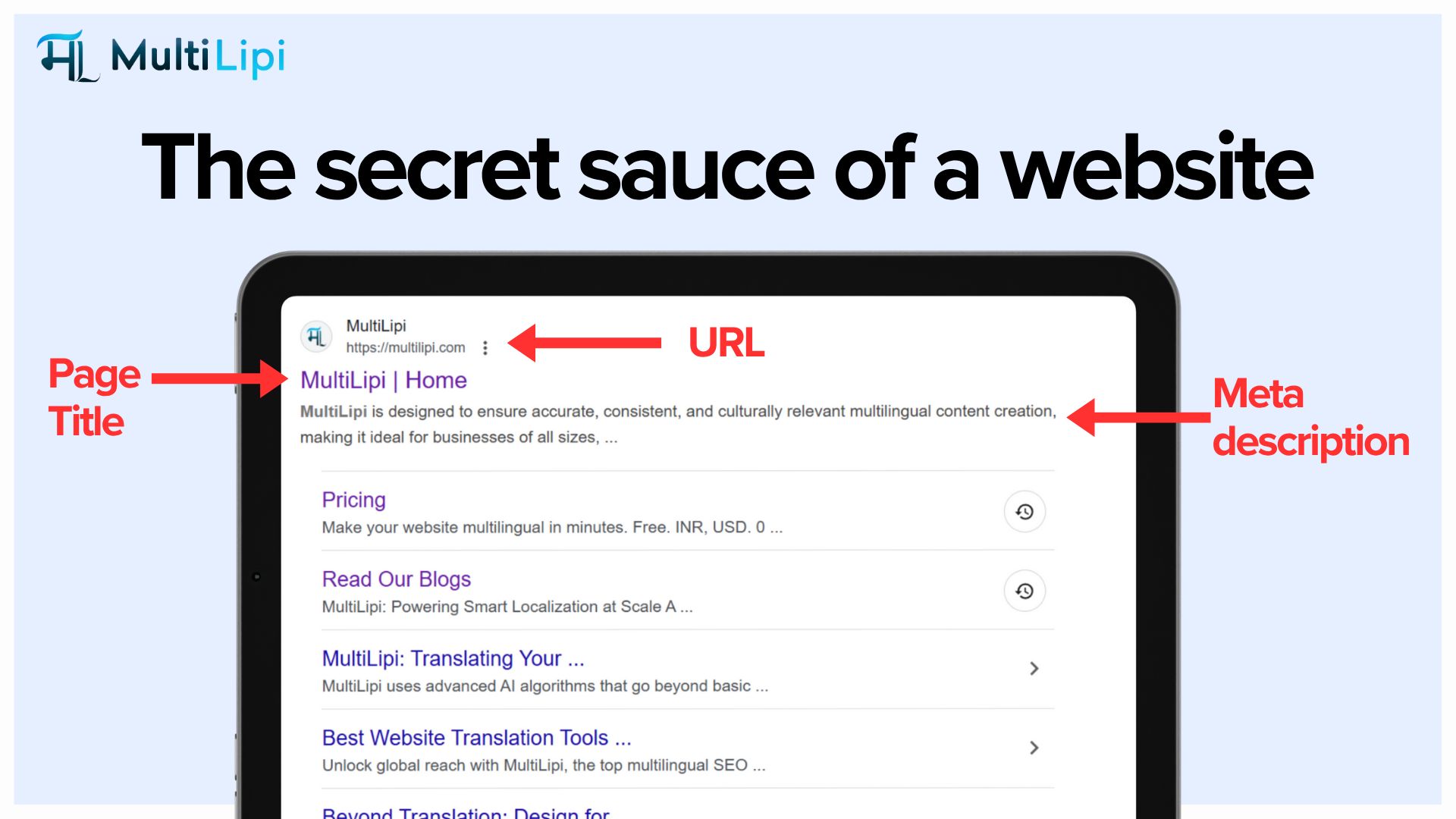
MultiLipi search result showing page title, URL, and meta description as key SEO elements for a multilingual website

Os metadados – incluindo as etiquetas de título e as descrições meta – servem como um resumo conciso do conteúdo de uma página web nos resultados de pesquisa. Traduzir estes elementos com precisão para os seus idiomas de destino garante que os motores de busca conseguem interpretar e categorizar devidamente o seu conteúdo para cada localidade, melhorando as suas posições nos resultados de pesquisa local (weglot.com). Igualmente importantes, estes snippets traduzidos são a primeira apresentação da sua marca que os utilizadores veem numa página de pesquisa, pelo que causar uma boa primeira impressão é fundamental para atrair cliques.

Por outro lado, metadados mal traduzidos podem confundir ou induzir os utilizadores em erro. Se o seu título ou descrição parecer estranho ou irrelevante devido a uma tradução deficiente, é provável que os utilizadores ignorem o seu resultado ou abandonem o seu site rapidamente – prejudicando a sua taxa de cliques e aumentando a taxa de rejeição, o que por sua vez prejudica o desempenho de SEO (weglot.comlinguise.com). Em suma, as traduções imprecisas conduzem a uma perda de tráfego.

Outro fator crítico é a implementação de tags hreflang para todas as versões linguísticas do seu site. As anotações Hreflang indicam aos motores de busca para qual idioma e região cada página se destina. Se estas etiquetas estiverem em falta ou mal configuradas, mesmo os metadados melhor traduzidos podem não ser mostrados ao público certo (weglot.comlinguise.com). Todos os sites multilingues devem utilizar hreflang (com os códigos de idioma e país corretos) para que o Google e outros motores de busca sirvam aos utilizadores a versão local adequada do seu conteúdo. Sem o hreflang, uma meta descrição em francês poderá aparecer por engano a utilizadores de língua inglesa, ou vice-versa, comprometendo os seus esforços.

Conclusão: A tradução precisa de metadados melhora tanto compreensão por parte dos motores de busca do seu conteúdo e o atratividade para o utilizador dos seus snippets de pesquisa. É um fator determinante para um melhor desempenho de SEO global quando associado a uma configuração de SEO técnico adequada.

Componentes Críticos da Tradução de Metadados Bem-Sucedida

Visual que demonstra os principais componentes de uma tradução de metadados bem-sucedida: texto focado na intenção, palavras-chave localizadas e memória de tradução.

Alcançar traduções de metadados de alta qualidade requer considerações linguísticas e estratégicas:

  • Pesquisa de Palavras-Chave Específicas do Mercado: Comece por pesquisar o comportamento de pesquisa no seu mercado-alvo. Identifique as palavras-chave e expressões que os utilizadores locais realmente pesquisam, em vez de traduzir diretamente as suas palavras-chave em inglês. Concentre-se em termos que tenham um bom volume de pesquisa e se alinhem com a intenção do utilizador nessa língua. Ferramentas como Semrush e Ahrefs (e recursos gratuitos como Google Trends) são inestimáveis para este processo, ajudando a descobrir termos de pesquisa local de alto volume e tópicos (localizejs.com). Ao adaptar os seus títulos e descrições para incluir palavras-chave específicas do idioma, estabelece uma ligação mais eficaz com o público local e os algoritmos de pesquisa.
     
  • Intenção em detrimento da tradução literal: Priorize sempre a transmissão do significando e a intenção dos metadados, em vez de efetuar uma tradução palavra a palavra. Uma frase que funciona bem em inglês poderá não ter um equivalente, por exemplo, em japonês ou árabe. Pode exigir a reformulação ou uma abordagem criativa (também conhecida como transcriação) para ressoar no idioma de destino. Por exemplo, um slogan de marketing inteligente em inglês pode soar estranho ou até mudar de significado se traduzido literalmente (linguise.com). Mantenha a mensagem principal, mas adapte a redação para se ajustar às nuances culturais locais e ao comportamento de pesquisa. Isto garante que os metadados permanecem claros, atraentes e relevantes para os falantes nativos.
     
  • Utilização de Memória de Tradução e Glossários: A consistência é fundamental em conteúdos multilingues. A implementação de um sistema de memória de tradução ou de um glossário pode melhorar significativamente a consistência entre páginas semelhantes. Estas ferramentas armazenam segmentos traduzidos anteriormente e a sua terminologia preferida para que os possa reutilizar em novos conteúdos. Por exemplo, o MultiLipi oferece um glossário integrado que lhe permite definir traduções para termos específicos (por exemplo, nomes de produtos ou slogans) para garantir uma formulação uniforme em todos os idiomas (multilipi.com). Ao utilizar um glossário ou memória de tradução, garante que uma frase como “Avaliação Gratuita” ou o lema da sua marca seja sempre traduzido da mesma forma preferida sempre que aparece, reforçando o reconhecimento da marca e evitando terminologia inconsistente.
     
  • Utilize Dados e Análises: Além da precisão linguística, utilize dados para orientar a sua estratégia de metadados. Monitore a forma como os utilizadores em diferentes regiões interagem com as suas páginas traduzidas. As ferramentas de analítica e de inteligência empresarial podem fornecer perceções sobre quais as versões de metadados traduzidos que apresentam taxas de cliques ou taxas de conversão mais elevadas. Por exemplo, a integração de plataformas como o MicroStrategy ou o Sisense pode ajudá-lo a analisar o desempenho por região (weglot.com). Se a meta-descrição em alemão tiver um CTR inferior à em inglês, isso pode indicar que a formulação não está a ressoar e precisa de ajustes. Os ajustes baseados em dados garantem que os seus metadados não são apenas traduzidos com precisão, mas também otimizados para obter resultados.
     

Ao combinar uma pesquisa exaustiva de palavras-chave, percepção cultural, ferramentas de consistência e análise de desempenho, estabelece uma base sólida para o sucesso da tradução de metadados em todos os seus idiomas de destino.

Otimização Específica por Idioma e Limites de Carateres

Línguas diferentes exigem frequentemente abordagens de otimização personalizadas devido a variações no comprimento e no sistema de escrita. Uma consideração importante é expansão ou contracção de texto. Por exemplo, uma frase em alemão pode ser cerca de 20–30% mais longa do que o seu equivalente em inglês (dorotapawlak.eu). Isto significa que um meta título que caiba dentro dos limites de pixéis do Google em inglês poderá ser demasiado longo em alemão, fazendo com que seja truncado nos resultados de pesquisa. Tenha sempre em conta estas diferenças – se traduzir um título em inglês diretamente, verifique se a versão traduzida se mantém dentro dos limites de caracteres recomendados (cerca de 55–60 carateres para títulos, ~155–160 para descrições na maioria dos casos, embora estes limites possam variar consoante o idioma e o motor de busca). Planear a expansão do texto (ou contração, em línguas como o chinês) ajudará a preservar a mensagem completa dos seus metadados nas SERP.

Caracteres CJK e scripts especiais: Línguas como o chinês, o japonês e o coreano utilizam caracteres que ocupam espaços individuais, mas transmitem mais significado por carácter. Podem ser apresentados de forma diferente nas páginas de pesquisa (por exemplo, o Google mostra frequentemente menos caracteres para línguas CJK). Certifique-se de que os seus títulos e descrições nestas línguas são concisos e informativos. Tenha também em atenção qualquer formato obrigatório (por exemplo, os metadados em japonês podem incluir pontuação de largura total).

Idiomas da Direita para a Esquerda (RTL): O árabe, o hebraico e outras línguas RTL exigem atenção especial quanto à forma como os metadados são apresentados. Certifique-se de que o código do seu site declara corretamente a direção do idioma para que os títulos e as descrições sejam renderizados adequadamente. Mesmo nos resultados de pesquisa, deve evitar texto corrompido ou desordenado. Coisas simples como a colocação de pontuação em texto RTL podem afetar a legibilidade. Em suma, teste sempre a forma como os seus metadados aparecem para idiomas RTL – frequentemente necessitam de ajustes na redação ou na formatação para garantir clareza (linguise.com).)

Pontuação e carateres locais: Cada idioma tem as suas próprias convenções tipográficas. O espanhol utiliza pontos de interrogação/exclamação invertidos, o francês e o alemão utilizam caracteres com acentos, etc. Utilize os caracteres localizados corretos nos seus metadados – isto não só transmite maior profissionalismo, como também pode influenciar a relevância das palavras-chave (por exemplo, "años" com ñ é uma palavra diferente de "anos" sem til). Não assuma que pode utilizar pontuação em inglês para tudo; adotar pontuação e espaçamento específicos do local fará com que os seus snippets pareçam nativos. Ignorar estas nuances pode conduzir a uma interpretação errada ou a uma impressão descuidada, o que poderá prejudicar o envolvimento do utilizador.

Por fim, faça sempre pré-visualizar os seus metadados traduzidos como apareceria nos resultados de pesquisa. Muitas ferramentas de SEO oferecem funcionalidade de pré-visualização de snippets. Isto permite-lhe detetar problemas como o truncamento, símbolos estranhos ou formulações que possam precisar de aperfeiçoamento antes de serem publicadas.

Requisitos Técnicos: Tags Hreflang e Estrutura de URLs

Uma tradução precisa por si só não basta – a configuração técnica de SEO do seu site multilingue também deve ser sólida. Implementação técnica adequada garante que os motores de busca conseguem descobrir e indexar o seu conteúdo traduzido de forma eficiente (weglot.com). Os elementos basilares a acertar são hreflang, estrutura de URLs, tags canónicas e sitemaps:

  • Atributos Hreflang: Como mencionado, utilize sempre as tags hreflang para especificar o idioma (e opcionalmente, a região) de cada página. Por exemplo, a sua página em francês deve ter uma tag hreflang="fr" (ou "fr-FR" para França em comparação com "fr-CA" para francês canadiano) a ligar a si própria, e tags recíprocas a ligar de volta às outras versões linguísticas. Isto ajuda o Google a servir a página em francês aos utilizadores francófonos, a página em espanhol aos utilizadores hispanofalantes, etc., em vez de adivinhar. Também evita problemas de conteúdo duplicado ao ligar explicitamente páginas equivalentes. Uma configuração de hreflang implementada corretamente é vital – sem ela, mesmo que traduza as meta tags na perfeição, os motores de busca “não sei qual a versão de idioma a apresentar aos utilizadores”, conduzindo a resultados subótimos (linguise.com). Seja meticuloso com os códigos de idioma e certifique-se de que cada página faz referência a todas as suas alternativas (incluindo uma tag auto-referencial).
     
  • Estrutura de URL (Subdomínios vs Subdiretórios): Defina uma estratégia de URL para o seu conteúdo multilingue e aplique-a consistentemente. As duas abordagens comuns são subdiretórios (por exemplo, oseusite.com/es/pagina) ou subdomínios (por exemplo, es.yourwebsite.com/page). Não existe uma resposta única – cada um tem prós e contras, e qualquer um pode funcionar para SEO se for feito corretamente. Os subdiretórios são muitas vezes mais simples de implementar e concentram toda a autoridade de SEO num único domínio, enquanto os subdomínios podem permitir uma maior separação (por vezes utilizados se estiver a segmentar diferentes países ou ao usar um serviço de proxy). A chave é ser consistente e garantir que as páginas de cada idioma estão claramente separadas numa destas estruturas (localizejs.com) . A MultiLipi suporta ambas as opções – por exemplo, pode escolher subpastilhas específicas da língua como /fr/ ou subdomínios dedicados como fr.yoursite.com dependendo das suas necessidades (wordpress.org). Qualquer que seja a estrutura que escolha, atualize os links internos e a navegação para direcionar os utilizadores (e os crawlers) para os URLs localizados corretos.
     
  • Etiquetas Canónicas: Se tiver várias versões de uma página, utilize tags canónicas de forma adequada para evitar penalizações por conteúdo duplicado. Em geral, cada página de idioma deve fazer referência canónica a si própria (uma vez que se trata de conteúdo original nesse idioma e não de uma duplicação). Não não aponte as páginas de diferentes idiomas para um único URL canónico, caso contrário os motores de busca poderão ignorar as alternativas. A única altura em que o canónico entra em jogo é se tiver conteúdo duplicado no same idioma (por exemplo, uma página para impressão). Para SEO multilingue, o hreflang é a ferramenta principal, e não as tags canónicas entre idiomas. Certifique-se de que o seu CMS ou plugin de tradução configura isto corretamente.
     
  • Sitemaps Localizados: Para sites de grande dimensão, considere criar sitemaps XML separados para cada idioma (ou um sitemap combinado que liste todos os URLs alternativos com hreflang). Isto ajuda os bots dos motores de busca a explorar eficientemente a estrutura do seu site. Por exemplo, poderá ter sitemap-en.xml, sitemap-fr.xml, etc., cada um contendo URLs apenas para esse idioma. Submeta-os na Google Search Console (e no Bing Webmaster Tools, etc.) para os respetivos locais. Isto garante que nenhuma página traduzida é ignorada devido a problemas de profundidade de rasteio. Se a manutenção de múltiplos mapas do site for onerosa, um único mapa do site também serve – certifique-se apenas de que cada URL está incluído e de que as relações hreflang estão indicadas.
     
  • Outros Elementos Técnicos: Lembre-se que os metadados não são apenas títulos e descrições. Não se esqueça de traduzir atributos alt de imagem, etiquetas Open Graph (para partilha em redes sociais) e quaisquer outras meta etiquetas que transportem conteúdo (como metadados do Twitter Card, descrições de esquema JSON-LD, etc.). Estas podem impactar o SEO e a forma como as suas páginas aparecem em plataformas sociais. Por exemplo, o texto alternativo de uma imagem no idioma do utilizador pode ajudar no SEO de imagens e na acessibilidade, e uma descrição Open Graph traduzida tornará o seu conteúdo mais apelativo quando partilhado em redes sociais locais. Muitos proprietários de sites negligenciam estes elementos técnicos de metadados durante a localização (linguise.com), por isso, certifique-se de que o seu fluxo de trabalho ou ferramenta de tradução os capta.
     

Acertar nestes detalhes técnicos anda de mãos dadas com a precisão linguística. Juntos, criam uma infraestrutura sólida para site multilíngue sucesso em SEO – onde cada página localizada pode atingir o seu potencial máximo nos rankings de pesquisa.

Abordagens de Automação vs. Tradução Manual do MultiLipi

MultiLipi funcionalidades para SEO global, incluindo tradução de metadados, melhores práticas de SEO multilingue, ferramentas de glossário, editor visual, sincronização e gestão em massa.

Quando se trata de traduzir metadados para um site multilíngue, surge uma questão comum: devemos confiar em ferramentas de tradução automática ou investir em tradutores humanos para esta tarefa? A resposta reside frequentemente num meio-termo. Vamos examinar ambas as abordagens:

Tradução Automatizada de Metadados: Prós e Contras

  • (+) Velocidade e Escalabilidade: A tradução automatizada oferece uma velocidade incrível. Se possui um grande site de comércio eletrónico ou atualizações frequentes no blog, a tradução automática pode processar centenas de meta tags quase instantaneamente. Esta escalabilidade torna viável traduzir esta página web e milhares de outros sem esperar por horários humanos. É ideal para entregas rápidas ou para testar vários idiomas de forma acelerada.
     
  • (+) Atualizações Oportunas: Para conteúdos que mudam com frequência (artigos de notícias, listas de produtos dinâmicas), as ferramentas automatizadas garantem que os seus metadados em todos os idiomas se mantêm atualizados. Não corre o risco de ter uma meta description desatualizada em espanhol porque um tradutor não estava disponível; o sistema traduz novos metadados em tempo real.
     
  • (-) Problemas de Nuances e Qualidade: A desvantagem é que a tradução puramente automática pode carecer da nuance cultural necessária para um texto de SEO eficaz. As ferramentas automatizadas podem interpretar mal expressões idiomáticas, o tom ou o contexto. Uma tradução literal pode parecer pouco natural ou confusa para os falantes nativos (linguise.com). Isto pode prejudicar as taxas de cliques se a metadescrição não fizer sentido ou não atrair o público local.
     
  • (-) Alinhamento Incorreto de Palavras-Chave: As máquinas podem não escolher as mesmas palavras-chave que um tradutor de SEO humano escolheria. Por exemplo, uma tradução automática pode utilizar uma palavra tecnicamente correta que tem zero volume de pesquisa no idioma de destino, ao passo que um ser humano saberia utilizar o sinónimo mais popular. Estas subtilezas significam que as traduções de metadados totalmente automatizadas podem, por vezes, ser subótimas para o desempenho de SEO.

Tradução Manual de Metadados: Prós e Contras

  • (+) Maior Precisão e Relevância Cultural: Tradutores humanos (especialmente aqueles com experiência em SEO) podem criar metadados que soam naturais e persuasivos na língua de destino. Podem manter a voz da sua marca e incorporar referências culturalmente relevantes ou chamadas para ação que as máquinas não detetariam. O resultado são meta títulos e descrições que ressoam tanto com os utilizadores locais como com os motores de busca. Isto é particularmente importante para conteúdo de marketing onde o tom e a emoção são importantes.
     
  • (+) Correspondência de Intenção: Um tradutor humano qualificado concentrar-se-á na intenção do utilizador e em palavras-chave relevantes, e não apenas no significado literal. Podem garantir que os metadados traduzidos apelam realmente ao que os utilizadores locais a ver para. Por exemplo, se o seu título meta em inglês for “10 Tips for Great Web Design”, um humano poderá saber que, em francês, os utilizadores têm maior probabilidade de pesquisar uma frase traduzida como “10 Ways to Improve Your Website” – ajustando a redação para corresponder aos hábitos de pesquisa locais.
     
  • (-) Demorado e Dispêndioso: Fazer tudo manualmente demora muito mais tempo. Criar e rever metadados para dezenas ou centenas de páginas em vários idiomas pode ser um processo lento, atrasando os lançamentos de conteúdos globais. Isto pode ser impeditivo para sites grandes ou atualizações urgentes. Além disso, a tradução humana de qualidade (e a posterior revisão de copywriting para SEO) pode ser dispendiosa, especialmente se precisar de linguistas profissionais para muitos idiomas.
     
  • (-) Riscos de Inconsistência: Sem um processo estruturado, a tradução manual por diferentes pessoas pode introduzir inconsistências. Um tradutor pode utilizar uma frase diferente de outro para o mesmo conceito, o que pode diluir a sua mensagem. (Isto pode ser mitigado utilizando glossários e fornecendo diretrizes claras aos tradutores, mas é algo que deve ser gerido com cuidado.)
     

Encontrar o Equilíbrio Certo – A Abordagem Híbrida: A boa notícia é que não tem de escolher estritamente uma ou outra opção. Muitas organizações concluem que uma abordagem híbrida à tradução de metadados produz os melhores resultados (weglot.com). Na prática, isto significa utilizar a tradução automática para realizar o trabalho pesado da tradução inicial, contando depois com uma intervenção humana (como um revisor nativo ou a sua equipa de marketing) para rever e aprimorar essas traduções. Esta abordagem oferece a velocidade da automação com a subtileza da supervisão humana. Pode obter rapidamente um rascunho de tradução para, por exemplo, 100 metadescrições de produtos, e depois dedicar tempo a polir as mais importantes ou a corrigir qualquer expressão menos natural.

As plataformas de tradução modernas suportam este fluxo de trabalho sem problemas. Por exemplo, pode ligar o seu site a uma tradutor de páginas web como o MultiLipi para gerar traduções instantâneas de metadados e, em seguida, utilizar a respetiva interface de pós-edição para afinar cada uma quanto ao tom e às palavras-chave. Ao automatizar o trabalho rotineiro e reservar o esforço humano para o controlo de qualidade, obtém uma elevada qualidade de tradução e execução rápida (weglot.com). Muitas empresas relatam que esta combinação (muitas vezes designada por IA + humano no processo) reduz drasticamente o tempo de introdução no mercado para novos idiomas, sem sacrificar o desempenho de SEO.

Em resumo, automação vs manual não é uma decisão de "ou um ou outro". Utilize a automatização para trabalhar em escala, mas planeie sempre uma etapa de revisão humana – especialmente para textos destinados aos clientes, como metadados, onde uma subtileza faz toda a diferença.

Acelere os seus esforços de SEO global com o MultiLipi
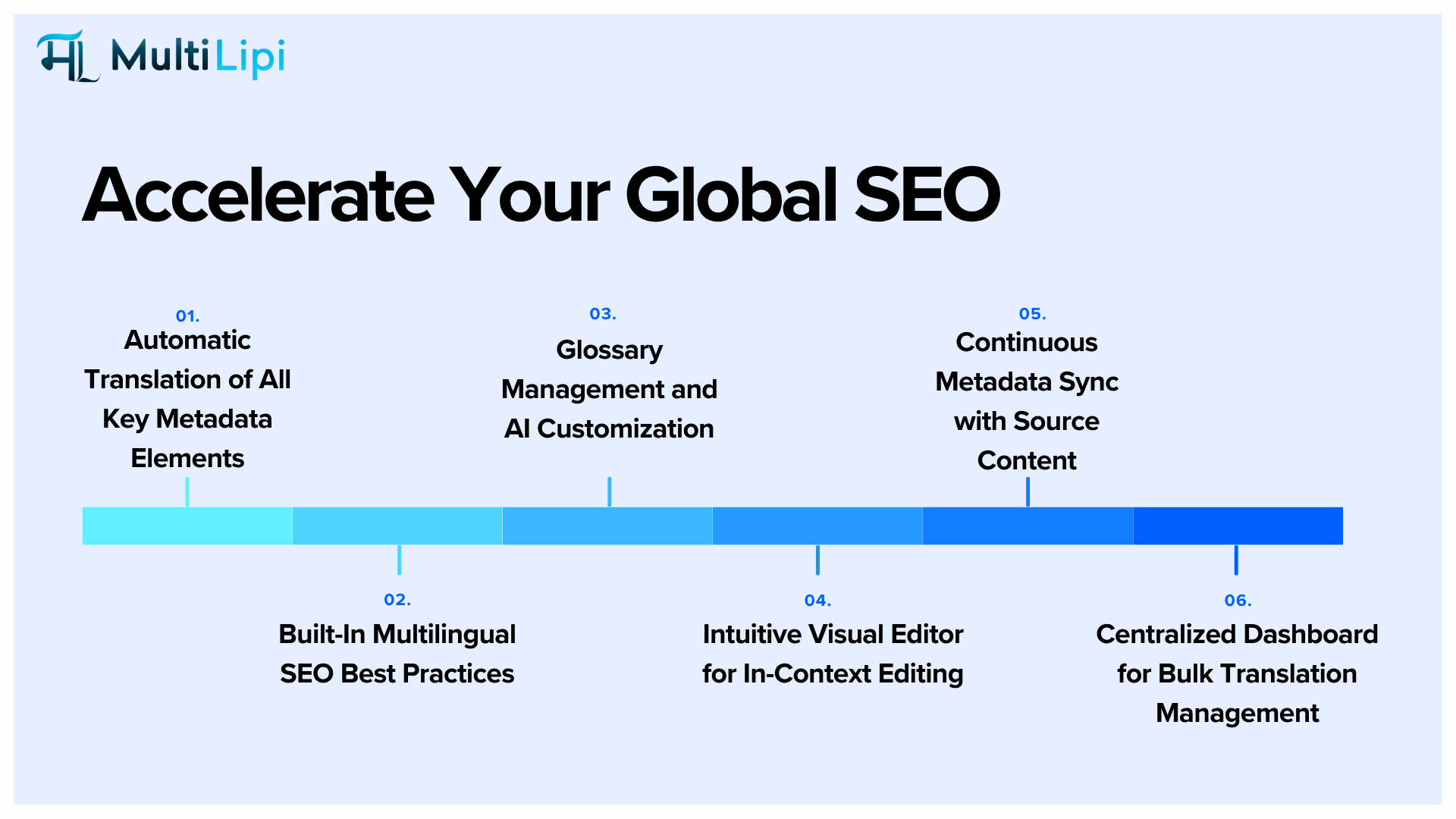
Infografia que destaca seis funcionalidades principais do MultiLipi para SEO multilingue, Acelerar o seu SEO Global

O MultiLipi é impulsionado por IA tradução de websites plataforma concebida para otimizar a tradução de metadados e eliminar as complicações do SEO multilingue. Combina o poder da automação com a subtileza da edição humana num fluxo de trabalho coeso. Eis como o MultiLipi o ajuda a otimizar os seus metadados (e conteúdo mais abrangente) para sucesso na pesquisa global:

  • Tradução Automática de Todos os Elementos Principais: A solução do MultiLipi deteta e traduz automaticamente elementos essenciais da página, tais como meta títulos, meta descrições, cabeçalhos, texto alternativo da imagem, e até mesmo campos personalizados ou tags de SEO. Isto garante que nenhuma parte dos metadados fica por traduzir. A plataforma foi concebida para gerir na totalidade site multilíngue SEO – por exemplo, traduzirá os seus slugs de URL ou criará estruturas de URL otimizadas para SEO para cada idioma, em vez de manter os URLs em inglês (wordpress.org). Ao abranger aspetos como URLs traduzidos e etiquetas alt, o MultiLipi assegura que toda a sua página está otimizada para a pesquisa local, e não apenas o texto visível.
     
  • Boas Práticas de SEO Multilingue Integradas: Quando utiliza o MultiLipi, a configuração técnica de SEO é amplamente tratada por si. A plataforma pode criar automaticamente subdiretórios ou subdomínios específicos de idioma para o seu conteúdo traduzido, dependendo da sua preferência, e implementar etiquetas hreflang em todo o site (wordpress.org). Isto significa que, desde o primeiro dia, as suas páginas traduzidas ficam devidamente estruturadas e indexadas pelos motores de busca em cada região. O MultiLipi é totalmente otimizado para SEO multilíngue, tal como a descrição do plugin do WordPress destaca – cada página traduzida é indexável pelo Google e a arquitetura do seu Web site está configurada para segmentação internacional de raiz  (wordpress.orgwordpress.org.)
     
  • Glossário e Personalização de IA: MultiLipi inclui a gestão de glossário e uma memória de tradução, permitindo-lhe definir traduções específicas para nomes de marcas, termos da indústria ou quaisquer frases que considere importantes. A plataforma utilizará consistentemente essas traduções preferidas em todo o seu site, preservando a voz da marca e a terminologia em todos os idiomas (memória de tradução multilipi). Por exemplo, se traduzir sempre "Contact Us" como "Kontakteer Ons" em neerlandês (em vez da predefinição de uma máquina), pode fixar essa opção. Esta funcionalidade garante que as nuances da sua marca e da sua mensagem são transmitidas com precisão, o que constitui uma grande vantagem para os metadados, onde pequenas diferenças de redação importam.
     
  • Painel de Edição Intuitivo (Editor Visual): Uma funcionalidade de destaque do MultiLipi é o seu painel de controlo intuitivo e editor visual em direto. Após a tradução automática inicial, pode facilmente rever e editar as traduções dentro de uma pré-visualização da sua página web. Isto significa que pode ver o seu título ou descrição traduzidos no respetivo contexto – como se ajustam à página, se excedem algum limite de caracteres, etc. – e ajustá-los no momento (editor Virtual multilipi). O editor permite ajustar com precisão as traduções para SEO, como afinar uma meta-descrição para incluir uma palavra-chave alvo ou atrair melhor os cliques. Como está a editar no contexto, é fácil garantir que os seus metadados traduzidos se mantêm dentro do comprimento necessário e ficam perfeitos para os utilizadores.
     
  • Atualizações contínuas e gestão em massa: À medida que o conteúdo principal do seu site muda, o MultiLipi deteta automaticamente metadados novos ou atualizados e solicita atualizações de tradução nos seus outros idiomas. Esta automatização reduz significativamente o esforço manual de manter todas as versões linguísticas sincronizadas. Além disso, o painel centralizado da plataforma permite-lhe gerir traduções em massa. Por exemplo, pode filtrar especificamente por metadados de SEO (como todos os seus meta títulos em francês) e editá-los num único local. Esta capacidade de edição em massa poupa imenso tempo para sites maiores. O MultiLipi fornece essencialmente um fluxo de trabalho de ponta a ponta: desde a tradução inicial até à edição e publicação – tudo num único centro.
     

Todas estas funcionalidades trabalham em conjunto para garantir que os seus metadados traduzidos não são apenas precisos, mas também otimizado. A abordagem de MultiLipi de combinar tradução automática de alta qualidade com um refinamento humano fácil significa que obtém tanto velocidade como precisão. Ao utilizar a plataforma, as empresas podem implementar as melhores práticas de SEO multilingue com muito menos esforço do que fariam manualmente. Em suma, MultiLipi capacita-o para apresentar um Web site multilingue totalmente otimizado ao mundo – sem necessidade de ser um perito técnico em SEO ou fluente em múltiplos idiomas.

(MultiLipi vs. outros:) Se tem estado a ponderar alternativas – tais como a tradução puramente manual ou 'plugins' de tradução genéricos – vale a pena notar como uma solução como o MultiLipi se destaca. O MultiLipi foi concebido a pensar no SEO, pelo que lida inerentemente com aspetos que outros poderiam exigir configuração adicional (hreflang, tradução de metadados, etc.). O seu fluxo de trabalho híbrido de IA e intervenção humana significa que não abdica da qualidade em prol da velocidade. E funcionalidades como a edição colaborativa (adicionar membros da equipa ao painel de controlo) tornam-no escalável para organizações. Essencialmente, o MultiLipi agrupa tradução + localização + SEO num único pacote, para que se possa concentrar em expandir o seu público global.

Boas Práticas para Tradução de Metadados

Para concluir, eis uma lista de verificação das melhores práticas e dicas para garantir que a tradução dos seus metadados impulsiona verdadeiramente o seu SEO global:

  • Tenha em Conta as Diferenças de Comprimento de Texto: Considere sempre quanto mais longo ou mais curto o seu texto traduzido poderá ser. Desenvolva os seus títulos e descrições para se adaptarem aos comprimentos recomendados pelos motores de busca para cada idioma. Por exemplo, preveja cerca de 30% de espaço adicional para a expansão do texto em alemão (dorotapawlak.eu). Após traduzir, utilize uma ferramenta de snippets de SEO ou a pré-visualização do Google para verificar se há truncagem em cada idioma de destino. Edite se necessário para evitar que palavras importantes sejam cortadas.
     
  • Incorpore Palavras-Chave Específicas do Idioma: Não assuma que as suas palavras-chave do idioma de origem são as melhores noutro mercado. Realize uma nova pesquisa de palavras-chave ou utilize ferramentas como o Google Trends para descobrir que expressões os locais utilizam. Em seguida, incorpore essas palavras-chave de forma natural nos seus metadados traduzidos. Isto melhora a relevância e pode impulsionar significativamente as posições nos motores de busca locais (localizejs.com). (Dica: Localize também quaisquer formatos numéricos ou unidades nos seus metadados – por exemplo, a conversão de moeda ou formatos de data –, uma vez que os utilizadores podem utilizar notação local nas pesquisas.)
     
  • Utilize Marcação Schema Apropriada ao Idioma: Se utilizar dados estruturados (JSON-LD, etc.) nas suas páginas, traduza também qualquer conteúdo dentro dessa marcação, ou utilize propriedades de esquema que suportem vários idiomas. Por exemplo, para o esquema de Organização ou Produto, forneça dados traduzidos nome or description campos quando aplicável. Isto ajuda os motores de busca a apresentar resultados ricos (como painéis de conhecimento ou snippets ricos) no idioma do utilizador. É um aspeto frequentemente esquecido do SEO multilingue.
     
  • Implementar Hreflang e URLs Específicos por Local: Vale a pena repetir – utilize hreflang em cada página e verifique se está correto. Além disso, estruture o seu site com indicadores claros de idioma nos URLs (seja subdiretório ou subdomínio). Por exemplo, um URL que termina em /es/producto sinaliza instantaneamente aos utilizadores e aos bots de pesquisa que esta é uma página em espanhol. Se tiver conteúdo regional distinto (por exemplo, en-US vs en-GB), inclua isso no hreflang e possivelmente utilize URLs separados para maior clareza. A segmentação linguística adequada evita a confusão do utilizador e melhora a indexação para o público certo (weglot.com).
     
  • Considere Variantes Regionais e Dialetos: Otimize para diferenças regionais dentro do mesmo idioma. Por exemplo, o espanhol em Espanha vs. o espanhol no México – se segmentar ambos, poderá necessitar de pequenos ajustes nos metadados (vocabulário diferente ou tom formal/informal). Da mesma forma, o francês europeu e o francês canadiano têm algumas distinções. Reflicta essas diferenças na sua cópia de meta para maximizar a relevância local. Se utilizar hreflang com códigos de região (como fr-FR, fr-CA), certifique-se de que o conteúdo corresponde efetivamente a esses locais.
     
  • Atenção às Regras Específicas de cada Motor de Busca: Se estiver a segmentar mercados onde o Google não é o motor de busca dominante, ajuste a sua estratégia de metadados em conformidade:
     
    • Baidu: Os títulos devem ter menos de 80 carateres (e as meta descrições menos de ~200) para o índice do Baidu (advance-metrics.com). Utilize palavras-chave em chinês simplificado nos seus títulos, uma vez que o Baidu depende fortemente da presença de palavras-chave. Além disso, o Baidu ainda presta atenção à etiqueta de meta palavras-chave (ao contrário do Google), por isso considere adicionar algumas relevantes em chinês.
       
    • Yandex: O motor de busca russo favorece conteúdo totalmente localizado. Garanta que os seus títulos e descrições não são apenas traduzidos, mas também localizados com o alfabeto cirílico e o contexto russo. O algoritmo do Yandex também lhe permite definir um público-alvo regional no Yandex Webmaster – faça-o para impulsionar as classificações locais (delante.co). Evite textos repetitivos ou que pareçam spam; o Yandex é mais rigoroso do que o Google em relação ao excesso de palavras-chave e desclassificará páginas que pareçam excessivamente otimizadas. Concentre-se em meta descrições claras e úteis que correspondam às expectativas dos utilizadores russos.
       
    • Naver: O principal motor de busca da Coreia do Sul tem preferências de comprimento de snippet mais curtas – aproximadamente <40 carateres para títulos e <80 para descrições é recomendado (delante.co). O Naver também dá grande ênfase aos cliques e ao envolvimento do utilizador. Crie os seus metadados para incluir uma forte chamada à ação ou proposta de valor que incentive os cliques (isto pode melhorar indiretamente as classificações, pois acredita-se que uma maior taxa de cliques beneficia o SEO do Naver). Além disso, se possível, integre funcionalidades específicas do Naver, como metadados para a pesquisa no Naver Blog, se estiver a utilizar esses serviços. De um modo geral, trate o Naver como um ecossistema único: o que funciona no Google (metadados longos e ricos em palavras-chave) pode não funcionar no Naver, que prefere a brevidade e o envolvimento.
       
  • Traduzir Todos Metadados (e muito mais): Não se trata apenas da </span></span><span style="font-family:Arial,sans-serif" mlms_t="true"><span style="color:#000000" mlms_t="true"> e </span></span><span style="font-family:'Roboto Mono',monospace"><span style="color:#188038"><meta description></span></span><span style="font-family:Arial,sans-serif" mlms_t="true"><span style="color:#000000" mlms_t="true"> que necessitam de tradução. Certifique-se de traduzir o texto âncora nas meta tags (se existirem), o texto alternativo das imagens e até o URL slug, se fizer sentido. Um URL localizado (por exemplo, </span></span><span style="font-family:'Roboto Mono',monospace"><span style="color:#188038">.../mejores-jugadores</span></span><span style="font-family:Arial,sans-serif" mlms_t="true"><span style="color:#000000" mlms_t="true"> em vez de </span></span><span style="font-family:'Roboto Mono',monospace"><span style="color:#188038">.../best-players</span></span><span style="font-family:Arial,sans-serif" mlms_t="true"><span style="color:#000000" mlms_t="true">) podem melhorar a relevância para pesquisas locais (</span></span><a href="https://www.linguise.com/blog/guide/how-to-translate-metadata-for-better-multilingual-seo/#:~:text=Not%20translating%20slug%20URLs" style="text-decoration:none"><span style="font-family:Arial,sans-serif"><span style="color:#1155cc"><u>linguise.com</u></span></span></a><span style="font-family:Arial,sans-serif" mlms_t="true"><span style="color:#000000" mlms_t="true">) – certifique-se apenas de implementar redireccionamentos 301 a partir dos URLs antigos se os alterar, de modo a preservar o valor de SEO. Da mesma forma, traduza as suas tags Open Graph e Twitter Card para que, quando a sua página for partilhada nas redes sociais noutro idioma, o excerto esteja nessa língua. Estes detalhes contribuem para uma experiência localizada coesa e podem influenciar indiretamente o SEO (através de sinais de comportamento do utilizador e da partilha de links).</span></span></span><br/>  </li> <li style="list-style-type:disc"><span style="font-size:20px"><span style="font-family:Arial,sans-serif" mlms_t="true"><span style="color:#000000" mlms_t="true"><strong mlms_t="true">Mantenha uma identidade de marca e terminologia consistentes:</strong> Garanta que o nome da sua marca e os termos-chave dos produtos são usados de forma consistente em todos os idiomas. Utilize a mesma transliteração ou tradução para a sua marca em cada tag de título, a menos que haja uma razão estratégica para a adaptar. Nas meta descrições, se tiver um slogan ou proposta de valor, mantenha-o consistente no espírito. Utilizar um glossário de tradução, conforme indicado, é útil aqui – a funcionalidade de glossário da MultiLipi, por exemplo, aplicará automaticamente os seus termos aprovados para que não acabe com diferentes tradutores a chamar três nomes diferentes ao seu produto (</span></span><a href="https://pt-pt.multilipi.com/#:~:text=experience,maintain%20consistent%20terminology%20across%20all" style="text-decoration:none"><span style="font-family:Arial,sans-serif"><span style="color:#1155cc"><u>multilipi.com</u></span></span></a><span style="font-family:Arial,sans-serif" mlms_t="true"><span style="color:#000000" mlms_t="true">). A consistência nos metadados não só ajuda ao reconhecimento da marca, como também parece profissional para os utilizadores que possam comparar excertos. É desconcertante se a meta descrição de um idioma utilizar um nome de empresa diferente ou um tom informal quando todos os outros são formais.</span></span></span><br/>  </li> </ul> <p mlms_t="true"><span style="font-size:20px" mlms_t="true"><span style="font-family:Arial,sans-serif" mlms_t="true"><span style="color:#000000" mlms_t="true">Por fim, faça sempre <strong mlms_t="true">testar e monitorizar</strong>. Após implementar as traduções de metadados, analise os seus dados de analítica e da search console. Observe as taxas de cliques por país/idioma e verifique se os novos metadados estão a ter um bom desempenho. Se a página em francês tiver uma taxa de cliques baixa, apesar de estar bem posicionada, talvez o texto meta não seja suficientemente apelativo em francês — pode realizar um teste A/B para efetuar ajustes. O SEO é iterativo, e o SEO multilingue ainda mais. Continue a afinar os seus metadados com base em dados reais e melhorará continuamente o seu desempenho de pesquisa global.</span></span></span></p> <h2 mlms_t="true"><span style="font-size:24px" mlms_t="true"><span style="font-family:Arial,sans-serif" mlms_t="true"><span style="color:#000000" mlms_t="true"><strong mlms_t="true">Experimente o MultiLipi Gratuitamente e Impulsione o Seu SEO Global</strong></span></span></span><br/> <img alt="MultiLipi banner de contacto a incentivar as empresas a crescer com conteúdo localizado, apresentando detalhes de suporte por e-mail e website " src="https://ik.imagekit.io/multilipi/media/media/https%3A/static.multilipi.com/media/uploads/2025/06/24/6_F3BMPQP.png" style="height:450px; width:800px" mlms_t="true" /></h2> <p><span style="font-size:20px"><span style="font-family:Arial,sans-serif" mlms_t="true"><span style="color:#000000" mlms_t="true">Metadados devidamente traduzidos e otimizados podem ter um efeito transformador no SEO global do seu sítio Web. Temos visto como a implementação de tags hreflang, a realização de investigação de palavras-chave específica para cada idioma e a manutenção da relevância cultural nas suas meta tags contribuem para uma melhor visibilidade nos mercados externos (</span></span><a href="https://www.weglot.com/blog/metadata-translation#:~:text=%E2%80%8DWe%E2%80%99ve%20seen%20the%20benefits%20that,significantly%20improve%20their%20SEO%20overseas" style="text-decoration:none"><span style="font-family:Arial,sans-serif"><span style="color:#1155cc"><u>weglot.com</u></span></span></a><span style="font-family:Arial,sans-serif" mlms_t="true"><span style="color:#000000" mlms_t="true">). No entanto, executar tudo isto manualmente pode ser complexo e demorado. É aqui que entra o </span></span><a href="https://pt-pt.multilipi.com/" style="text-decoration:none" mlms_t="true"><span style="font-family:Arial,sans-serif" mlms_t="true"><span style="color:#1155cc" mlms_t="true"><strong mlms_t="true"><u mlms_t="true">MultiLipi</u></strong></span></span><span style="font-family:Arial,sans-serif"><span style="color:#1155cc"><u> </u></span></span></a><span style="font-family:Arial,sans-serif" mlms_t="true"><span style="color:#000000" mlms_t="true">surge como a sua solução para simplificar o processo.</span></span></span></p> <p><span style="font-size:20px"><span style="font-family:Arial,sans-serif" mlms_t="true"><span style="color:#000000" mlms_t="true">MultiLipi permite-lhe superar os desafios típicos de SEO multilingue ao <strong mlms_t="true">a traduzir automaticamente</strong> todos os elementos cruciais de metadados, garantindo que são indexados corretamente e otimizados para cada localidade. A plataforma trata do trabalho árduo de configuração técnica (como a criação de URLs localizados e a adição de hreflang) e fornece-lhe uma interface intuitiva para aperfeiçoar as traduções. Essencialmente, MultiLipi é o facilitador de que necessita para acelerar a sua presença online em novas línguas e regiões (</span></span><a href="https://pt-pt.multilipi.com/#:~:text=define%20your%20brand%E2%80%99s%20global%20success,Try%20MultiLipi%20for" style="text-decoration:none"><span style="font-family:Arial,sans-serif"><span style="color:#1155cc"><u>multilipi.com</u></span></span></a><span style="font-family:Arial,sans-serif" mlms_t="true"><span style="color:#000000" mlms_t="true">) – sem comprometer a qualidade ou as melhores práticas de SEO.</span></span></span></p> <p><span style="font-size:20px"><span style="font-family:Arial,sans-serif" mlms_t="true"><span style="color:#000000" mlms_t="true"><strong mlms_t="true">Pronto para adotar o multilinguismo?</strong> Pode começar com MultiLipi em poucos minutos. A plataforma oferece um período experimental gratuito (um mês gratuito através do plugin do WordPress, com um plano gratuito contínuo disponível) (</span></span><a href="https://wordpress.org/plugins/multilipi-multilingual-seo/#:~:text=Enhance%20your%20visibility%2C%20boost%20conversions%2C,quality%20translations%20powered%20by%20AI" style="text-decoration:none"><span style="font-family:Arial,sans-serif"><span style="color:#1155cc"><u>wordpress.org</u></span></span></a><span style="font-family:Arial,sans-serif" mlms_t="true"><span style="color:#000000" mlms_t="true">), para que possa ver em primeira mão como melhora o desempenho do seu website traduzido. Com as ferramentas de tradução e SEO baseadas em IA da MultiLipi, poderá <strong mlms_t="true">traduzir esta página web e todo o seu site</strong> com facilidade e, em seguida, otimize-o para obter o máximo impacto nos resultados de pesquisa.</span></span></span></p> <p mlms_t="true"><span style="font-size:20px" mlms_t="true"><span style="font-family:Arial,sans-serif" mlms_t="true"><span style="color:#000000" mlms_t="true">Não deixe que as barreiras linguísticas limitem o seu crescimento. Invista numa tradução precisa de metadados e numa ferramenta robusta como MultiLipi para <strong mlms_t="true">impulsionar o seu SEO multilíngue</strong>. Comece a sua avaliação gratuita com o MultiLipi hoje mesmo e sinta o aumento no tráfego global e no envolvimento que resulta de falar a língua dos seus clientes – em cada SERP e em cada página.</span></span></span></p> <p> </p><style> .blog-content { font-family: ui-sans-serif, system-ui, sans-serif, "Apple Color Emoji", "Segoe UI Emoji", "Segoe UI Symbol", "Noto Color Emoji"; color: var(--text-main, #0F172A); line-height: 1.75; font-size: 1.125rem; /* 18px */ max-width: 100%; } /* Headings */ .blog-content h1, .blog-content h2, .blog-content h3, .blog-content h4, .blog-content h5, .blog-content h6 { color: var(--text-main, #0F172A); font-weight: 700; margin-top: 2.5em; margin-bottom: 1em; letter-spacing: -0.02em; line-height: 1.25; } .blog-content h1:first-child, .blog-content h2:first-child, .blog-content h3:first-child { margin-top: 0; } .blog-content h1 { font-size: 2.5rem; /* 40px */ line-height: 1.2; margin-bottom: 1.5rem; } .blog-content h2 { font-size: 2rem; /* 32px */ border-bottom: 2px solid #E2E8F0; padding-bottom: 0.5em; margin-top: 3rem; } .blog-content h3 { font-size: 1.5rem; /* 24px */ margin-top: 2rem; } .blog-content h4 { font-size: 1.25rem; /* 20px */ font-weight: 600; } .blog-content h5 { font-size: 1.125rem; /* 18px */ font-weight: 600; } .blog-content h6 { font-size: 1rem; /* 16px */ font-weight: 600; color: #475569; } /* Paragraphs */ .blog-content p { margin-bottom: 1.75em; color: #334155; line-height: 1.8; } .blog-content p:last-child { margin-bottom: 0; } .blog-content strong, .blog-content b { font-weight: 600; color: #0F172A; } .blog-content em, .blog-content i { font-style: italic; } /* Lists */ .blog-content ul, .blog-content ol { margin-bottom: 2em; padding-left: 2em; color: #334155; } .blog-content ul li, .blog-content ol li { margin-bottom: 0.75em; padding-left: 0.5em; line-height: 1.75; } .blog-content ul li:last-child, .blog-content ol li:last-child { margin-bottom: 0; } .blog-content ul { list-style-type: disc; } .blog-content ol { list-style-type: decimal; } .blog-content ul ul, .blog-content ol ul { margin-top: 0.5em; margin-bottom: 0.5em; } .blog-content ul ol, .blog-content ol ol { margin-top: 0.5em; margin-bottom: 0.5em; } /* Links */ .blog-content a { color: #2563EB; text-decoration: none; border-bottom: 1px solid transparent; transition: all 0.2s ease; font-weight: 500; } .blog-content a:hover { border-bottom-color: #2563EB; color: #1E40AF; } .blog-content a:focus { outline: 2px solid #3B82F6; outline-offset: 2px; border-radius: 2px; } /* Images */ .blog-content img { border-radius: 0.75rem; /* 12px */ margin: 2.5em 0; max-width: 100%; height: auto; box-shadow: 0 10px 30px -10px rgba(0, 0, 0, 0.1), 0 4px 6px -2px rgba(0, 0, 0, 0.05); border: 1px solid #E2E8F0; } .blog-content figure { margin: 2.5em 0; } .blog-content figcaption { margin-top: 1em; text-align: center; font-size: 0.875rem; color: #64748B; font-style: italic; } /* Blockquotes */ .blog-content blockquote { border-left: 4px solid #3B82F6; padding: 1.5em 1.75em; margin: 2.5em 0; font-style: italic; color: #475569; background: linear-gradient(135deg, #F8FAFC 0%, #F1F5F9 100%); border-radius: 0 0.75rem 0.75rem 0; box-shadow: 0 2px 8px rgba(0, 0, 0, 0.05); } .blog-content blockquote p { margin-bottom: 0.75em; } .blog-content blockquote p:last-child { margin-bottom: 0; } .blog-content blockquote cite { display: block; margin-top: 1em; font-size: 0.875rem; color: #64748B; font-style: normal; } /* Code Blocks */ .blog-content pre { background: #1E293B; color: #E2E8F0; padding: 1.5em; border-radius: 0.75rem; overflow-x: auto; margin: 2em 0; border: 1px solid #334155; box-shadow: 0 4px 12px rgba(0, 0, 0, 0.15); line-height: 1.6; } .blog-content code { font-family: 'Menlo', 'Monaco', 'Courier New', monospace; font-size: 0.875em; } .blog-content pre code { background: transparent; color: inherit; padding: 0; border-radius: 0; } .blog-content p code, .blog-content li code { background: #F1F5F9; color: #0F172A; padding: 0.25em 0.5em; border-radius: 0.375rem; font-weight: 500; border: 1px solid #E2E8F0; } /* Tables */ .blog-content table { width: 100%; border-collapse: collapse; margin: 2.5em 0; border-radius: 0.75rem; overflow: hidden; box-shadow: 0 4px 12px rgba(0, 0, 0, 0.08); } .blog-content table thead { background: linear-gradient(135deg, #3B82F6 0%, #2563EB 100%); } .blog-content table th { padding: 1em 1.25em; text-align: left; font-weight: 600; color: #FFFFFF; font-size: 0.875rem; text-transform: uppercase; letter-spacing: 0.05em; } .blog-content table td { padding: 1em 1.25em; border-bottom: 1px solid #E2E8F0; color: #334155; } .blog-content table tbody tr { background: #FFFFFF; transition: background 0.2s ease; } .blog-content table tbody tr:nth-child(even) { background: #F8FAFC; } .blog-content table tbody tr:hover { background: #F1F5F9; } .blog-content table tbody tr:last-child td { border-bottom: none; } /* Horizontal Rule */ .blog-content hr { border: none; border-top: 2px solid #E2E8F0; margin: 3em 0; } /* Responsive Typography */ @media (max-width: 768px) { .blog-content { font-size: 1rem; /* 16px on mobile */ line-height: 1.7; } .blog-content h1 { font-size: 2rem; /* 32px */ } .blog-content h2 { font-size: 1.625rem; /* 26px */ } .blog-content h3 { font-size: 1.375rem; /* 22px */ } .blog-content h4 { font-size: 1.125rem; /* 18px */ } .blog-content ul, .blog-content ol { padding-left: 1.5em; } .blog-content pre { padding: 1em; font-size: 0.875rem; } .blog-content blockquote { padding: 1em 1.25em; } } </style></div></article><div class="mt-12 space-y-12"><div><h3 style="font-size:28px;font-weight:700;color:#0F172A;margin-bottom:24px" mlms_t="true">Ler a seguir</h3><div class="grid md:grid-cols-3 gap-6 read-next-grid"><a href="/blog/localization-growth-engine-china-entry-multilingual" class="block h-full" style="text-decoration:none"><article class="rounded-xl overflow-hidden cursor-pointer group h-full" style="background:#FFFFFF;border:1px solid #E2E8F0"><div class="relative overflow-hidden" style="height:160px" mlms_t="true"><div class="relative inline-block overflow-hidden w-full h-full object-cover transition-transform duration-700 group-hover:scale-110" mlms_t="true"><img alt="Localização como Motor de Crescimento: Da Entrada na China a Escala Multilingue" loading="lazy" decoding="async" data-nimg="fill" class="w-full h-full object-cover transition-transform duration-700 group-hover:scale-110" style="position:absolute;height:100%;width:100%;left:0;top:0;right:0;bottom:0;object-fit:cover;color:transparent" src="https://ik.imagekit.io/multilipi/media/cover_images/blog_title_card_tqmP9aP.png" mlms_t="true" /></div></div><div class="p-5"><span class="inline-block rounded-full px-3 py-1 mb-3" style="background:#64748B15;font-size:11px;font-weight:700;color:#64748B;text-transform:uppercase">Normal</span><h4 style="font-size:16px;font-weight:700;color:#0F172A;margin-bottom:12px;line-height:1.4" mlms_t="true">Localização como Motor de Crescimento: Da Entrada na China a Mercados Multilingues</h4><div class="flex items-center gap-2" style="color:#94A3B8;font-size:12px"><span>8/17/2026</span><span>•</span><span>10 Min<!-- --> ler</span></div></div></article></a><a href="/blog/growth-engine-global-brands" class="block h-full" style="text-decoration:none"><article class="rounded-xl overflow-hidden cursor-pointer group h-full" style="background:#FFFFFF;border:1px solid #E2E8F0"><div class="relative overflow-hidden" style="height:160px" mlms_t="true"><div class="relative inline-block overflow-hidden w-full h-full object-cover transition-transform duration-700 group-hover:scale-110" mlms_t="true"><img alt="Imagem de capa do blogue" loading="lazy" decoding="async" data-nimg="fill" class="w-full h-full object-cover transition-transform duration-700 group-hover:scale-110" style="position:absolute;height:100%;width:100%;left:0;top:0;right:0;bottom:0;object-fit:cover;color:transparent" src="https://ik.imagekit.io/multilipi/media/cover_images/blog_title_card_GUBKyGL.png" mlms_t="true" /></div></div><div class="p-5"><span class="inline-block rounded-full px-3 py-1 mb-3" style="background:#64748B15;font-size:11px;font-weight:700;color:#64748B;text-transform:uppercase">Normal</span><h4 style="font-size:16px;font-weight:700;color:#0F172A;margin-bottom:12px;line-height:1.4" mlms_t="true">GEO como Motor de Crescimento para Marcas Globais</h4><div class="flex items-center gap-2" style="color:#94A3B8;font-size:12px" mlms_t="true"><span>8/10/2026</span><span>•</span><span mlms_t="true">5 min<!-- --> ler</span></div></div></article></a><a href="/blog/measuring-seo-accuracy-why-traffic-tools-mislead" class="block h-full" style="text-decoration:none"><article class="rounded-xl overflow-hidden cursor-pointer group h-full" style="background:#FFFFFF;border:1px solid #E2E8F0"><div class="relative overflow-hidden" style="height:160px" mlms_t="true"><div class="relative inline-block overflow-hidden w-full h-full object-cover transition-transform duration-700 group-hover:scale-110" mlms_t="true"><img alt="Medição da Precisão de SEO: Por Que as Ferramentas de Tráfego Enganam Tão Frequentemente" loading="lazy" decoding="async" data-nimg="fill" class="w-full h-full object-cover transition-transform duration-700 group-hover:scale-110" style="position:absolute;height:100%;width:100%;left:0;top:0;right:0;bottom:0;object-fit:cover;color:transparent" src="https://ik.imagekit.io/multilipi/media/cover_images/blog_title_card_2_RjbwQ65.png" mlms_t="true" /></div></div><div class="p-5"><span class="inline-block rounded-full px-3 py-1 mb-3" style="background:#64748B15;font-size:11px;font-weight:700;color:#64748B;text-transform:uppercase">Normal</span><h4 style="font-size:16px;font-weight:700;color:#0F172A;margin-bottom:12px;line-height:1.4" mlms_t="true">Medição da Precisão de SEO: Por Que as Ferramentas de Tráfego Enganam Tão Frequentemente</h4><div class="flex items-center gap-2" style="color:#94A3B8;font-size:12px" mlms_t="true"><span>8/5/2026</span><span>•</span><span mlms_t="true">5 min<!-- --> ler</span></div></div></article></a></div></div></div></div><div class="lg:col-span-3" style="min-width:0"><div class="sticky rounded-2xl p-6 toc-pad" style="top:100px;background:#FFFFFF;border:1px solid #E2E8F0"><h3 style="font-size:16px;font-weight:700;color:#0F172A;margin-bottom:20px;text-transform:uppercase;letter-spacing:0.05em" mlms_t="true">Neste artigo</h3><nav class="space-y-1"></nav><button class="flex items-center justify-center gap-2 rounded-xl py-3 px-4 transition-all w-full mt-4" style="background:linear-gradient(135deg, #3B82F6 0%, #2563EB 100%);color:#FFFFFF;font-size:14px;font-weight:700;border:none;cursor:pointer;box-shadow:0 4px 12px rgba(59, 130, 246, 0.25)" tabindex="0" mlms_t="true"><span mlms_t="true">Resumir no ChatGPT</span><svg xmlns="http://www.w3.org/2000/svg" width="24" height="24" viewBox="0 0 24 24" fill="none" stroke="currentColor" stroke-width="2" stroke-linecap="round" stroke-linejoin="round" class="lucide lucide-arrow-right h-4 w-4"><path d="M5 12h14"></path><path d="m12 5 7 7-7 7"></path></svg></button><div class="mt-8 pt-6" style="border-top:1px solid #E2E8F0"><p style="font-size:13px;font-weight:600;color:#64748B;margin-bottom:12px;text-transform:uppercase;letter-spacing:0.05em" mlms_t="true">Partilhar</p><div class="flex gap-2"><button class="flex-1 rounded-lg py-2 px-3 transition-all hover:bg-blue-50" style="background:#F8FAFC;border:1px solid #E2E8F0;cursor:pointer" title="LinkedIn"><svg xmlns="http://www.w3.org/2000/svg" width="24" height="24" viewBox="0 0 24 24" fill="none" stroke="currentColor" stroke-width="2" stroke-linecap="round" stroke-linejoin="round" class="lucide lucide-linkedin h-4 w-4 mx-auto" style="color:#64748B"><path d="M16 8a6 6 0 0 1 6 6v7h-4v-7a2 2 0 0 0-2-2 2 2 0 0 0-2 2v7h-4v-7a6 6 0 0 1 6-6z"></path><rect width="4" height="12" x="2" y="9"></rect><circle cx="4" cy="4" r="2"></circle></svg></button><button class="flex-1 rounded-lg py-2 px-3 transition-all hover:bg-blue-50" style="background:#F8FAFC;border:1px solid #E2E8F0;cursor:pointer" title="Twitter"><svg xmlns="http://www.w3.org/2000/svg" width="24" height="24" viewBox="0 0 24 24" fill="none" stroke="currentColor" stroke-width="2" stroke-linecap="round" stroke-linejoin="round" class="lucide lucide-twitter h-4 w-4 mx-auto" style="color:#64748B"><path d="M22 4s-.7 2.1-2 3.4c1.6 10-9.4 17.3-18 11.6 2.2.1 4.4-.6 6-2C3 15.5.5 9.6 3 5c2.2 2.6 5.6 4.1 9 4-.9-4.2 4-6.6 7-3.8 1.1 0 3-1.2 3-1.2z"></path></svg></button><button class="flex-1 rounded-lg py-2 px-3 transition-all hover:bg-blue-50" style="background:#F8FAFC;border:1px solid #E2E8F0;cursor:pointer" title="Copiar Link" mlms_t="true"><svg xmlns="http://www.w3.org/2000/svg" width="24" height="24" viewBox="0 0 24 24" fill="none" stroke="currentColor" stroke-width="2" stroke-linecap="round" stroke-linejoin="round" class="lucide lucide-link h-4 w-4 mx-auto" style="color:#64748B"><path d="M10 13a5 5 0 0 0 7.54.54l3-3a5 5 0 0 0-7.07-7.07l-1.72 1.71"></path><path d="M14 11a5 5 0 0 0-7.54-.54l-3 3a5 5 0 0 0 7.07 7.07l1.71-1.71"></path></svg></button></div><div class="mt-4 rounded-lg px-3 py-2.5" style="background:linear-gradient(135deg, rgba(37, 99, 235, 0.05) 0%, rgba(147, 51, 234, 0.05) 100%);border:1px solid rgba(37, 99, 235, 0.15)"><p style="font-size:11px;color:#64748B;line-height:1.5">💡 <strong style="color:#2563EB" mlms_t="true">Dica Pro:</strong> Partilhar conhecimento multilíngue ajuda a comunidade global a aprender. Marque-nos<!-- --> <span style="color:#2563EB;font-weight:600">@MultiLipi</span> e nós apresentamo-lo!</p></div></div></div></div></div></div></section><section class="relative py-24" style="background:#FAFAFC"><div class="mx-auto max-w-[1200px] px-6"><div class="grid md:grid-cols-2 gap-12 items-center"><div style="opacity:0;transform:translateX(-30px)" mlms_t="true"><h2 class="mb-4 text-3xl md:text-5xl" style="font-weight:700;letter-spacing:-0.02em;color:#0F172A;line-height:1.2" mlms_t="true">Pronto para Expandir Globalmente?</h2><p class="mb-6" style="font-size:20px;line-height:1.7;color:#64748B" mlms_t="true">Vamos discutir como a MultiLipi pode transformar a sua estratégia de conteúdo e ajudá-lo a alcançar públicos globais com otimização multilíngue baseada em IA.</p><p style="font-size:16px;line-height:1.7;color:#64748B" mlms_t="true">Preencha o formulário e a nossa equipa entrará em contacto consigo nas próximas 24 horas.</p></div><div class="rounded-3xl p-8" style="background:rgba(255, 255, 255, 0.9);backdrop-filter:blur(20px);border:1px solid rgba(226, 232, 240, 0.8);box-shadow:0 20px 50px rgba(0, 0, 0, 0.08);opacity:0;transform:translateX(30px)"><form class="space-y-4"><div class="grid md:grid-cols-2 gap-4"><input type="text" placeholder="Nome Completo" required="" class="rounded-xl px-4 py-3 focus:outline-none focus:ring-2 focus:ring-blue-500 transition-all" style="background:#F1F5F9;border:none;font-size:15px;color:#0F172A;opacity:1" name="name" value="" mlms_t="true" /><input type="email" placeholder="Email" required="" class="rounded-xl px-4 py-3 focus:outline-none focus:ring-2 focus:ring-blue-500 transition-all" style="background:#F1F5F9;border:none;font-size:15px;color:#0F172A;opacity:1" name="email" value="" /></div><div class="grid md:grid-cols-2 gap-4" mlms_t="true"><input type="tel" placeholder="Nº de Telefone" class="rounded-xl px-4 py-3 focus:outline-none focus:ring-2 focus:ring-blue-500 transition-all" style="background:#F1F5F9;border:none;font-size:15px;color:#0F172A;opacity:1" name="phone" value="" mlms_t="true" /><input type="text" placeholder="Nome da Empresa" class="rounded-xl px-4 py-3 focus:outline-none focus:ring-2 focus:ring-blue-500 transition-all" style="background:#F1F5F9;border:none;font-size:15px;color:#0F172A;opacity:1" name="company" value="" mlms_t="true" /></div><input type="text" placeholder="Assunto" class="w-full rounded-xl px-4 py-3 focus:outline-none focus:ring-2 focus:ring-blue-500 transition-all" style="background:#F1F5F9;border:none;font-size:15px;color:#0F172A;opacity:1" name="subject" value="" mlms_t="true" /><textarea name="message" placeholder="Mensagem" rows="5" class="w-full rounded-xl px-4 py-3 focus:outline-none focus:ring-2 focus:ring-blue-500 transition-all" style="background:#F1F5F9;border:none;font-size:15px;color:#0F172A;resize:none;opacity:1" mlms_t="true"></textarea><div class="pt-2 flex justify-center"><div id="cf-turnstile"></div></div><button type="submit" disabled="" class="w-full flex items-center justify-center gap-2 rounded-xl px-6 py-4 transition-all" style="background:#3B82F6;color:#FFFFFF;font-size:16px;font-weight:700;border:none;cursor:not-allowed;box-shadow:0 8px 24px rgba(59, 130, 246, 0.3);opacity:0.6" tabindex="0" mlms_t="true">Enviar Mensagem<svg xmlns="http://www.w3.org/2000/svg" width="24" height="24" viewBox="0 0 24 24" fill="none" stroke="currentColor" stroke-width="2" stroke-linecap="round" stroke-linejoin="round" class="lucide lucide-send h-5 w-5"><path d="M14.536 21.686a.5.5 0 0 0 .937-.024l6.5-19a.496.496 0 0 0-.635-.635l-19 6.5a.5.5 0 0 0-.024.937l7.93 3.18a2 2 0 0 1 1.112 1.11z"></path><path d="m21.854 2.147-10.94 10.939"></path></svg></button></form></div></div></div></section></div><!--$--><!--/$--></main><footer class="relative mt-0" style="background:#000000"><div class="absolute inset-0" style="opacity:0.08;pointer-events:none"><svg class="h-full w-full" xmlns="http://www.w3.org/2000/svg"><defs><pattern id="footer-grid" width="60" height="60" patternUnits="userSpaceOnUse"><path d="M 60 0 L 0 0 0 60" fill="none" stroke="#FFFFFF" stroke-width="0.5"></path></pattern></defs><rect width="100%" height="100%" fill="url(#footer-grid)"></rect></svg></div><div class="absolute left-0 top-0 h-full w-1/3" style="background:radial-gradient(ellipse at left center, rgba(37, 99, 235, 0.15) 0%, rgba(37, 99, 235, 0.05) 40%, transparent 70%);filter:blur(60px);pointer-events:none"></div><div class="absolute right-0 top-0 h-full w-1/3" style="background:radial-gradient(ellipse at right center, rgba(147, 51, 234, 0.15) 0%, rgba(147, 51, 234, 0.05) 40%, transparent 70%);filter:blur(60px);pointer-events:none"></div><div class="relative mx-auto max-w-[1400px] px-4 md:px-12 pt-16 pb-12"><div class="grid grid-cols-1 md:grid-cols-2 gap-8 md:gap-16 items-start"><div><div class="flex items-center justify-between mb-6" style="height:50px"><div class="flex items-center gap-2.5 mb-6"><div class="relative flex h-30 w-30 items-center justify-center rounded-lg"><img alt="logo" loading="lazy" decoding="async" data-nimg="fill" class="object-contain" style="position:absolute;height:100%;width:100%;left:0;top:0;right:0;bottom:0;color:transparent" sizes="100vw" srcSet="/_next/image?url=%2F_next%2Fstatic%2Fmedia%2FMultiLip.0xgex_hqqpl37.png&w=640&q=75 640w, /_next/image?url=%2F_next%2Fstatic%2Fmedia%2FMultiLip.0xgex_hqqpl37.png&w=750&q=75 750w, /_next/image?url=%2F_next%2Fstatic%2Fmedia%2FMultiLip.0xgex_hqqpl37.png&w=828&q=75 828w, /_next/image?url=%2F_next%2Fstatic%2Fmedia%2FMultiLip.0xgex_hqqpl37.png&w=1080&q=75 1080w, /_next/image?url=%2F_next%2Fstatic%2Fmedia%2FMultiLip.0xgex_hqqpl37.png&w=1200&q=75 1200w, /_next/image?url=%2F_next%2Fstatic%2Fmedia%2FMultiLip.0xgex_hqqpl37.png&w=1920&q=75 1920w, /_next/image?url=%2F_next%2Fstatic%2Fmedia%2FMultiLip.0xgex_hqqpl37.png&w=2048&q=75 2048w, /_next/image?url=%2F_next%2Fstatic%2Fmedia%2FMultiLip.0xgex_hqqpl37.png&w=3840&q=75 3840w" src="/_next/image?url=%2F_next%2Fstatic%2Fmedia%2FMultiLip.0xgex_hqqpl37.png&w=3840&q=75" /></div></div><div class="flex items-center gap-3"><a href="https://www.linkedin.com/company/multilipi-technologies-pvt-ltd/ " target="_blank" rel="noopener noreferrer" class="flex items-center justify-center rounded-full transition-all hover:scale-110" style="width:36px;height:36px;background:rgba(255, 255, 255, 0.08);border:1px solid rgba(255, 255, 255, 0.15)" aria-label="LinkedIn"><svg xmlns="http://www.w3.org/2000/svg" width="24" height="24" viewBox="0 0 24 24" fill="none" stroke="currentColor" stroke-width="2" stroke-linecap="round" stroke-linejoin="round" class="lucide lucide-linkedin h-4 w-4 transition-colors" style="color:#94A3B8;stroke-width:1.5"><path d="M16 8a6 6 0 0 1 6 6v7h-4v-7a2 2 0 0 0-2-2 2 2 0 0 0-2 2v7h-4v-7a6 6 0 0 1 6-6z"></path><rect width="4" height="12" x="2" y="9"></rect><circle cx="4" cy="4" r="2"></circle></svg></a><a href="https://www.youtube.com/@multilipi2628" target="_blank" rel="noopener noreferrer" class="flex items-center justify-center rounded-full transition-all hover:scale-110" style="width:36px;height:36px;background:rgba(255, 255, 255, 0.08);border:1px solid rgba(255, 255, 255, 0.15)" aria-label="YouTube"><svg xmlns="http://www.w3.org/2000/svg" width="24" height="24" viewBox="0 0 24 24" fill="none" stroke="currentColor" stroke-width="2" stroke-linecap="round" stroke-linejoin="round" class="lucide lucide-youtube h-4 w-4 transition-colors" style="color:#94A3B8;stroke-width:1.5"><path d="M2.5 17a24.12 24.12 0 0 1 0-10 2 2 0 0 1 1.4-1.4 49.56 49.56 0 0 1 16.2 0A2 2 0 0 1 21.5 7a24.12 24.12 0 0 1 0 10 2 2 0 0 1-1.4 1.4 49.55 49.55 0 0 1-16.2 0A2 2 0 0 1 2.5 17"></path><path d="m10 15 5-3-5-3z"></path></svg></a><a href="https://x.com/MultiLipi?s=20" target="_blank" rel="noopener noreferrer" class="flex items-center justify-center rounded-full transition-all hover:scale-110" style="width:36px;height:36px;background:rgba(255, 255, 255, 0.08);border:1px solid rgba(255, 255, 255, 0.15)" aria-label="X"><svg xmlns="http://www.w3.org/2000/svg" width="24" height="24" viewBox="0 0 24 24" fill="none" stroke="currentColor" stroke-width="2" stroke-linecap="round" stroke-linejoin="round" class="lucide lucide-twitter h-4 w-4 transition-colors" style="color:#94A3B8;stroke-width:1.5"><path d="M22 4s-.7 2.1-2 3.4c1.6 10-9.4 17.3-18 11.6 2.2.1 4.4-.6 6-2C3 15.5.5 9.6 3 5c2.2 2.6 5.6 4.1 9 4-.9-4.2 4-6.6 7-3.8 1.1 0 3-1.2 3-1.2z"></path></svg></a></div></div><h3 class="mb-5" style="font-size:16px;font-weight:600;color:#E2E8F0;line-height:1.5;font-family:'Inter', 'SF Pro Display', -apple-system, sans-serif" mlms_t="true">Tradução de Websites com IA, SEO Multilingue e Plataforma GEO</h3><p style="font-size:14px;line-height:1.7;color:#94A3B8;font-family:'Inter', 'SF Pro Text', -apple-system, sans-serif;font-style:italic">"A MultiLipi foi concebida para lhe poupar tempo, para que possa escalar <span style="color:#60A5FA;font-weight:600" mlms_t="true">globalmente</span> sem a complicação do manual <span style="color:#60A5FA;font-weight:600" mlms_t="true">localização</span>."</p></div><div class="space-y-6"><div class="flex items-center gap-4 p-4 rounded-2xl transition-all hover:scale-[1.02]" style="background:rgba(255, 255, 255, 0.05);backdrop-filter:blur(12px);border:1px solid rgba(255, 255, 255, 0.1);cursor:pointer"><div class="relative inline-block overflow-hidden rounded-xl" style="width:56px;height:56px;object-fit:cover;border:2px solid rgba(255, 255, 255, 0.15)"><img alt="Dewang Bhardwaj" loading="lazy" decoding="async" data-nimg="fill" class="rounded-xl" style="position:absolute;height:100%;width:100%;left:0;top:0;right:0;bottom:0;object-fit:cover;color:transparent" sizes="100vw" srcSet="/_next/image?url=https%3A%2F%2Fstatic.multilipi.com%2Fstatic-staging%2Fimgs%2Fdewang-pfp.jpg&w=640&q=75 640w, /_next/image?url=https%3A%2F%2Fstatic.multilipi.com%2Fstatic-staging%2Fimgs%2Fdewang-pfp.jpg&w=750&q=75 750w, /_next/image?url=https%3A%2F%2Fstatic.multilipi.com%2Fstatic-staging%2Fimgs%2Fdewang-pfp.jpg&w=828&q=75 828w, /_next/image?url=https%3A%2F%2Fstatic.multilipi.com%2Fstatic-staging%2Fimgs%2Fdewang-pfp.jpg&w=1080&q=75 1080w, /_next/image?url=https%3A%2F%2Fstatic.multilipi.com%2Fstatic-staging%2Fimgs%2Fdewang-pfp.jpg&w=1200&q=75 1200w, /_next/image?url=https%3A%2F%2Fstatic.multilipi.com%2Fstatic-staging%2Fimgs%2Fdewang-pfp.jpg&w=1920&q=75 1920w, /_next/image?url=https%3A%2F%2Fstatic.multilipi.com%2Fstatic-staging%2Fimgs%2Fdewang-pfp.jpg&w=2048&q=75 2048w, /_next/image?url=https%3A%2F%2Fstatic.multilipi.com%2Fstatic-staging%2Fimgs%2Fdewang-pfp.jpg&w=3840&q=75 3840w" src="/_next/image?url=https%3A%2F%2Fstatic.multilipi.com%2Fstatic-staging%2Fimgs%2Fdewang-pfp.jpg&w=3840&q=75" /></div><div class="flex-1"><div style="font-size:15px;font-weight:600;color:#F8FAFC;font-family:'Inter', 'SF Pro Display', -apple-system, sans-serif">Dewang Bhardwaj</div><div style="font-size:13px;color:#94A3B8;font-family:'Inter', 'SF Pro Text', -apple-system, sans-serif" mlms_t="true">Co-fundador @MultiLipi</div></div><a href="https://www.linkedin.com/in/dewang-bhardwaj-7718091b4/" target="_blank" rel="noopener noreferrer" class="flex items-center justify-center rounded-lg transition-all hover:scale-110" style="width:32px;height:32px;background:rgba(255, 255, 255, 0.08);border:1px solid rgba(255, 255, 255, 0.15);flex-shrink:0" aria-label="Dewang Bhardwaj LinkedIn"><svg xmlns="http://www.w3.org/2000/svg" width="24" height="24" viewBox="0 0 24 24" fill="none" stroke="currentColor" stroke-width="2" stroke-linecap="round" stroke-linejoin="round" class="lucide lucide-linkedin h-4 w-4 transition-colors" style="color:#94A3B8;stroke-width:1.5"><path d="M16 8a6 6 0 0 1 6 6v7h-4v-7a2 2 0 0 0-2-2 2 2 0 0 0-2 2v7h-4v-7a6 6 0 0 1 6-6z"></path><rect width="4" height="12" x="2" y="9"></rect><circle cx="4" cy="4" r="2"></circle></svg></a></div><div class="flex items-center gap-4 p-4 rounded-2xl transition-all hover:scale-[1.02]" style="background:rgba(255, 255, 255, 0.05);backdrop-filter:blur(12px);border:1px solid rgba(255, 255, 255, 0.1);cursor:pointer"><div class="relative inline-block overflow-hidden rounded-xl" style="width:56px;height:56px;object-fit:cover;border:2px solid rgba(255, 255, 255, 0.15)"><img alt="Kunal Singh Shekhawat" loading="lazy" decoding="async" data-nimg="fill" class="rounded-xl" style="position:absolute;height:100%;width:100%;left:0;top:0;right:0;bottom:0;object-fit:cover;color:transparent" sizes="100vw" srcSet="/_next/image?url=https%3A%2F%2Fstatic.multilipi.com%2Fstatic-staging%2Fimgs%2Fkunal-pfp.jpeg&w=640&q=75 640w, /_next/image?url=https%3A%2F%2Fstatic.multilipi.com%2Fstatic-staging%2Fimgs%2Fkunal-pfp.jpeg&w=750&q=75 750w, /_next/image?url=https%3A%2F%2Fstatic.multilipi.com%2Fstatic-staging%2Fimgs%2Fkunal-pfp.jpeg&w=828&q=75 828w, /_next/image?url=https%3A%2F%2Fstatic.multilipi.com%2Fstatic-staging%2Fimgs%2Fkunal-pfp.jpeg&w=1080&q=75 1080w, /_next/image?url=https%3A%2F%2Fstatic.multilipi.com%2Fstatic-staging%2Fimgs%2Fkunal-pfp.jpeg&w=1200&q=75 1200w, /_next/image?url=https%3A%2F%2Fstatic.multilipi.com%2Fstatic-staging%2Fimgs%2Fkunal-pfp.jpeg&w=1920&q=75 1920w, /_next/image?url=https%3A%2F%2Fstatic.multilipi.com%2Fstatic-staging%2Fimgs%2Fkunal-pfp.jpeg&w=2048&q=75 2048w, /_next/image?url=https%3A%2F%2Fstatic.multilipi.com%2Fstatic-staging%2Fimgs%2Fkunal-pfp.jpeg&w=3840&q=75 3840w" src="/_next/image?url=https%3A%2F%2Fstatic.multilipi.com%2Fstatic-staging%2Fimgs%2Fkunal-pfp.jpeg&w=3840&q=75" /></div><div class="flex-1"><div style="font-size:15px;font-weight:600;color:#F8FAFC;font-family:'Inter', 'SF Pro Display', -apple-system, sans-serif">Kunal Singh Shekhawat</div><div style="font-size:13px;color:#94A3B8;font-family:'Inter', 'SF Pro Text', -apple-system, sans-serif" mlms_t="true">Co-fundador @MultiLipi</div></div><a href="https://www.linkedin.com/in/kunal-singh-shekhawat-3904ba196/" target="_blank" rel="noopener noreferrer" class="flex items-center justify-center rounded-lg transition-all hover:scale-110" style="width:32px;height:32px;background:rgba(255, 255, 255, 0.08);border:1px solid rgba(255, 255, 255, 0.15);flex-shrink:0" aria-label="Dewang Bhardwaj LinkedIn"><svg xmlns="http://www.w3.org/2000/svg" width="24" height="24" viewBox="0 0 24 24" fill="none" stroke="currentColor" stroke-width="2" stroke-linecap="round" stroke-linejoin="round" class="lucide lucide-linkedin h-4 w-4 transition-colors" style="color:#94A3B8;stroke-width:1.5"><path d="M16 8a6 6 0 0 1 6 6v7h-4v-7a2 2 0 0 0-2-2 2 2 0 0 0-2 2v7h-4v-7a6 6 0 0 1 6-6z"></path><rect width="4" height="12" x="2" y="9"></rect><circle cx="4" cy="4" r="2"></circle></svg></a></div></div></div></div><div class="mx-4 md:mx-12" style="height:1px;background:rgba(255, 255, 255, 0.1)"></div><div class="relative mx-auto max-w-[1400px] px-4 md:px-12 pt-12 pb-12"><div class="grid grid-cols-2 md:grid-cols-4 lg:grid-cols-7 gap-8"><div class="col-span-1" mlms_t="true"><h3 class="mb-5" style="font-size:12px;font-weight:700;color:#FFFFFF;text-transform:uppercase;letter-spacing:0.1em;font-family:'Inter', 'SF Pro Display', -apple-system, sans-serif" mlms_t="true">Ferramentas Gratuitas</h3><ul class="space-y-3" mlms_t="true"><li mlms_t="true"><a class="transition-colors hover:text-blue-400" style="font-size:14px;line-height:1.6;color:#94A3B8;text-decoration:none;font-family:'Inter', 'SF Pro Text', -apple-system, sans-serif;display:block" href="/tools/word-count" mlms_t="true">Ferramenta de Contagem de Palavras</a></li><li mlms_t="true"><a class="transition-colors hover:text-blue-400" style="font-size:14px;line-height:1.6;color:#94A3B8;text-decoration:none;font-family:'Inter', 'SF Pro Text', -apple-system, sans-serif;display:block" href="/tools/seo-analyzer" mlms_t="true">Analisador SEO de IA</a></li><li mlms_t="true"><a class="transition-colors hover:text-blue-400" style="font-size:14px;line-height:1.6;color:#94A3B8;text-decoration:none;font-family:'Inter', 'SF Pro Text', -apple-system, sans-serif;display:block" href="/tools/hreflang-checker" mlms_t="true">Detector de Hreflang</a></li><li mlms_t="true"><a class="transition-colors hover:text-blue-400" style="font-size:14px;line-height:1.6;color:#94A3B8;text-decoration:none;font-family:'Inter', 'SF Pro Text', -apple-system, sans-serif;display:block" href="/tools/llms-generator" mlms_t="true">Criador de LLMS.txt</a></li><li mlms_t="true"><a class="transition-colors hover:text-blue-400" style="font-size:14px;line-height:1.6;color:#94A3B8;text-decoration:none;font-family:'Inter', 'SF Pro Text', -apple-system, sans-serif;display:block" href="/tools/schema-generator" mlms_t="true">Criador de Schema.org</a></li><li mlms_t="true"><a class="transition-colors hover:text-blue-400" style="font-size:14px;line-height:1.6;color:#60A5FA;text-decoration:none;font-family:'Inter', 'SF Pro Text', -apple-system, sans-serif;display:block" href="/tools" mlms_t="true">Ver Todas as Ferramentas</a></li></ul></div><div class="col-span-1" mlms_t="true"><h3 class="mb-5" style="font-size:12px;font-weight:700;color:#FFFFFF;text-transform:uppercase;letter-spacing:0.1em;font-family:'Inter', 'SF Pro Display', -apple-system, sans-serif" mlms_t="true">Soluções</h3><ul class="space-y-3" mlms_t="true"><li mlms_t="true"><a class="transition-colors hover:text-blue-400" style="font-size:14px;line-height:1.6;color:#94A3B8;text-decoration:none;font-family:'Inter', 'SF Pro Text', -apple-system, sans-serif;display:block" href="/solutions/ecommerce" mlms_t="true">Para eCommerce</a></li><li mlms_t="true"><a class="transition-colors hover:text-blue-400" style="font-size:14px;line-height:1.6;color:#94A3B8;text-decoration:none;font-family:'Inter', 'SF Pro Text', -apple-system, sans-serif;display:block" href="/solutions/government" mlms_t="true">Para o Governo</a></li><li mlms_t="true"><a class="transition-colors hover:text-blue-400" style="font-size:14px;line-height:1.6;color:#94A3B8;text-decoration:none;font-family:'Inter', 'SF Pro Text', -apple-system, sans-serif;display:block" href="/solutions/marketing" mlms_t="true">Para Marketing</a></li><li mlms_t="true"><a class="transition-colors hover:text-blue-400" style="font-size:14px;line-height:1.6;color:#94A3B8;text-decoration:none;font-family:'Inter', 'SF Pro Text', -apple-system, sans-serif;display:block" href="/solutions/agencies" mlms_t="true">Para Agências Web</a></li></ul></div><div class="col-span-1"><h3 class="mb-5" style="font-size:12px;font-weight:700;color:#FFFFFF;text-transform:uppercase;letter-spacing:0.1em;font-family:'Inter', 'SF Pro Display', -apple-system, sans-serif" mlms_t="true">Integrações</h3><ul class="space-y-3"><li><a class="transition-colors hover:text-blue-400" style="font-size:14px;line-height:1.6;color:#94A3B8;text-decoration:none;font-family:'Inter', 'SF Pro Text', -apple-system, sans-serif;display:block" href="/integrations/wordpress">WordPress</a></li><li><a class="transition-colors hover:text-blue-400" style="font-size:14px;line-height:1.6;color:#94A3B8;text-decoration:none;font-family:'Inter', 'SF Pro Text', -apple-system, sans-serif;display:block" href="/integrations/wix">Wix</a></li><li><a class="transition-colors hover:text-blue-400" style="font-size:14px;line-height:1.6;color:#94A3B8;text-decoration:none;font-family:'Inter', 'SF Pro Text', -apple-system, sans-serif;display:block" href="/integrations/webflow">Webflow</a></li><li><a class="transition-colors hover:text-blue-400" style="font-size:14px;line-height:1.6;color:#94A3B8;text-decoration:none;font-family:'Inter', 'SF Pro Text', -apple-system, sans-serif;display:block" href="/integrations/shopify">Shopify</a></li></ul></div><div class="col-span-1" mlms_t="true"><h3 class="mb-5" style="font-size:12px;font-weight:700;color:#FFFFFF;text-transform:uppercase;letter-spacing:0.1em;font-family:'Inter', 'SF Pro Display', -apple-system, sans-serif" mlms_t="true">Plataforma</h3><ul class="space-y-3" mlms_t="true"><li mlms_t="true"><a class="transition-colors hover:text-blue-400" style="font-size:14px;line-height:1.6;color:#94A3B8;text-decoration:none;font-family:'Inter', 'SF Pro Text', -apple-system, sans-serif;display:block" href="/pricing" mlms_t="true">Preços</a></li><li mlms_t="true"><a class="transition-colors hover:text-blue-400" style="font-size:14px;line-height:1.6;color:#94A3B8;text-decoration:none;font-family:'Inter', 'SF Pro Text', -apple-system, sans-serif;display:block" href="/technology" mlms_t="true">Tecnologia</a></li><li mlms_t="true"><a class="transition-colors hover:text-blue-400" style="font-size:14px;line-height:1.6;color:#94A3B8;text-decoration:none;font-family:'Inter', 'SF Pro Text', -apple-system, sans-serif;display:block" href="/affiliate" mlms_t="true">Afiliado (40%)</a></li><li mlms_t="true"><a class="transition-colors hover:text-blue-400" style="font-size:14px;line-height:1.6;color:#94A3B8;text-decoration:none;font-family:'Inter', 'SF Pro Text', -apple-system, sans-serif;display:block" href="/available-languages" mlms_t="true">Idiomas Disponíveis</a></li><li mlms_t="true"><a class="transition-colors hover:text-blue-400" style="font-size:14px;line-height:1.6;color:#94A3B8;text-decoration:none;font-family:'Inter', 'SF Pro Text', -apple-system, sans-serif;display:block" href="/help" mlms_t="true">Centro de Ajuda</a></li><li mlms_t="true"><a class="transition-colors hover:text-blue-400" style="font-size:14px;line-height:1.6;color:#94A3B8;text-decoration:none;font-family:'Inter', 'SF Pro Text', -apple-system, sans-serif;display:block" href="/contact-us" mlms_t="true">Contacte-nos</a></li></ul></div><div class="col-span-1"><h3 class="mb-5" style="font-size:12px;font-weight:700;color:#FFFFFF;text-transform:uppercase;letter-spacing:0.1em;font-family:'Inter', 'SF Pro Display', -apple-system, sans-serif" mlms_t="true">Recursos</h3><ul class="space-y-3"><li><a class="transition-colors hover:text-blue-400" style="font-size:14px;line-height:1.6;color:#94A3B8;text-decoration:none;font-family:'Inter', 'SF Pro Text', -apple-system, sans-serif;display:block" href="/blog">Blog</a></li><li mlms_t="true"><a class="transition-colors hover:text-blue-400" style="font-size:14px;line-height:1.6;color:#94A3B8;text-decoration:none;font-family:'Inter', 'SF Pro Text', -apple-system, sans-serif;display:block" href="/glossary" mlms_t="true">Glossário</a></li><li mlms_t="true"><a class="transition-colors hover:text-blue-400" style="font-size:14px;line-height:1.6;color:#94A3B8;text-decoration:none;font-family:'Inter', 'SF Pro Text', -apple-system, sans-serif;display:block" href="/case-studies" mlms_t="true">Estudos de Caso</a></li><li mlms_t="true"><a class="transition-colors hover:text-blue-400" style="font-size:14px;line-height:1.6;color:#94A3B8;text-decoration:none;font-family:'Inter', 'SF Pro Text', -apple-system, sans-serif;display:block" href="/translate" mlms_t="true">Tradutor Gratuito</a></li><li><a class="transition-colors hover:text-blue-400" style="font-size:14px;line-height:1.6;color:#94A3B8;text-decoration:none;font-family:'Inter', 'SF Pro Text', -apple-system, sans-serif;display:block" href="/faq">FAQs</a></li><li mlms_t="true"><a class="transition-colors hover:text-blue-400" style="font-size:14px;line-height:1.6;color:#94A3B8;text-decoration:none;font-family:'Inter', 'SF Pro Text', -apple-system, sans-serif;display:block" href="/migration" mlms_t="true">Migrações</a></li></ul></div><div class="col-span-1" mlms_t="true"><h3 class="mb-5" style="font-size:12px;font-weight:700;color:#FFFFFF;text-transform:uppercase;letter-spacing:0.1em;font-family:'Inter', 'SF Pro Display', -apple-system, sans-serif" mlms_t="true">Aprender</h3><ul class="space-y-3" mlms_t="true"><li mlms_t="true"><a class="transition-colors hover:text-blue-400" style="font-size:14px;line-height:1.6;color:#94A3B8;text-decoration:none;font-family:'Inter', 'SF Pro Text', -apple-system, sans-serif;display:block" href="/multilingual-seo" mlms_t="true">SEO Multilingue</a></li><li mlms_t="true"><a class="transition-colors hover:text-blue-400" style="font-size:14px;line-height:1.6;color:#94A3B8;text-decoration:none;font-family:'Inter', 'SF Pro Text', -apple-system, sans-serif;display:block" href="/geo-guide" mlms_t="true">Guia GEO</a></li><li mlms_t="true"><a class="transition-colors hover:text-blue-400" style="font-size:14px;line-height:1.6;color:#94A3B8;text-decoration:none;font-family:'Inter', 'SF Pro Text', -apple-system, sans-serif;display:block" href="/aeo-guide" mlms_t="true">Guia AEO</a></li><li mlms_t="true"><a class="transition-colors hover:text-blue-400" style="font-size:14px;line-height:1.6;color:#94A3B8;text-decoration:none;font-family:'Inter', 'SF Pro Text', -apple-system, sans-serif;display:block" href="/llm-optimization" mlms_t="true">Otimização de LLM</a></li></ul></div><div class="col-span-1" mlms_t="true"><h3 class="mb-5" style="font-size:12px;font-weight:700;color:#FFFFFF;text-transform:uppercase;letter-spacing:0.1em;font-family:'Inter', 'SF Pro Display', -apple-system, sans-serif" mlms_t="true">Comparar</h3><ul class="space-y-3" mlms_t="true"><li mlms_t="true"><a class="transition-colors hover:text-blue-400" style="font-size:14px;line-height:1.6;color:#94A3B8;text-decoration:none;font-family:'Inter', 'SF Pro Text', -apple-system, sans-serif;display:block;font-weight:400" href="/alternatives/weglot-vs-multilipi" mlms_t="true">Alternativa Weglot</a></li><li mlms_t="true"><a class="transition-colors hover:text-blue-400" style="font-size:14px;line-height:1.6;color:#94A3B8;text-decoration:none;font-family:'Inter', 'SF Pro Text', -apple-system, sans-serif;display:block;font-weight:400" href="/alternatives/gtranslate-vs-multilipi" mlms_t="true">Alternativa ao GTranslate</a></li><li mlms_t="true"><a class="transition-colors hover:text-blue-400" style="font-size:14px;line-height:1.6;color:#94A3B8;text-decoration:none;font-family:'Inter', 'SF Pro Text', -apple-system, sans-serif;display:block;font-weight:400" href="/alternatives/wpml-vs-multilipi" mlms_t="true">Alternativa WPML</a></li><li mlms_t="true"><a class="transition-colors hover:text-blue-400" style="font-size:14px;line-height:1.6;color:#94A3B8;text-decoration:none;font-family:'Inter', 'SF Pro Text', -apple-system, sans-serif;display:block;font-weight:400" href="/alternatives/translatepress-vs-multilipi" mlms_t="true">Alternativa TranslatePress</a></li><li mlms_t="true"><a class="transition-colors hover:text-blue-400" style="font-size:14px;line-height:1.6;color:#60A5FA;text-decoration:none;font-family:'Inter', 'SF Pro Text', -apple-system, sans-serif;display:block;font-weight:600" href="/alternatives" mlms_t="true">ver mais</a></li></ul></div><div class="col-span-2 md:col-span-4 lg:col-span-7 flex flex-wrap justify-center gap-x-82 gap-y-4 pt-2 pb-1" mlms_t="true"><a class="transition-colors hover:text-blue-400" style="font-size:14px;color:#94A3B8;text-decoration:none;font-family:'Inter', 'SF Pro Text', -apple-system, sans-serif" href="/terms_and_conditions" mlms_t="true">Termos de Serviço</a><a class="transition-colors hover:text-blue-400" style="font-size:14px;color:#94A3B8;text-decoration:none;font-family:'Inter', 'SF Pro Text', -apple-system, sans-serif" href="/privacy_policy" mlms_t="true">Política de Privacidade</a><a class="transition-colors hover:text-blue-400" style="font-size:14px;color:#94A3B8;text-decoration:none;font-family:'Inter', 'SF Pro Text', -apple-system, sans-serif" href="/refund_policy" mlms_t="true">Política de Reembolso</a></div></div></div><div class="relative border-t" style="border-color:rgba(255, 255, 255, 0.1)" mlms_t="true"><div class="mx-auto max-w-[1400px] px-4 md:px-12 py-8" mlms_t="true"><div class="flex items-center justify-center" mlms_t="true"><span style="font-size:13px;color:#94A3B8;font-family:'Inter', 'SF Pro Text', -apple-system, sans-serif;text-align:center" mlms_t="true">© 2026 MultiLipi – A solução completa para tradução de websites com IA, SEO multilíngue e Otimização de Motor Generativo (GEO).</span></div></div></div></footer><script src="/_next/static/chunks/0_k5kz-r4593u.js" id="_R_" async=""></script><script>(self.__next_f=self.__next_f||[]).push([0])</script><script>self.__next_f.push([1,"1:\"$Sreact.fragment\"\n2:I[39756,[\"/_next/static/chunks/0b82nu517l61p.js\",\"/_next/static/chunks/00-csyj9a6t-x.js\"],\"default\"]\n3:I[58298,[\"/_next/static/chunks/0b82nu517l61p.js\",\"/_next/static/chunks/00-csyj9a6t-x.js\",\"/_next/static/chunks/0t7ga2wirmt1q.js\",\"/_next/static/chunks/0adcua~-1pm01.js\"],\"default\"]\n4:I[37457,[\"/_next/static/chunks/0b82nu517l61p.js\",\"/_next/static/chunks/00-csyj9a6t-x.js\"],\"default\"]\n5:I[29306,[\"/_next/static/chunks/0b82nu517l61p.js\",\"/_next/static/chunks/00-csyj9a6t-x.js\",\"/_next/static/chunks/0v8~s1hkg7zf7.js\",\"/_next/static/chunks/0adcua~-1pm01.js\"],\"default\"]\n6:I[54576,[\"/_next/static/chunks/0b82nu517l61p.js\",\"/_next/static/chunks/00-csyj9a6t-x.js\"],\"GoogleAnalytics\"]\n7:I[79520,[\"/_next/static/chunks/0b82nu517l61p.js\",\"/_next/static/chunks/00-csyj9a6t-x.js\"],\"\"]\n8:I[83481,[\"/_next/static/chunks/0b82nu517l61p.js\",\"/_next/static/chunks/00-csyj9a6t-x.js\",\"/_next/static/chunks/0cwjn7-uyk_a-.js\",\"/_next/static/chunks/0adcua~-1pm01.js\"],\"PremiumNav\"]\n9:I[59598,[\"/_next/static/chunks/0b82nu517l61p.js\",\"/_next/static/chunks/00-csyj9a6t-x.js\",\"/_next/static/chunks/0cwjn7-uyk_a-.js\",\"/_next/static/chunks/0adcua~-1pm01.js\"],\"LegacyNavigationProvider\"]\na:I[20068,[\"/_next/static/chunks/0b82nu517l61p.js\",\"/_next/static/chunks/00-csyj9a6t-x.js\",\"/_next/static/chunks/0cwjn7-uyk_a-.js\",\"/_next/static/chunks/0adcua~-1pm01.js\"],\"PremiumFooter\"]\nb:I[23130,[\"/_next/static/chunks/0b82nu517l61p.js\",\"/_next/static/chunks/00-csyj9a6t-x.js\",\"/_next/static/chunks/0cwjn7-uyk_a-.js\",\"/_next/static/chunks/0adcua~-1pm01.js\"],\"default\"]\nc:I[48659,[\"/_next/static/chunks/0b82nu517l61p.js\",\"/_next/static/chunks/00-csyj9a6t-x.js\",\"/_next/static/chunks/0cwjn7-uyk_a-.js\",\"/_next/static/chunks/0adcua~-1pm01.js\"],\"MultilipiSlugTracker\"]\ne:I[97367,[\"/_next/static/chunks/0b82nu517l61p.js\",\"/_next/static/chunks/00-csyj9a6t-x.js\"],\"OutletBoundary\"]\nf:\"$Sreact.suspense\"\n12:I[97367,[\"/_next/static/chunks/0b82nu517l61p.js\",\"/_next/static/chunks/00-csyj9a6t-x.js\"],\"ViewportBoundary\"]\n14:I[97367,[\"/_next/static/chunks/0b82nu517l61p.js\",\"/_next/static/chunks/00-csyj9a6t-x.js\"],\"MetadataBoundary\"]\n16:I[63491,[\"/_next/static/chunks/0b82nu517l61p.js\",\"/_next/static/chunks/00-csyj9a6t-x.js\",\"/_next/static/chunks/0i42mm_yh40_-.js\",\"/_next/static/chunks/0adcua~-1pm01.js\"],\"default\"]\n:HL[\"/_next/static/chunks/10e8vgd.bn__w.css\",\"style\"]\n"])</script><script>self.__next_f.push([1,"0:{\"P\":null,\"c\":[\"\",\"blog\",\"metadata-translation-for-global-seo\"],\"q\":\"\",\"i\":false,\"f\":[[[\"\",{\"children\":[\"(main)\",{\"children\":[\"blog\",{\"children\":[[\"slug\",\"metadata-translation-for-global-seo\",\"d\",null],{\"children\":[\"__PAGE__\",{}]}]}]}]},\"$undefined\",\"$undefined\",16],[[\"$\",\"$1\",\"c\",{\"children\":[[[\"$\",\"link\",\"0\",{\"rel\":\"stylesheet\",\"href\":\"/_next/static/chunks/10e8vgd.bn__w.css\",\"precedence\":\"next\",\"crossOrigin\":\"$undefined\",\"nonce\":\"$undefined\"}],[\"$\",\"script\",\"script-0\",{\"src\":\"/_next/static/chunks/0b82nu517l61p.js\",\"async\":true,\"nonce\":\"$undefined\"}],[\"$\",\"script\",\"script-1\",{\"src\":\"/_next/static/chunks/00-csyj9a6t-x.js\",\"async\":true,\"nonce\":\"$undefined\"}]],[\"$\",\"html\",null,{\"lang\":\"en\",\"suppressHydrationWarning\":true,\"children\":[\"$\",\"body\",null,{\"className\":\"font-sans antialiased\",\"suppressHydrationWarning\":true,\"children\":[[\"$\",\"$L2\",null,{\"parallelRouterKey\":\"children\",\"error\":\"$3\",\"errorStyles\":[],\"errorScripts\":[[\"$\",\"script\",\"script-0\",{\"src\":\"/_next/static/chunks/0t7ga2wirmt1q.js\",\"async\":true}],[\"$\",\"script\",\"script-1\",{\"src\":\"/_next/static/chunks/0adcua~-1pm01.js\",\"async\":true}]],\"template\":[\"$\",\"$L4\",null,{}],\"templateStyles\":\"$undefined\",\"templateScripts\":\"$undefined\",\"notFound\":[[\"$\",\"$L5\",null,{}],[]],\"forbidden\":\"$undefined\",\"unauthorized\":\"$undefined\"}],[\"$\",\"$L6\",null,{\"gaId\":\"G-3LLSTZJTF8\"}],[\"$\",\"$L7\",null,{\"src\":\"https://referly.so/affiliate-tracker.js\",\"data-affiliate\":true,\"data-program-id\":\"45a2a404-fa09-4700-ae94-9873c0eedb4e\",\"strategy\":\"afterInteractive\"}]]}]}]]}],{\"children\":[[\"$\",\"$1\",\"c\",{\"children\":[[[\"$\",\"script\",\"script-0\",{\"src\":\"/_next/static/chunks/0cwjn7-uyk_a-.js\",\"async\":true,\"nonce\":\"$undefined\"}],[\"$\",\"script\",\"script-1\",{\"src\":\"/_next/static/chunks/0adcua~-1pm01.js\",\"async\":true,\"nonce\":\"$undefined\"}]],[[\"$\",\"$L8\",null,{}],[\"$\",\"$L9\",null,{\"children\":[\"$\",\"main\",null,{\"className\":\"pt-16 min-h-screen bg-[#FAFAFC]\",\"children\":[\"$\",\"$L2\",null,{\"parallelRouterKey\":\"children\",\"error\":\"$undefined\",\"errorStyles\":\"$undefined\",\"errorScripts\":\"$undefined\",\"template\":[\"$\",\"$L4\",null,{}],\"templateStyles\":\"$undefined\",\"templateScripts\":\"$undefined\",\"notFound\":[[\"$\",\"$L5\",null,{}],[]],\"forbidden\":\"$undefined\",\"unauthorized\":\"$undefined\"}]}]}],[\"$\",\"$La\",null,{}],[\"$\",\"$Lb\",null,{}],[\"$\",\"$Lc\",null,{}]]]}],{\"children\":[[\"$\",\"$1\",\"c\",{\"children\":[null,[\"$\",\"$L2\",null,{\"parallelRouterKey\":\"children\",\"error\":\"$undefined\",\"errorStyles\":\"$undefined\",\"errorScripts\":\"$undefined\",\"template\":[\"$\",\"$L4\",null,{}],\"templateStyles\":\"$undefined\",\"templateScripts\":\"$undefined\",\"notFound\":\"$undefined\",\"forbidden\":\"$undefined\",\"unauthorized\":\"$undefined\"}]]}],{\"children\":[[\"$\",\"$1\",\"c\",{\"children\":[null,[\"$\",\"$L2\",null,{\"parallelRouterKey\":\"children\",\"error\":\"$undefined\",\"errorStyles\":\"$undefined\",\"errorScripts\":\"$undefined\",\"template\":[\"$\",\"$L4\",null,{}],\"templateStyles\":\"$undefined\",\"templateScripts\":\"$undefined\",\"notFound\":\"$undefined\",\"forbidden\":\"$undefined\",\"unauthorized\":\"$undefined\"}]]}],{\"children\":[[\"$\",\"$1\",\"c\",{\"children\":[\"$Ld\",[[\"$\",\"script\",\"script-0\",{\"src\":\"/_next/static/chunks/0mjgt4s2oz51h.js\",\"async\":true,\"nonce\":\"$undefined\"}],[\"$\",\"script\",\"script-1\",{\"src\":\"/_next/static/chunks/0ur35.19~28r..js\",\"async\":true,\"nonce\":\"$undefined\"}],[\"$\",\"script\",\"script-2\",{\"src\":\"/_next/static/chunks/0i7tr9jd~aj4e.js\",\"async\":true,\"nonce\":\"$undefined\"}]],[\"$\",\"$Le\",null,{\"children\":[\"$\",\"$f\",null,{\"name\":\"Next.MetadataOutlet\",\"children\":\"$@10\"}]}]]}],{},null,false,null]},null,false,\"$@11\"]},null,false,\"$@11\"]},null,false,null]},null,false,null],[\"$\",\"$1\",\"h\",{\"children\":[null,[\"$\",\"$L12\",null,{\"children\":\"$L13\"}],[\"$\",\"div\",null,{\"hidden\":true,\"children\":[\"$\",\"$L14\",null,{\"children\":[\"$\",\"$f\",null,{\"name\":\"Next.Metadata\",\"children\":\"$L15\"}]}]}],null]}],false]],\"m\":\"$undefined\",\"G\":[\"$16\",[[\"$\",\"link\",\"0\",{\"rel\":\"stylesheet\",\"href\":\"/_next/static/chunks/10e8vgd.bn__w.css\",\"precedence\":\"next\",\"crossOrigin\":\"$undefined\",\"nonce\":\"$undefined\"}]]],\"S\":false,\"h\":null,\"s\":\"$undefined\",\"l\":\"$undefined\",\"p\":\"$undefined\",\"d\":\"$undefined\",\"b\":\"Yu21VAGXtXPUP7gHdcR_T\"}\n"])</script><script>self.__next_f.push([1,"17:[]\n11:\"$W17\"\n13:[[\"$\",\"meta\",\"0\",{\"charSet\":\"utf-8\"}],[\"$\",\"meta\",\"1\",{\"name\":\"viewport\",\"content\":\"width=device-width, initial-scale=1\"}]]\n"])</script><script>self.__next_f.push([1,"19:I[69993,[\"/_next/static/chunks/0b82nu517l61p.js\",\"/_next/static/chunks/00-csyj9a6t-x.js\",\"/_next/static/chunks/0cwjn7-uyk_a-.js\",\"/_next/static/chunks/0adcua~-1pm01.js\",\"/_next/static/chunks/0mjgt4s2oz51h.js\",\"/_next/static/chunks/0ur35.19~28r..js\",\"/_next/static/chunks/0i7tr9jd~aj4e.js\"],\"default\"]\n1e:I[27201,[\"/_next/static/chunks/0b82nu517l61p.js\",\"/_next/static/chunks/00-csyj9a6t-x.js\"],\"IconMark\"]\n18:T795,"])</script><script>self.__next_f.push([1,"{\"@context\":\"https://schema.org\",\"@graph\":[{\"@type\":\"Organization\",\"@id\":\"https://multilipi.com/#organization\",\"name\":\"MultiLipi\",\"legalName\":\"MultiLipi Technologies Pvt Ltd\",\"url\":\"https://multilipi.com\",\"logo\":{\"@type\":\"ImageObject\",\"url\":\"https://static.multilipi.com/static-staging/files/image.webp\",\"width\":112,\"height\":112},\"sameAs\":[\"https://www.linkedin.com/company/multilipi-technologies-pvt-ltd/\",\"https://x.com/MultiLipi\",\"https://www.youtube.com/@multilipi2628\",\"https://www.g2.com/products/multilipi/reviews\"],\"contactPoint\":{\"@type\":\"ContactPoint\",\"email\":\"support@multilipi.com\",\"contactType\":\"customer support\",\"areaServed\":\"World\",\"availableLanguage\":[\"English\",\"Hindi\",\"French\",\"Japanese\"]}},{\"@type\":\"WebSite\",\"@id\":\"https://multilipi.com/#website\",\"url\":\"https://multilipi.com\",\"name\":\"MultiLipi\",\"description\":\"The #1 Multilingual SEO \u0026 Generative Engine Optimization (GEO) Platform.\",\"publisher\":{\"@id\":\"https://multilipi.com/#organization\"},\"inLanguage\":\"en\"},{\"@type\":\"SoftwareApplication\",\"@id\":\"https://multilipi.com/#software\",\"name\":\"MultiLipi Website Translator\",\"applicationCategory\":\"BusinessApplication\",\"operatingSystem\":\"Cloud, SaaS\",\"offers\":{\"@type\":\"Offer\",\"price\":\"0\",\"priceCurrency\":\"USD\",\"availability\":\"https://schema.org/InStock\"},\"aggregateRating\":{\"@type\":\"AggregateRating\",\"ratingValue\":\"4.8\",\"ratingCount\":\"120\"}},{\"@type\":\"BlogPosting\",\"@id\":\"https://multilipi.com/blog/metadata-translation-for-global-seo#main-content\",\"url\":\"https://multilipi.com/blog/metadata-translation-for-global-seo\",\"name\":\"Why Accurate Metadata Translation Matters for SEO\",\"description\":\"Read this article on MultiLipi.\",\"image\":{\"@type\":\"ImageObject\",\"url\":\"https://multilipi.com/default-og.png\"},\"isPartOf\":{\"@id\":\"https://multilipi.com/#website\"},\"about\":{\"@id\":\"https://multilipi.com/#software\"},\"author\":{\"@type\":\"Person\",\"name\":\"MultiLipi Team\"},\"headline\":\"Why Accurate Metadata Translation Matters for SEO\"}]}"])</script><script>self.__next_f.push([1,"1a:Tb2d9,"])</script><script>self.__next_f.push([1,"\u003cstyle\u003e\r\n:root{--mlp-blue:#2563eb;--mlp-purple:#7c3aed;--mlp-green:#16a34a;--mlp-text:#475569;--mlp-heading:#0f172a;--mlp-border:rgba(37,99,235,.14)}\r\n.mlp-article{max-width:990px;margin:0 auto;background:#fff;border:1px solid var(--mlp-border);border-radius:34px;padding:44px 42px;box-shadow:0 22px 65px rgba(37,99,235,.08);font-family:Inter,system-ui,-apple-system,Segoe UI,Roboto,Arial,sans-serif;color:var(--mlp-text);line-height:1.8;overflow:hidden}.mlp-article *{box-sizing:border-box;visibility:visible!important}.mlp-article p{font-size:18px;line-height:1.8;color:#475569;margin:0 0 20px}.mlp-article a{color:#1d4ed8!important;font-weight:700;text-decoration:underline;text-underline-offset:3px}.mlp-article h2{font-size:34px;line-height:1.22;color:#0f172a;margin:0;font-weight:900;letter-spacing:-.03em}.mlp-article h3{font-size:24px;line-height:1.35;color:#172554;margin:26px 0 12px;font-weight:850;letter-spacing:-.02em}.mlp-hero{position:relative;padding:30px 28px;border-radius:32px;background:linear-gradient(135deg,#ffffff 0%,#eff6ff 48%,#fff 100%);border:1px solid rgba(37,99,235,.18);box-shadow:0 18px 48px rgba(37,99,235,.09);margin-bottom:34px;overflow:hidden}.mlp-hero:after{content:\"🌐\";position:absolute;right:-12px;bottom:-38px;font-size:170px;opacity:.08;transform:rotate(-12deg);line-height:1}.mlp-eyebrow,.mlp-small-label{display:inline-flex;align-items:center;gap:8px;padding:8px 14px;border-radius:999px;background:#eff6ff;color:#1d4ed8;font-size:12px;text-transform:uppercase;font-weight:900;letter-spacing:.07em;margin-bottom:18px}.mlp-hero-title{font-size:36px!important;margin-bottom:12px!important;max-width:760px;position:relative;z-index:1}.mlp-hero-sub{font-size:18px;color:#475569;max-width:760px;position:relative;z-index:1}.mlp-signal-strip{display:grid;grid-template-columns:repeat(auto-fit,minmax(180px,1fr));gap:14px;margin-top:22px;position:relative;z-index:1}.mlp-signal{padding:16px;border-radius:22px;background:#fff;border:1px solid rgba(37,99,235,.12);box-shadow:0 12px 28px rgba(37,99,235,.06)}.mlp-signal strong{display:block;color:#0f172a;font-size:15px;margin-bottom:4px}.mlp-signal span{font-size:13px;color:#64748b}.mlp-section{margin:0 0 48px}.mlp-section-title{display:flex;align-items:center;gap:14px;margin-bottom:18px}.mlp-section-title span{width:14px;height:54px;border-radius:999px;background:linear-gradient(180deg,#2563eb,#8b5cf6);box-shadow:0 10px 24px rgba(37,99,235,.22);flex:0 0 auto}.mlp-subhead{position:relative;padding-left:18px}.mlp-subhead:before{content:\"\";position:absolute;left:0;top:13px;width:8px;height:8px;border-radius:999px;background:linear-gradient(135deg,#2563eb,#8b5cf6);box-shadow:0 0 0 7px rgba(37,99,235,.1)}.mlp-checklist{list-style:none;padding:0;margin:4px 0 24px;display:grid;gap:12px}.mlp-checklist li{position:relative;padding:14px 16px 14px 46px;background:#fff;border:1px solid rgba(37,99,235,.13);border-radius:20px;box-shadow:0 12px 28px rgba(15,23,42,.04);font-size:17px;line-height:1.6;color:#475569}.mlp-checklist li:before{content:\"✓\";position:absolute;left:15px;top:15px;width:21px;height:21px;display:flex;align-items:center;justify-content:center;border-radius:50%;background:linear-gradient(135deg,#2563eb,#7c3aed);color:#fff;font-weight:900;font-size:12px}.mlp-quote{margin:24px 0;padding:20px 24px;border-left:5px solid #7c3aed;background:linear-gradient(135deg,#faf5ff 0%,#fff 100%);border-radius:0 24px 24px 0;box-shadow:0 14px 34px rgba(124,58,237,.08);font-style:italic;color:#5b21b6;font-size:18px}.mlp-callout{position:relative;overflow:hidden;padding:28px;border-radius:30px;background:linear-gradient(135deg,var(--mlp-bg) 0%,white 100%);border:3px solid rgba(var(--mlp-accent-rgb),.30);box-shadow:0 18px 42px rgba(var(--mlp-accent-rgb),.20);margin:24px 0 28px}.mlp-giant-emoji{position:absolute;right:10px;bottom:-20px;font-size:180px;opacity:.10;transform:rotate(-15deg);line-height:1;pointer-events:none}.mlp-icon-badge{width:58px;height:58px;border-radius:20px;background:linear-gradient(135deg,rgba(var(--mlp-accent-rgb),1),rgba(var(--mlp-accent-rgb),.72));display:flex;align-items:center;justify-content:center;color:#fff;font-size:25px;box-shadow:0 14px 30px rgba(var(--mlp-accent-rgb),.25);margin-bottom:14px}.mlp-callout-copy{position:relative;z-index:1;max-width:86%}.mlp-callout h3{display:flex;align-items:center;gap:11px;margin:0 0 12px;color:#0f172a;font-size:28px}.mlp-inline-emoji{font-size:28px}.mlp-callout ul{list-style:none;margin:0;padding:0;display:grid;gap:9px}.mlp-callout li{position:relative;padding-left:18px;color:#334155;font-size:17px;line-height:1.6}.mlp-callout li:before{content:\"•\";position:absolute;left:0;color:rgba(var(--mlp-accent-rgb),1);font-weight:900}.mlp-matrix{margin:28px 0;padding:25px;border-radius:30px;background:linear-gradient(135deg,#fff 0%,#f8fbff 100%);border:1px solid rgba(37,99,235,.16);box-shadow:0 16px 38px rgba(37,99,235,.07)}.mlp-matrix-header span{display:inline-flex;padding:7px 12px;border-radius:999px;background:#eff6ff;color:#1d4ed8;font-size:12px;font-weight:900;text-transform:uppercase;letter-spacing:.06em;margin-bottom:10px}.mlp-matrix-header h3{margin:0 0 6px}.mlp-matrix-header p{margin:0 0 16px;font-size:16px}.mlp-matrix-grid{display:grid;grid-template-columns:repeat(auto-fit,minmax(220px,1fr));gap:14px}.mlp-matrix-card{position:relative;padding:18px;border-radius:24px;background:#fff;border:1px solid rgba(37,99,235,.13);box-shadow:0 12px 28px rgba(15,23,42,.05)}.mlp-matrix-number{width:34px;height:34px;border-radius:12px;background:linear-gradient(135deg,#2563eb,#7c3aed);color:#fff;display:flex;align-items:center;justify-content:center;font-weight:900;margin-bottom:10px;font-size:13px}.mlp-kv{display:grid;gap:4px;padding:9px 0;border-bottom:1px dashed rgba(148,163,184,.35)}.mlp-kv:last-child{border-bottom:none}.mlp-kv span{font-size:11px;text-transform:uppercase;font-weight:900;color:#64748b;letter-spacing:.06em}.mlp-kv strong{font-size:15px;line-height:1.45;color:#0f172a;font-weight:750}.mlp-faq-grid{display:grid;gap:14px}.mlp-faq-card{padding:20px;border-radius:24px;background:linear-gradient(135deg,#fff 0%,#f8fbff 100%);border:1px solid rgba(37,99,235,.14);box-shadow:0 12px 30px rgba(37,99,235,.06)}.mlp-faq-card h3{margin:0 0 8px;font-size:20px}.mlp-faq-card p{margin:0;font-size:16.5px}.mlp-resource-zone{padding:28px;border-radius:30px;background:linear-gradient(135deg,#fff 0%,#eff6ff 100%);border:1px solid rgba(37,99,235,.15);box-shadow:0 18px 44px rgba(37,99,235,.08);margin-top:34px}.mlp-resource-zone h2{font-size:30px;margin-bottom:10px}.mlp-resource-grid{display:grid;grid-template-columns:repeat(auto-fit,minmax(210px,1fr));gap:13px;margin-top:18px}.mlp-resource-card{display:flex;flex-direction:column;gap:8px;padding:16px 18px;border-radius:20px;background:#fff;border:1px solid rgba(37,99,235,.13);box-shadow:0 12px 28px rgba(15,23,42,.04);text-decoration:none!important}.mlp-resource-card span{color:#0f172a;font-weight:850;font-size:15px;line-height:1.45}.mlp-resource-card strong{font-size:13px;color:#2563eb}.mlp-scroll{opacity:1!important;visibility:visible!important;transform:none;animation:mlpFadeUp .65s ease both}@keyframes mlpFadeUp{from{opacity:.001;transform:translateY(16px)}to{opacity:1;transform:translateY(0)}}@supports (animation-timeline:view()){.mlp-scroll{animation:mlpFadeUp both;animation-timeline:view();animation-range:entry 0% cover 24%}}@media(max-width:760px){.mlp-article{padding:28px 18px;border-radius:24px}.mlp-article h2{font-size:27px}.mlp-hero-title{font-size:29px!important}.mlp-article p{font-size:17px}.mlp-callout-copy{max-width:100%}.mlp-giant-emoji{font-size:125px;right:-8px;bottom:-22px}.mlp-callout h3{font-size:23px}.mlp-section-title{align-items:flex-start}}\r\n\u003c/style\u003e\r\n\u003carticle class=\"mlp-article\"\u003e\u003cdiv class=\"mlp-hero mlp-scroll\"\u003e\u003cdiv class=\"mlp-eyebrow\"\u003eMultiLipi Growth Article\u003c/div\u003e\u003ch2 class=\"mlp-hero-title\"\u003eLocalization as a Growth Engine: From China Entry to Multilingual Markets\u003c/h2\u003e\u003cp class=\"mlp-hero-sub\"\u003eA practical market-entry and multilingual expansion blueprint for teams that want localization to drive search visibility, trust, and conversions across regions.\u003c/p\u003e\u003cdiv class=\"mlp-signal-strip\"\u003e\u003cdiv class=\"mlp-signal\"\u003e\u003cstrong\u003eMarket Entry\u003c/strong\u003e\u003cspan\u003eChina-first foundations, compliance, UX, and payment readiness\u003c/span\u003e\u003c/div\u003e\u003cdiv class=\"mlp-signal\"\u003e\u003cstrong\u003eLanguage Strategy\u003c/strong\u003e\u003cspan\u003ePrioritize core languages and long-tail markets by ROI\u003c/span\u003e\u003c/div\u003e\u003cdiv class=\"mlp-signal\"\u003e\u003cstrong\u003eSEO + GEO\u003c/strong\u003e\u003cspan\u003eMetadata, hreflang, schema, and local intent signals\u003c/span\u003e\u003c/div\u003e\u003c/div\u003e\u003c/div\u003e\u003cdiv class=\"mlp-callout mlp-callout-insight mlp-scroll\" style=\"--mlp-bg:#faf5ff;--mlp-accent-rgb:124,58,237;\"\u003e\u003cdiv class=\"mlp-giant-emoji\"\u003e🌍\u003c/div\u003e\u003cdiv class=\"mlp-icon-badge\"\u003e🧭\u003c/div\u003e\u003cdiv class=\"mlp-callout-copy\"\u003e\u003ch3\u003e\u003cspan class=\"mlp-inline-emoji\"\u003e🌍\u003c/span\u003eLocalization is not a translation layer — it is a market-entry system\u003c/h3\u003e\u003cul\u003e\u003cli\u003eTailor language, pricing, UX, imagery, and local trust signals to match how each market actually buys.\u003c/li\u003e\u003cli\u003eUse \u003ca href=\"https://multilipi.com/technology\" target=\"_blank\" rel=\"noopener\"\u003eAI-enabled localization\u003c/a\u003e plus human review to shorten time-to-market while protecting brand voice and accuracy.\u003c/li\u003e\u003cli\u003ePrioritize languages by market potential, then expand through \u003ca href=\"https://multilipi.com/multilingual-seo\" target=\"_blank\" rel=\"noopener\"\u003emultilingual SEO\u003c/a\u003e, localized content hubs, and technical search signals.\u003c/li\u003e\u003c/ul\u003e\u003c/div\u003e\u003c/div\u003e\u003csection class=\"mlp-section mlp-scroll\"\u003e\u003cdiv class=\"mlp-section-title\"\u003e\u003cspan\u003e\u003c/span\u003e\u003ch2\u003eOpening Perspective\u003c/h2\u003e\u003c/div\u003e\u003cdiv class=\"mlp-small-label\"\u003eExpert Insight\u003c/div\u003e\u003cblockquote class=\"mlp-quote\"\u003e\u0026quot;\u003ca href=\"https://multilipi.com/blog/translation-vs-localization-ai-search-visibility\" target=\"_blank\" rel=\"noopener\"\u003eLocalization\u003c/a\u003e isn’t a checkbox; it’s a strategic growth engine that must be data-driven, prioritizing markets by potential ROI, and aligning pricing, UX, imagery, and culture to unlock sustainable, cross-border value.\u0026quot; , Industry Analyst\u003c/blockquote\u003e\u003c/section\u003e\u003csection id=\"introduction\" class=\"mlp-section mlp-scroll\"\u003e\u003cdiv class=\"mlp-section-title\"\u003e\u003cspan\u003e\u003c/span\u003e\u003ch2\u003eIntroduction\u003c/h2\u003e\u003c/div\u003e\u003ch3 class=\"mlp-subhead\"\u003eLocalization as a Growth Driver\u003c/h3\u003e\u003cp\u003e\u003ca href=\"https://multilipi.com/blog/translation-vs-localization-ai-search-visibility\" target=\"_blank\" rel=\"noopener\"\u003eLocalization\u003c/a\u003e goes beyond \u003ca href=\"https://multilipi.com/translate\" target=\"_blank\" rel=\"noopener\"\u003etranslation\u003c/a\u003e; it serves as a powerful growth engine, significantly influencing the localization market size and forecast from 2026 to 2033. It shapes how you communicate with each market, adjusts pricing and user experiences, and aligns with local trust signals. Conducting localized market research and ensuring cultural alignment are crucial for understanding regional preferences and behaviors, enabling businesses to leverage localization as a strategic advantage. Incorporating Local SEO and geo-targeting ensures that organizations can effectively tap into local search trends, enhancing visibility and engagement within specific regions. With the localization market projected to expand considerably during this period, the importance of region-specific CRO and SEO becomes even more evident, unlocking measurable growth by matching local search patterns, payment preferences, and cultural expectations. This approach transforms entry into Asia, Europe, or the Americas from a one-time push into sustainable, scalable expansion.\u003c/p\u003e\u003cp\u003eAt MultiLipi, \u003ca href=\"https://multilipi.com/blog/local-seo-global-multilingual-signals\" target=\"_blank\" rel=\"noopener\"\u003elocal language optimization\u003c/a\u003e drives engagement , conversions, and lifetime value. When done well, localization becomes a growth engine that compounds as you scale across markets.\u003c/p\u003e\u003ch3 class=\"mlp-subhead\"\u003eOverview of MultiLipi and AI enabled Localization\u003c/h3\u003e\u003cp\u003eWe offer a \u003ca href=\"https://multilipi.com/translate\" target=\"_blank\" rel=\"noopener\"\u003emultilingual website translation\u003c/a\u003e and localization platform designed for CMS and e-commerce, ensuring that your digital presence resonates with diverse audiences through effective localization in website and e-commerce strategies. Our AI-enabled workflow delivers fast, \u003ca href=\"https://multilipi.com/glossary\" target=\"_blank\" rel=\"noopener\"\u003eeditable translations\u003c/a\u003e with high fidelity to brand voice, elevating user experience across various markets.\u003c/p\u003e\u003cp\u003eKey capabilities include:\u003c/p\u003e\u003cul class=\"mlp-checklist\"\u003e\u003cli\u003e\u003ca href=\"https://multilipi.com/integrations\" target=\"_blank\" rel=\"noopener\"\u003eOne line code integration\u003c/a\u003e for rapid deployment\u003c/li\u003e\u003cli\u003e\u003ca href=\"https://multilipi.com/glossary\" target=\"_blank\" rel=\"noopener\"\u003eEditable translations\u003c/a\u003e that preserve tone and accuracy\u003c/li\u003e\u003cli\u003e\u003ca href=\"https://multilipi.com/multilingual-seo\" target=\"_blank\" rel=\"noopener\"\u003eMultilingual SEO\u003c/a\u003e features to improve indexing and visibility\u003c/li\u003e\u003cli\u003eSupport for \u003ca href=\"https://multilipi.com/available-languages\" target=\"_blank\" rel=\"noopener\"\u003eregional nuances\u003c/a\u003e across languages such as Hindi, French, Japanese, Arabic, and Spanish\u003c/li\u003e\u003c/ul\u003e\u003cp\u003ePractical steps to deploy with confidence: map top markets, align pricing with local benchmarks, and test language variants with real users. Record conversions per locale to identify underperforming pages and iterate quickly.\u003c/p\u003e\u003c/section\u003e\u003csection id=\"1-market-entry-in-china-localization-foundations\" class=\"mlp-section mlp-scroll\"\u003e\u003cdiv class=\"mlp-section-title\"\u003e\u003cspan\u003e\u003c/span\u003e\u003ch2\u003e1. Market Entry in China: Localization Foundations\u003c/h2\u003e\u003c/div\u003e\u003cdiv class=\"mlp-callout mlp-callout-warning mlp-scroll\" style=\"--mlp-bg:#fffbeb;--mlp-accent-rgb:245,158,11;\"\u003e\u003cdiv class=\"mlp-giant-emoji\"\u003e⚠️\u003c/div\u003e\u003cdiv class=\"mlp-icon-badge\"\u003e🧩\u003c/div\u003e\u003cdiv class=\"mlp-callout-copy\"\u003e\u003ch3\u003e\u003cspan class=\"mlp-inline-emoji\"\u003e⚠️\u003c/span\u003eChina entry localization checklist\u003c/h3\u003e\u003cul\u003e\u003cli\u003eMap user data, consent flows, payment rails, and platform expectations before scaling campaigns.\u003c/li\u003e\u003cli\u003eAdapt UX for Simplified Chinese, WeChat/Alipay behavior, Baidu visibility, and mobile-first browsing.\u003c/li\u003e\u003cli\u003eValidate visuals and copy with local reviewers so cultural nuance is handled before launch.\u003c/li\u003e\u003c/ul\u003e\u003c/div\u003e\u003c/div\u003e\u003ch3 class=\"mlp-subhead\"\u003eCultural Nuances and Regulatory Considerations\u003c/h3\u003e\u003cp\u003e\u003ca href=\"https://multilipi.com/available-languages\" target=\"_blank\" rel=\"noopener\"\u003eChina\u003c/a\u003e’s digital landscape requires careful data handling and platform compliance. Brands must store user data within the mainland and align with consent flows to maintain campaign continuity. Practical step: map data journeys from collection to storage and test consent prompts with local users to reduce drop-offs.\u003c/p\u003e\u003cp\u003eMessaging should reflect local etiquette around holidays, governance, and privacy. Subtle misreads can erode trust. Action item: conduct a regional visuals and copy review with a Chinese marketing partner to identify and address adapt messaging and language prioritization pitfalls early. In markets like Southeast Asia, platforms such as Shopee illustrate how regional marketplaces shape local UX expectations and payment flows, reinforcing the need for platform-aware localization.\u003c/p\u003e\u003ch3 class=\"mlp-subhead\"\u003eLanguage Prioritization and Localized UX in China\u003c/h3\u003e\u003cp\u003eAdopt Simplified Chinese across touchpoints and tailor currency, dates, and onboarding to local norms. Practical setup: integrate WeChat and Alipay as primary payment rails, and design mobile-first layouts for devices common in urban markets.\u003c/p\u003e\u003cp\u003eStreamline checkout and adapt navigation to Chinese user expectations. Measure conversion velocity from landing to purchase within the local context to optimize flow).\u003c/p\u003e\u003ch3 class=\"mlp-subhead\"\u003eCase Studies: Market Fit and Early Wins\u003c/h3\u003e\u003cp\u003eEarly validation comes from Baidu search visibility, WeChat distribution, and price tuning aligned with local purchasing power. Track Guanxi-building signals and refresh creative assets to match cultural resonance, accelerating validation.\u003c/p\u003e\u003cdiv class=\"mlp-small-label\"\u003eExpert Insight\u003c/div\u003e\u003cblockquote class=\"mlp-quote\"\u003e\u0026quot;Localization in \u003ca href=\"https://multilipi.com/available-languages\" target=\"_blank\" rel=\"noopener\"\u003eChina\u003c/a\u003e isn’t just translating words; it’s shaping a native experience, down to language variants, platforms, and payment flows, while complying with PIPL and Ad Law to unlock visibility and trust across Baidu, WeChat, and domestic channels.\u0026quot; , Market/Industry Expert\u003c/blockquote\u003e\u003c/section\u003e\u003csection id=\"2-global-language-strategy-selecting-target-languages-for-growth\" class=\"mlp-section mlp-scroll\"\u003e\u003cdiv class=\"mlp-section-title\"\u003e\u003cspan\u003e\u003c/span\u003e\u003ch2\u003e2. Global Language Strategy: Selecting Target Languages for Growth\u003c/h2\u003e\u003c/div\u003e\u003ch3 class=\"mlp-subhead\"\u003eImpact on Pricing, Imagery, and UI\u003c/h3\u003e\u003cp\u003eLanguage choices influence pricing models, imagery, and UI tone, making multilingual content strategies that embrace cultural sensitivity and content adaptation essential for effective communication. Align currency formats, tax rules, and discounts with local expectations and regulatory norms to ensure that your content resonates across different languages and cultures, reflecting the unique values and preferences of each audience.\u003c/p\u003e\u003cp\u003eIncorporate \u003ca href=\"https://multilipi.com/blog/ultimate-multilingual-seo-strategy-2025\" target=\"_blank\" rel=\"noopener\"\u003emultilingual SEO strategies\u003c/a\u003e from day one: localized \u003ca href=\"https://multilipi.com/blog/metadata-translation-for-global-seo\" target=\"_blank\" rel=\"noopener\"\u003emetadata\u003c/a\u003e, category naming, and CTAs that resonate in each market. Use regionally representative imagery and culturally relevant examples to reduce friction.\u003c/p\u003e\u003c/section\u003e\u003csection id=\"3-transcreation-over-translation-aligning-brand-voice-across-markets\" class=\"mlp-section mlp-scroll\"\u003e\u003cdiv class=\"mlp-section-title\"\u003e\u003cspan\u003e\u003c/span\u003e\u003ch2\u003e3. Transcreation over Translation: Aligning Brand Voice Across Markets\u003c/h2\u003e\u003c/div\u003e\u003ch3 class=\"mlp-subhead\"\u003eWhen to Transcreate vs. Translate\u003c/h3\u003e\u003cp\u003e\u003ca href=\"https://multilipi.com/translate\" target=\"_blank\" rel=\"noopener\"\u003eTranslation\u003c/a\u003e aims for exact meaning, while \u003ca href=\"https://multilipi.com/blog/website-translation-vs-localization-difference\" target=\"_blank\" rel=\"noopener\"\u003etranscreation\u003c/a\u003e rather than a literal translation preserves intent and emotion. For technical manuals, product specs, and policy text where wording must be precise, use translation with a native reviewer for accuracy checks.\u003c/p\u003e\u003cp\u003eChoose \u003ca href=\"https://multilipi.com/blog/website-translation-vs-localization-difference\" target=\"_blank\" rel=\"noopener\"\u003etranscreation\u003c/a\u003e when a message must land culturally the same way, especially in the context of \u003ca href=\"https://multilipi.com/blog/designing-for-website-localization\" target=\"_blank\" rel=\"noopener\"\u003ecultural adaptation\u003c/a\u003e and transcreation in Asia. In campaigns, slogans, and brand storytelling, adapt humor, references, and cadence to local markets across diverse Asian cultures so the emotional pull remains intact.\u003c/p\u003e\u003ch3 class=\"mlp-subhead\"\u003eMaintaining Consistent Brand Voice\u003c/h3\u003e\u003cp\u003eDevelop a brand voice guide that defines tone, vocabulary, and allowable cultural tweaks. Provide concrete examples for each region and publish updates quarterly.\u003c/p\u003e\u003cp\u003eEstablish a clear review loop with regional editors to ensure assets align with global standards while allowing local flavor. Consistency builds trust across multilingual audiences and reduces rework costs.\u003c/p\u003e\u003ch3 class=\"mlp-subhead\"\u003eCultural Adaptation in Messaging and Visuals\u003c/h3\u003e\u003cp\u003eTailor messaging to reflect local holidays, values, and conversations, ensuring it resonates through \u003ca href=\"https://multilipi.com/blog/designing-for-website-localization\" target=\"_blank\" rel=\"noopener\"\u003enon-verbal localization\u003c/a\u003e elements like colors and symbols. Pair copy with visuals that align with regional symbolism and color connotations, enhancing the emotional connection and cultural relevance of your message.\u003c/p\u003e\u003cp\u003eCollaborate with local creators to validate interpretations and flag potential missteps early. This approach improves engagement and scales localization. MultiLipi guides teams through a practical workflow that preserves a global voice with regional relevance.\u003c/p\u003e\u003c/section\u003e\u003csection id=\"4-ai-enabled-localization-speed-quality-and-scale\" class=\"mlp-section mlp-scroll\"\u003e\u003cdiv class=\"mlp-section-title\"\u003e\u003cspan\u003e\u003c/span\u003e\u003ch2\u003e4. AI-Enabled Localization: Speed, Quality, and Scale\u003c/h2\u003e\u003c/div\u003e\u003cdiv class=\"mlp-callout mlp-callout-success mlp-scroll\" style=\"--mlp-bg:#ecfdf5;--mlp-accent-rgb:22,163,74;\"\u003e\u003cdiv class=\"mlp-giant-emoji\"\u003e🚀\u003c/div\u003e\u003cdiv class=\"mlp-icon-badge\"\u003e⚙️\u003c/div\u003e\u003cdiv class=\"mlp-callout-copy\"\u003e\u003ch3\u003e\u003cspan class=\"mlp-inline-emoji\"\u003e🚀\u003c/span\u003eSpeed-to-market benefit\u003c/h3\u003e\u003cul\u003e\u003cli\u003e\u003ca href=\"https://multilipi.com/integrations/wordpress\" target=\"_blank\" rel=\"noopener\"\u003eCMS\u003c/a\u003e and commerce integrations reduce handoffs between content, translation, QA, and publishing.\u003c/li\u003e\u003cli\u003e\u003ca href=\"https://multilipi.com/blog/global-eeat-authority-guide\" target=\"_blank\" rel=\"noopener\"\u003eHuman-in-the-loop\u003c/a\u003e review protects voice, accuracy, and regional sensitivity at scale.\u003c/li\u003e\u003cli\u003e\u003ca href=\"https://multilipi.com/glossary\" target=\"_blank\" rel=\"noopener\"\u003eTranslation memory\u003c/a\u003e and glossaries compound quality gains across every new market launch.\u003c/li\u003e\u003c/ul\u003e\u003c/div\u003e\u003c/div\u003e\u003ch3 class=\"mlp-subhead\"\u003eAutomated Workflows with CMS/eCommerce Integration\u003c/h3\u003e\u003cp\u003e\u003ca href=\"https://multilipi.com/blog/website-localization-seo-benefits\" target=\"_blank\" rel=\"noopener\"\u003eAI-driven localization\u003c/a\u003e accelerates content updates by connecting translation pipelines directly to your CMS and \u003ca href=\"https://multilipi.com/integrations/shopify\" target=\"_blank\" rel=\"noopener\"\u003ecommerce platforms\u003c/a\u003e. This reduces handoffs and keeps product pages, blogs, and catalogs aligned across markets.\u003c/p\u003e\u003cul class=\"mlp-checklist\"\u003e\u003cli\u003eAutomated content ingestion from \u003ca href=\"https://multilipi.com/integrations/wordpress\" target=\"_blank\" rel=\"noopener\"\u003eCMS\u003c/a\u003e to translation memory and glossary systems\u003c/li\u003e\u003cli\u003eReal-time localization for product launches and promotional campaigns\u003c/li\u003e\u003cli\u003eSeamless synchronization of pricing, stock, and tax rules across locales\u003c/li\u003e\u003c/ul\u003e\u003ch3 class=\"mlp-subhead\"\u003eQuality Assurance and Human-in-the-Loop\u003c/h3\u003e\u003cp\u003eAutomation increases throughput, while human oversight protects accuracy and brand safety. A practical review loop catches tone, regional sensitivities, and domain-specific nuances before publication.\u003c/p\u003e\u003cul class=\"mlp-checklist\"\u003e\u003cli\u003eTiered QA workflows with automated checks for terminology consistency\u003c/li\u003e\u003cli\u003eRegional editors for niche markets to ensure local relevance\u003c/li\u003e\u003cli\u003eOngoing feedback loops to refine glossaries and translation memories\u003c/li\u003e\u003c/ul\u003e\u003ch3 class=\"mlp-subhead\"\u003eMultilingual SEO and Indexing for Global Reach\u003c/h3\u003e\u003cp\u003eAI-enhanced SEO extends beyond literal translation by shaping \u003ca href=\"https://multilipi.com/blog/metadata-translation-for-global-seo\" target=\"_blank\" rel=\"noopener\"\u003emetadata\u003c/a\u003e, schema, and \u003ca href=\"https://multilipi.com/blog/guide-multilingual-schema-markup\" target=\"_blank\" rel=\"noopener\"\u003estructured data\u003c/a\u003e for multiple languages. This supports better discoverability and indexing across markets.\u003c/p\u003e\u003cul class=\"mlp-checklist\"\u003e\u003cli\u003e\u003ca href=\"https://multilipi.com/blog/multilingual-seo-best-practices-global-website\" target=\"_blank\" rel=\"noopener\"\u003eLocalized keyword\u003c/a\u003e monitoring and dynamic metadata generation\u003c/li\u003e\u003cli\u003e\u003ca href=\"https://multilipi.com/tools/hreflang-checker\" target=\"_blank\" rel=\"noopener\"\u003eHreflang\u003c/a\u003e and canonical tagging aligned with language and region signals\u003c/li\u003e\u003cli\u003e\u003ca href=\"https://multilipi.com/blog/website-localization-seo-benefits\" target=\"_blank\" rel=\"noopener\"\u003eContent localization strategies\u003c/a\u003e that reflect local search intent and user behavior\u003c/li\u003e\u003c/ul\u003e\u003c/section\u003e\u003csection id=\"5-localized-user-experience-design-imagery-and-commerce\" class=\"mlp-section mlp-scroll\"\u003e\u003cdiv class=\"mlp-section-title\"\u003e\u003cspan\u003e\u003c/span\u003e\u003ch2\u003e5. Localized User Experience: Design, Imagery, and Commerce\u003c/h2\u003e\u003c/div\u003e\u003ch3 class=\"mlp-subhead\"\u003eUI/UX Adaptations by Market\u003c/h3\u003e\u003cp\u003eDesign for local browsing and purchasing habits while considering visual design adaptation for multilingual markets. For example, in Latin America, users may prefer shorter forms and social proof upfront, whereas in parts of Europe, detailed product specs can drive confidence. Additionally, incorporating language-specific visuals can enhance user engagement. Implement a mobile-first layout in markets with limited bandwidth and high smartphone use to reduce load times, ensuring that visual elements resonate across different languages and cultures.\u003c/p\u003e\u003cp\u003ePractical steps: map top navigation by market, run 2, 3 small local UI tests per quarter, and keep global navigation in a consistent header. Use regional heatmaps to adjust element placement and CTAs. Track completion rates after changes and compare against regional baselines.\u003c/p\u003e\u003ch3 class=\"mlp-subhead\"\u003eCultural Imagery and Color Semantics\u003c/h3\u003e\u003cp\u003eChoose visuals that reflect local daily life, celebrations, and environments without stereotypes. In India, feature family-oriented scenes; in Japan, emphasize simplicity and calm. Test color cues with local users to confirm meaning and legibility under varying lighting conditions.\u003c/p\u003e\u003cp\u003ePractical tips: maintain a core brand palette, but allow region-specific accents. Create a local image bank with authentic model releases and alt text in regional languages to boost accessibility.\u003c/p\u003e\u003ch3 class=\"mlp-subhead\"\u003eLocalized Pricing, Payment Methods, and Taxation\u003c/h3\u003e\u003cp\u003eDisplay prices in local currency with clear tax disclosure at checkout. Offer widely used methods such as wallets in Southeast Asia, bank transfers in parts of Europe, and cash-on-delivery in select regions. Update tax rules automatically to prevent mismatches during seasonal promotions.\u003c/p\u003e\u003cp\u003eActionable steps: automate currency switching based on geolocation, preconfigure discount tax rules per region, and present tax-inclusive pricing where required by local law.\u003c/p\u003e\u003cdiv class=\"mlp-matrix mlp-scroll\"\u003e\u003cdiv class=\"mlp-matrix-header\"\u003e\u003cspan\u003eVisual Table\u003c/span\u003e\u003ch3\u003eLocalization UX Scorecard\u003c/h3\u003e\u003cp\u003eA market-by-market implementation view that converts the source table into practical localization priorities.\u003c/p\u003e\u003c/div\u003e\u003cdiv class=\"mlp-matrix-grid\"\u003e\u003cdiv class=\"mlp-matrix-card mlp-scroll\"\u003e\u003cdiv class=\"mlp-matrix-number\"\u003e01\u003c/div\u003e\u003cdiv class=\"mlp-kv\"\u003e\u003cspan\u003eAspect\u003c/span\u003e\u003cstrong\u003eUI/UX\u003c/strong\u003e\u003c/div\u003e\u003cdiv class=\"mlp-kv\"\u003e\u003cspan\u003eConsiderations\u003c/span\u003e\u003cstrong\u003eMarket-specific navigation, pacing, and form lengths\u003c/strong\u003e\u003c/div\u003e\u003cdiv class=\"mlp-kv\"\u003e\u003cspan\u003eBenefits\u003c/span\u003e\u003cstrong\u003eLower friction, higher completion rates\u003c/strong\u003e\u003c/div\u003e\u003c/div\u003e\u003cdiv class=\"mlp-matrix-card mlp-scroll\"\u003e\u003cdiv class=\"mlp-matrix-number\"\u003e02\u003c/div\u003e\u003cdiv class=\"mlp-kv\"\u003e\u003cspan\u003eAspect\u003c/span\u003e\u003cstrong\u003eImagery\u003c/strong\u003e\u003c/div\u003e\u003cdiv class=\"mlp-kv\"\u003e\u003cspan\u003eConsiderations\u003c/span\u003e\u003cstrong\u003eRegionally resonant scenes, people, and activities\u003c/strong\u003e\u003c/div\u003e\u003cdiv class=\"mlp-kv\"\u003e\u003cspan\u003eBenefits\u003c/span\u003e\u003cstrong\u003eStronger relatability\u003c/strong\u003e\u003c/div\u003e\u003c/div\u003e\u003cdiv class=\"mlp-matrix-card mlp-scroll\"\u003e\u003cdiv class=\"mlp-matrix-number\"\u003e03\u003c/div\u003e\u003cdiv class=\"mlp-kv\"\u003e\u003cspan\u003eAspect\u003c/span\u003e\u003cstrong\u003eColor\u003c/strong\u003e\u003c/div\u003e\u003cdiv class=\"mlp-kv\"\u003e\u003cspan\u003eConsiderations\u003c/span\u003e\u003cstrong\u003eCultural associations and symbolism\u003c/strong\u003e\u003c/div\u003e\u003cdiv class=\"mlp-kv\"\u003e\u003cspan\u003eBenefits\u003c/span\u003e\u003cstrong\u003eImproved trust and readability\u003c/strong\u003e\u003c/div\u003e\u003c/div\u003e\u003cdiv class=\"mlp-matrix-card mlp-scroll\"\u003e\u003cdiv class=\"mlp-matrix-number\"\u003e04\u003c/div\u003e\u003cdiv class=\"mlp-kv\"\u003e\u003cspan\u003eAspect\u003c/span\u003e\u003cstrong\u003ePricing\u003c/strong\u003e\u003c/div\u003e\u003cdiv class=\"mlp-kv\"\u003e\u003cspan\u003eConsiderations\u003c/span\u003e\u003cstrong\u003eLocal currency, tax inclusion, regional discounts\u003c/strong\u003e\u003c/div\u003e\u003cdiv class=\"mlp-kv\"\u003e\u003cspan\u003eBenefits\u003c/span\u003e\u003cstrong\u003eAccurate value perception\u003c/strong\u003e\u003c/div\u003e\u003c/div\u003e\u003cdiv class=\"mlp-matrix-card mlp-scroll\"\u003e\u003cdiv class=\"mlp-matrix-number\"\u003e05\u003c/div\u003e\u003cdiv class=\"mlp-kv\"\u003e\u003cspan\u003eAspect\u003c/span\u003e\u003cstrong\u003ePayments\u003c/strong\u003e\u003c/div\u003e\u003cdiv class=\"mlp-kv\"\u003e\u003cspan\u003eConsiderations\u003c/span\u003e\u003cstrong\u003ePopular wallets, cards, and offline options\u003c/strong\u003e\u003c/div\u003e\u003cdiv class=\"mlp-kv\"\u003e\u003cspan\u003eBenefits\u003c/span\u003e\u003cstrong\u003eHigher checkout success\u003c/strong\u003e\u003c/div\u003e\u003c/div\u003e\u003c/div\u003e\u003c/div\u003e\u003cp\u003eCoordinate with regional partners to validate design choices against local usability benchmarks. A consistent framework for local A/B testing helps refine features without sacrificing global brand coherence. MultiLipi can assist by providing localized UI kits and currency-ready components to speed rollout.\u003c/p\u003e\u003c/section\u003e\u003csection id=\"6-operational-playbook-one-line-code-integration-and-workflow\" class=\"mlp-section mlp-scroll\"\u003e\u003cdiv class=\"mlp-section-title\"\u003e\u003cspan\u003e\u003c/span\u003e\u003ch2\u003e6. Operational Playbook: One Line Code Integration and Workflow\u003c/h2\u003e\u003c/div\u003e\u003ch3 class=\"mlp-subhead\"\u003eSeamless CMS/Commerce Integration\u003c/h3\u003e\u003cp\u003eConnect localization workflows directly with your CMS and \u003ca href=\"https://multilipi.com/integrations/shopify\" target=\"_blank\" rel=\"noopener\"\u003ecommerce platforms\u003c/a\u003e to prevent delays between content creation and market deployment. This keeps product pages, catalogs, and promos in sync across regions, reducing misaligned offers.\u003c/p\u003e\u003cp\u003eFor Korean markets, tailor content to Hangul-native readers, align with local \u003ca href=\"https://multilipi.com/solutions/ecommerce\" target=\"_blank\" rel=\"noopener\"\u003epayment methods\u003c/a\u003e, and optimize for local search engines like Naver and Daum while respecting regional cultural nuances.\u003c/p\u003e\u003cul class=\"mlp-checklist\"\u003e\u003cli\u003eOne line code snippets to trigger translation pipelines on content publish, with failover if a power outage or network issue occurs\u003c/li\u003e\u003cli\u003eAutomatic synchronization of localized product data, pricing, and inventory, plus cadence controls for seasonal campaigns\u003c/li\u003e\u003cli\u003eCentralized glossaries and translation memories that persist across languages, with routine reviews to catch drift\u003c/li\u003e\u003c/ul\u003e\u003ch3 class=\"mlp-subhead\"\u003eWorkflow Automation and Collaboration\u003c/h3\u003e\u003cp\u003eAutomate review cycles, approvals, and publish timelines while enabling regional editors to contribute in their language. Set guardrails so every locale follows the same brand rules.\u003c/p\u003e\u003cul class=\"mlp-checklist\"\u003e\u003cli\u003eRole based access and parallel workflows to speed localization without overloading any single reviewer\u003c/li\u003e\u003cli\u003eReal time status dashboards for translators, editors, and marketers, with alerts for stalled tasks\u003c/li\u003e\u003cli\u003eIntegrated feedback loops to continuously improve glossaries and reduce repetitive corrections\u003c/li\u003e\u003c/ul\u003e\u003ch3 class=\"mlp-subhead\"\u003eMeasuring Impact: KPIs and Growth Metrics\u003c/h3\u003e\u003cp\u003eTrack how localization drives engagement and revenue across markets by analyzing key metrics such as Customer Acquisition Cost (CAC) and Customer Lifetime Value (LTV) within your \u003ca href=\"https://multilipi.com/blog/hidden-costs-bad-localization-multilingual-seo\" target=\"_blank\" rel=\"noopener\"\u003eLocalization ROI\u003c/a\u003e measurement framework. By integrating localization efforts with global marketing strategies, you can connect these metrics to concrete business outcomes, ensuring that your localized SEO initiatives are effectively quantified. This integration allows you to adjust budgets accordingly and maximize Localization ROI through a detailed understanding of performance metrics, thereby enhancing the overall impact of your marketing efforts across diverse regions.\u003c/p\u003e\u003cul class=\"mlp-checklist\"\u003e\u003cli\u003eTime to market: days from content creation to published localized page, with a 2x target improvement year over year\u003c/li\u003e\u003cli\u003eLocalization accuracy: post edit rate and QA pass percentage, plus root cause analysis for corrections\u003c/li\u003e\u003cli\u003eMarket specific performance: organic traffic, click through rate, and \u003ca href=\"https://multilipi.com/blog/fast-multilingual-wordpress-website-conversions\" target=\"_blank\" rel=\"noopener\"\u003econversion lift\u003c/a\u003e by language, with seasonal benchmarks\u003c/li\u003e\u003c/ul\u003e\u003c/section\u003e\u003csection id=\"7-multilingual-seo-capturing-global-search-intent\" class=\"mlp-section mlp-scroll\"\u003e\u003cdiv class=\"mlp-section-title\"\u003e\u003cspan\u003e\u003c/span\u003e\u003ch2\u003e7. Multilingual SEO: Capturing Global Search Intent\u003c/h2\u003e\u003c/div\u003e\u003ch3 class=\"mlp-subhead\"\u003eLocalized Keyword Strategy and Metadata\u003c/h3\u003e\u003cp\u003eCreate a language aware \u003ca href=\"https://multilipi.com/blog/ultimate-multilingual-seo-strategy-2025\" target=\"_blank\" rel=\"noopener\"\u003ekeyword map\u003c/a\u003e that reflects how local audiences search and what they value. Prioritize terms with strong commercial relevance for each market and tailor metadata to match user expectations in the native language.\u003c/p\u003e\u003cul class=\"mlp-checklist\"\u003e\u003cli\u003eDynamic keyword prioritization by region\u003c/li\u003e\u003cli\u003eLocalized title tags and meta descriptions that mirror local search phrases\u003c/li\u003e\u003cli\u003e\u003ca href=\"https://multilipi.com/blog/guide-multilingual-schema-markup\" target=\"_blank\" rel=\"noopener\"\u003eStructured data\u003c/a\u003e schemas adapted to market specific needs\u003c/li\u003e\u003c/ul\u003e\u003ch3 class=\"mlp-subhead\"\u003eHreflang and Technical SEO Best Practices\u003c/h3\u003e\u003cp\u003eUse \u003ca href=\"https://multilipi.com/tools/hreflang-checker\" target=\"_blank\" rel=\"noopener\"\u003ehreflang\u003c/a\u003e signals to guide search engines to the correct language and region versions. Keep a clean technical foundation to avoid crawl and \u003ca href=\"https://multilipi.com/tools/sitemap-validator\" target=\"_blank\" rel=\"noopener\"\u003eindexing\u003c/a\u003e friction across sites.\u003c/p\u003e\u003cul class=\"mlp-checklist\"\u003e\u003cli\u003eAccurate hreflang annotations for all language URIs\u003c/li\u003e\u003cli\u003eConsistent canonicalization across multilingual pages\u003c/li\u003e\u003cli\u003e\u003ca href=\"https://multilipi.com/tools/seo-analyzer\" target=\"_blank\" rel=\"noopener\"\u003eResponsive\u003c/a\u003e, fast loading pages with indexable multilingual content\u003c/li\u003e\u003c/ul\u003e\u003ch3 class=\"mlp-subhead\"\u003eContent Localization for Search Visibility\u003c/h3\u003e\u003cp\u003eGo beyond translation to match regional \u003ca href=\"https://multilipi.com/blog/keywords-to-entities-ai-search-optimization\" target=\"_blank\" rel=\"noopener\"\u003esearch intent\u003c/a\u003e and content gaps. Blend market specific topics with evergreen assets to sustain long tail visibility.\u003c/p\u003e\u003cul class=\"mlp-checklist\"\u003e\u003cli\u003eContent tailored to local questions, needs, and seasonal trends\u003c/li\u003e\u003cli\u003eIn market authoritativeness through regionally relevant examples\u003c/li\u003e\u003cli\u003e\u003ca href=\"https://multilipi.com/blog/multilingual-geo-guide-2026\" target=\"_blank\" rel=\"noopener\"\u003eMultilingual content hubs\u003c/a\u003e that cluster related topics by language\u003c/li\u003e\u003c/ul\u003e\u003ch3 class=\"mlp-subhead\"\u003eHigh Priority Topics: Cultural Adaptation and Market Context\u003c/h3\u003e\u003cp\u003eTo drive true growth, weave \u003ca href=\"https://multilipi.com/blog/designing-for-website-localization\" target=\"_blank\" rel=\"noopener\"\u003ecultural adaptation\u003c/a\u003e and regional market dynamics into your SEO playbook. Recognize how collectivist cultures and high context communication shape trust and engagement in Asia and beyond. Localize messaging to reflect core values, social norms, and business etiquette to strengthen brand resonance.\u003c/p\u003e\u003ch3 class=\"mlp-subhead\"\u003eMarket Specific Language Prioritization and Data-Driven Localization\u003c/h3\u003e\u003cp\u003eLocalization and Global Marketing: Adapting Digital Strategies for Diverse Audiences\u003c/p\u003e\u003cul class=\"mlp-checklist\"\u003e\u003cli\u003eCase example: a wellness brand boosted \u003ca href=\"https://multilipi.com/tools/seo-analyzer\" target=\"_blank\" rel=\"noopener\"\u003eorganic traffic\u003c/a\u003e by 28% after prioritizing Cantonese in Hong Kong and Mandarin in mainland China\u003c/li\u003e\u003cli\u003ePractical step: run a 6 week pilot with 3 core pages per language and compare \u003ca href=\"https://multilipi.com/blog/fast-multilingual-wordpress-website-conversions\" target=\"_blank\" rel=\"noopener\"\u003econversion lift\u003c/a\u003e\u003c/li\u003e\u003cli\u003eExpert tip: pair keyword research with local consumer forums to identify niche questions\u003c/li\u003e\u003c/ul\u003e\u003ch3 class=\"mlp-subhead\"\u003eRegulatory Compliance and Local Search Ecosystems\u003c/h3\u003e\u003cp\u003eNavigate Asia\u0026#x27;s complex regulatory landscape with tailored compliance strategies that emphasize regulatory compliance for APAC localization, including adherence to frameworks such as PIPL and DPDPA, as well as broader regulatory and data privacy considerations like GDPR and other regional rules. By aligning localization workflows with these frameworks, you can mitigate risk while effectively expanding your reach in APAC markets. These strategies must also adapt to local search ecosystems, including \u003ca href=\"https://multilipi.com/blog/optimize-multilingual-website-ai-search\" target=\"_blank\" rel=\"noopener\"\u003eBaidu and Naver\u003c/a\u003e, and integrate with popular platforms like WeChat and LINE where relevant, ensuring a seamless experience across diverse markets.\u003c/p\u003e\u003cul class=\"mlp-checklist\"\u003e\u003cli\u003eAudit content for region specific restrictions before publishing\u003c/li\u003e\u003cli\u003eIntegrate local \u003ca href=\"https://multilipi.com/solutions/ecommerce\" target=\"_blank\" rel=\"noopener\"\u003epayment methods\u003c/a\u003e and trusted validators on product pages\u003c/li\u003e\u003cli\u003eTest \u003ca href=\"https://multilipi.com/tools/sitemap-validator\" target=\"_blank\" rel=\"noopener\"\u003eindexing\u003c/a\u003e on Baidu and Naver with region specific sitemaps\u003c/li\u003e\u003c/ul\u003e\u003ch3 class=\"mlp-subhead\"\u003eLocalization ROI and Performance Metrics\u003c/h3\u003e\u003cp\u003eMeasure success through CAC, LTV, and \u003ca href=\"https://multilipi.com/multilingual-seo\" target=\"_blank\" rel=\"noopener\"\u003eregional SEO performance\u003c/a\u003e. Post localization, engagement on local sites often rises, and you should track comparable lift across translated assets to prove value and optimize spend.\u003c/p\u003e\u003cul class=\"mlp-checklist\"\u003e\u003cli\u003eTrack lift in \u003ca href=\"https://multilipi.com/tools/seo-analyzer\" target=\"_blank\" rel=\"noopener\"\u003eorganic traffic\u003c/a\u003e by locale within 6 weeks of publish\u003c/li\u003e\u003cli\u003eUse cohort analysis to attribute revenue changes to \u003ca href=\"https://multilipi.com/blog/website-localization-seo-benefits\" target=\"_blank\" rel=\"noopener\"\u003elocalized assets\u003c/a\u003e\u003c/li\u003e\u003cli\u003eSet a 12 week target to achieve break-even on localization investments\u003c/li\u003e\u003c/ul\u003e\u003ch3 class=\"mlp-subhead\"\u003eTechnology and Platform Integration\u003c/h3\u003e\u003cp\u003eEmbed localization within the platforms your buyers already use. Local apps and super apps, local payment gateways, and regional search engines should be part of your integration plan to ensure a seamless user experience and higher conversion rates.\u003c/p\u003e\u003ch3 class=\"mlp-subhead\"\u003eBuilding Local Partnerships and Guanxi\u003c/h3\u003e\u003cp\u003eDevelop local partnerships to accelerate cultural understanding and trust building. Recognize Guanxi principles as a driver of long term growth in collectivist markets and leverage these relationships to navigate regulatory and market nuances.\u003c/p\u003e\u003c/section\u003e\u003csection id=\"faq\" class=\"mlp-section mlp-scroll\"\u003e\u003cdiv class=\"mlp-section-title\"\u003e\u003cspan\u003e\u003c/span\u003e\u003ch2\u003eFAQ\u003c/h2\u003e\u003c/div\u003e\u003cdiv class=\"mlp-faq-grid\"\u003e\u003cdiv class=\"mlp-faq-card mlp-scroll\"\u003e\u003ch3\u003eHow does localization drive growth in multilingual markets?\u003c/h3\u003e\u003cp\u003eLocalized experiences align with regional expectations, boosting engagement, trust, and conversion. It goes beyond translation by adapting pricing, imagery, and user interfaces for each market, reflecting cultural adaptation strategies and regional preferences.\u003c/p\u003e\u003c/div\u003e\u003cdiv class=\"mlp-faq-card mlp-scroll\"\u003e\u003ch3\u003eWhat distinguishes transcreation from translation in this context?\u003c/h3\u003e\u003cp\u003eTranscreation adapts messaging and visuals to the local culture while preserving brand voice. Translation focuses on linguistic accuracy, which may miss cultural nuance and context.\u003c/p\u003e\u003c/div\u003e\u003cdiv class=\"mlp-faq-card mlp-scroll\"\u003e\u003ch3\u003eWhich languages should you prioritize first in a \u003ca href=\"https://multilipi.com/blog/ecommerce-guide-to-going-global-7-steps\" target=\"_blank\" rel=\"noopener\"\u003eglobal expansion\u003c/a\u003e?\u003c/h3\u003e\u003cp\u003ePrioritization depends on market potential, competitive landscape, and regional demand. Start with languages targeting high-value markets and scalable opportunities, then expand to long-tail locales using data-driven language prioritization and the T-Index.\u003c/p\u003e\u003c/div\u003e\u003cdiv class=\"mlp-faq-card mlp-scroll\"\u003e\u003ch3\u003eHow does \u003ca href=\"https://multilipi.com/technology\" target=\"_blank\" rel=\"noopener\"\u003eAI-enabled localization\u003c/a\u003e fit into a growth plan?\u003c/h3\u003e\u003cp\u003eAI accelerates speed and scale, but requires \u003ca href=\"https://multilipi.com/blog/global-eeat-authority-guide\" target=\"_blank\" rel=\"noopener\"\u003ehuman-in-the-loop\u003c/a\u003e QA to maintain quality. Automated workflows should sync with CMS and \u003ca href=\"https://multilipi.com/solutions/ecommerce\" target=\"_blank\" rel=\"noopener\"\u003eeCommerce\u003c/a\u003e to keep content aligned across markets, supported by continuous optimization and feedback loops.\u003c/p\u003e\u003c/div\u003e\u003cdiv class=\"mlp-faq-card mlp-scroll\"\u003e\u003ch3\u003eWhat role does multilingual SEO play in visibility?\u003c/h3\u003e\u003cp\u003e\u003ca href=\"https://multilipi.com/blog/multilingual-seo-best-practices-global-website\" target=\"_blank\" rel=\"noopener\"\u003eLocalized keyword\u003c/a\u003e strategies, metadata, and hreflang implementations ensure content matches local \u003ca href=\"https://multilipi.com/blog/keywords-to-entities-ai-search-optimization\" target=\"_blank\" rel=\"noopener\"\u003esearch intent\u003c/a\u003e. Technical SEO must support indexability and fast load times for all language variants, leveraging regional search engines like Baidu and Naver where relevant.\u003c/p\u003e\u003c/div\u003e\u003cdiv class=\"mlp-faq-card mlp-scroll\"\u003e\u003ch3\u003eCan you measure localization impact effectively?\u003c/h3\u003e\u003cp\u003eTrack region-specific metrics such as organic traffic, click-through rate, and conversion lift. Include process metrics like time-to-market and post-editing QA rates to gauge efficiency, and monitor \u003ca href=\"https://multilipi.com/blog/hidden-costs-bad-localization-multilingual-seo\" target=\"_blank\" rel=\"noopener\"\u003elocalization ROI\u003c/a\u003e with CAC and LTV benchmarks.\u003c/p\u003e\u003c/div\u003e\u003c/div\u003e\u003c/section\u003e\u003csection id=\"conclusion\" class=\"mlp-section mlp-scroll\"\u003e\u003cdiv class=\"mlp-section-title\"\u003e\u003cspan\u003e\u003c/span\u003e\u003ch2\u003eConclusion\u003c/h2\u003e\u003c/div\u003e\u003cp\u003eLocalization is a systems approach that sustains growth across Asian and multilingual markets. Our framework ties market insight to \u003ca href=\"https://multilipi.com/llm-optimization\" target=\"_blank\" rel=\"noopener\"\u003eAI\u003c/a\u003e enabled workflows and regional experimentation, delivering measurable outcomes.\u003c/p\u003e\u003cp\u003eEffective growth comes from aligning language prioritization with market potential, applying transcreation where it strengthens brand voice, and integrating localization into CMS processes for scale across teams and regions. This is where speed meets accuracy at scale.\u003c/p\u003e\u003cul class=\"mlp-checklist\"\u003e\u003cli\u003ePrioritize languages tied to high value markets while preserving room for long tail expansion.\u003c/li\u003e\u003cli\u003eUse transcreation for culturally resonant messaging in core markets and translate for breadth where appropriate.\u003c/li\u003e\u003cli\u003eEmbed multilingual SEO into every iteration to sustain visibility as you scale.\u003c/li\u003e\u003c/ul\u003e\u003cp\u003eAt MultiLipi, we emphasize \u003ca href=\"https://multilipi.com/integrations\" target=\"_blank\" rel=\"noopener\"\u003eone line code integration\u003c/a\u003e, editable translations, and \u003ca href=\"https://multilipi.com/llm-optimization\" target=\"_blank\" rel=\"noopener\"\u003eAI\u003c/a\u003e enabled workflows to shorten time to market without compromising quality. This combination supports a robust localization plan that fuels regional growth and global reach.\u003c/p\u003e\u003c/section\u003e\u003csection class=\"mlp-section mlp-scroll\"\u003e\u003cdiv class=\"mlp-section-title\"\u003e\u003cspan\u003e\u003c/span\u003e\u003ch2\u003eAdditional Market Perspective\u003c/h2\u003e\u003c/div\u003e\u003cp\u003eIfeanyi Okonkwo, a leading voice in localization strategy, emphasizes treating global markets as a portfolio, prioritizing high-potential languages while maintaining regional nuance to accelerate growth. Google’s suite of localization tools and AI-driven insights can further optimize multilingual campaigns, helping brands scale efficiently across search, ads, and content in diverse markets.\u003c/p\u003e\u003c/section\u003e\u003csection class=\"mlp-resource-zone mlp-scroll\"\u003e\u003cdiv class=\"mlp-eyebrow\"\u003eAfter-Conclusion Backlinks\u003c/div\u003e\u003ch2\u003eMore MultiLipi resources for localization-led growth\u003c/h2\u003e\u003cp\u003eUse these internal guides and tools to extend this article into a practical localization, SEO, and multilingual implementation roadmap.\u003c/p\u003e\u003cdiv class=\"mlp-resource-grid\"\u003e\u003ca class=\"mlp-resource-card mlp-scroll\" href=\"https://multilipi.com/blog/website-localization-seo-benefits\" target=\"_blank\" rel=\"noopener\"\u003e\u003cspan\u003eWebsite Localization SEO Benefits\u003c/span\u003e\u003cstrong\u003eOpen resource →\u003c/strong\u003e\u003c/a\u003e\u003ca class=\"mlp-resource-card mlp-scroll\" href=\"https://multilipi.com/blog/translation-vs-localization-ai-search-visibility\" target=\"_blank\" rel=\"noopener\"\u003e\u003cspan\u003eTranslation vs Localization for AI Search\u003c/span\u003e\u003cstrong\u003eOpen resource →\u003c/strong\u003e\u003c/a\u003e\u003ca class=\"mlp-resource-card mlp-scroll\" href=\"https://multilipi.com/blog/beginner-guide-website-localization\" target=\"_blank\" rel=\"noopener\"\u003e\u003cspan\u003eBeginner Guide to Website Localization\u003c/span\u003e\u003cstrong\u003eOpen resource →\u003c/strong\u003e\u003c/a\u003e\u003ca class=\"mlp-resource-card mlp-scroll\" href=\"https://multilipi.com/blog/multilingual-seo-best-practices-global-website\" target=\"_blank\" rel=\"noopener\"\u003e\u003cspan\u003eMultilingual SEO Best Practices\u003c/span\u003e\u003cstrong\u003eOpen resource →\u003c/strong\u003e\u003c/a\u003e\u003ca class=\"mlp-resource-card mlp-scroll\" href=\"https://multilipi.com/tools/hreflang-checker\" target=\"_blank\" rel=\"noopener\"\u003e\u003cspan\u003eHreflang Checker\u003c/span\u003e\u003cstrong\u003eOpen resource →\u003c/strong\u003e\u003c/a\u003e\u003ca class=\"mlp-resource-card mlp-scroll\" href=\"https://multilipi.com/tools/schema-generator\" target=\"_blank\" rel=\"noopener\"\u003e\u003cspan\u003eSchema Generator\u003c/span\u003e\u003cstrong\u003eOpen resource →\u003c/strong\u003e\u003c/a\u003e\u003ca class=\"mlp-resource-card mlp-scroll\" href=\"https://multilipi.com/integrations/shopify\" target=\"_blank\" rel=\"noopener\"\u003e\u003cspan\u003eShopify Integration\u003c/span\u003e\u003cstrong\u003eOpen resource →\u003c/strong\u003e\u003c/a\u003e\u003ca class=\"mlp-resource-card mlp-scroll\" href=\"https://multilipi.com/integrations/wix\" target=\"_blank\" rel=\"noopener\"\u003e\u003cspan\u003eWix Integration\u003c/span\u003e\u003cstrong\u003eOpen resource →\u003c/strong\u003e\u003c/a\u003e\u003ca class=\"mlp-resource-card mlp-scroll\" href=\"https://multilipi.com/integrations/webflow\" target=\"_blank\" rel=\"noopener\"\u003e\u003cspan\u003eWebflow Integration\u003c/span\u003e\u003cstrong\u003eOpen resource →\u003c/strong\u003e\u003c/a\u003e\u003ca class=\"mlp-resource-card mlp-scroll\" href=\"https://multilipi.com/blog/ecommerce-globalisation-vs-localisation\" target=\"_blank\" rel=\"noopener\"\u003e\u003cspan\u003eEcommerce Globalisation vs Localisation\u003c/span\u003e\u003cstrong\u003eOpen resource →\u003c/strong\u003e\u003c/a\u003e\u003c/div\u003e\u003c/section\u003e\u003c/article\u003e"])</script><script>self.__next_f.push([1,"1b:T7fe7,"])</script><script>self.__next_f.push([1,"\u003cstyle\u003e\r\n:root{\r\n --ml-text:#334155;\r\n --ml-heading:#0f172a;\r\n --ml-blue:#2563eb;\r\n --ml-purple:#7c3aed;\r\n --ml-green:#16a34a;\r\n --ml-border:rgba(37,99,235,0.12);\r\n}\r\n.ml-article{max-width:980px;margin:0 auto;background:#fff;border:1px solid var(--ml-border);border-radius:32px;padding:48px 42px;box-shadow:0 18px 55px rgba(37,99,235,.08);font-family:Inter,system-ui,-apple-system,Segoe UI,Roboto,Arial,sans-serif;color:var(--ml-text);line-height:1.8}\r\n.ml-article *{box-sizing:border-box}\r\n.ml-article p{font-size:18px;color:#475569;margin:0 0 20px 0}\r\n.ml-article a{color:#1d4ed8;text-decoration:underline;font-weight:600;text-underline-offset:3px}\r\n.ml-article h2{font-size:34px;line-height:1.25;color:var(--ml-heading);margin:0 0 18px 0;font-weight:900;letter-spacing:-.03em}\r\n.ml-article h3{font-size:25px;line-height:1.35;color:#172554;margin:30px 0 14px 0;font-weight:800;letter-spacing:-.02em}\r\n.ml-kicker,.ml-section-kicker,.ml-board-badge,.ml-subkicker{display:inline-flex;align-items:center;gap:8px;padding:8px 14px;border-radius:999px;background:#eff6ff;color:#1d4ed8;font-size:13px;font-weight:800;letter-spacing:.06em;text-transform:uppercase;margin-bottom:18px}\r\n.ml-intro-section{margin-bottom:30px}\r\n.ml-section{margin:0 0 52px 0}\r\n.ml-section-head{display:flex;align-items:center;gap:14px;margin-bottom:12px}\r\n.ml-section-accent{width:14px;height:52px;border-radius:999px;background:linear-gradient(180deg,#2563eb 0%,#8b5cf6 100%);box-shadow:0 8px 24px rgba(37,99,235,.18)}\r\n.ml-subheading{position:relative;padding-left:16px}\r\n.ml-subheading::before{content:\"\";position:absolute;left:0;top:12px;width:8px;height:8px;border-radius:50%;background:linear-gradient(135deg,#60a5fa,#8b5cf6);box-shadow:0 0 0 6px rgba(96,165,250,.12)}\r\n.ml-list{margin:0 0 24px 0;padding:0;display:grid;gap:12px}\r\n.ml-list li{list-style:none;background:#fff;border:1px solid rgba(37,99,235,.12);border-radius:18px;padding:14px 16px 14px 44px;position:relative;box-shadow:0 10px 24px rgba(15,23,42,.04);font-size:17px;color:#475569}\r\n.ml-list li::before{content:\"✓\";position:absolute;left:16px;top:14px;width:18px;height:18px;border-radius:50%;background:linear-gradient(135deg,#2563eb,#7c3aed);color:#fff;font-size:12px;display:flex;align-items:center;justify-content:center;font-weight:700}\r\n.ml-quote{margin:26px 0;padding:20px 24px;border-left:5px solid #8b5cf6;background:linear-gradient(135deg,#faf5ff 0%,#ffffff 100%);border-radius:0 24px 24px 0;color:#5b21b6;font-size:18px;font-style:italic;box-shadow:0 16px 30px rgba(124,58,237,.08)}\r\n.ml-visual-board{margin:30px 0;padding:26px;border-radius:28px;background:linear-gradient(135deg,#ffffff 0%,#f8fbff 55%,#f8faff 100%);border:1px solid rgba(37,99,235,.16);box-shadow:0 20px 42px rgba(37,99,235,.08)}\r\n.ml-board-head h3{margin:0 0 10px 0;font-size:28px;color:#0f172a}\r\n.ml-board-head p{margin-bottom:18px}\r\n.ml-table-card-grid{display:grid;grid-template-columns:repeat(auto-fit,minmax(210px,1fr));gap:16px}\r\n.ml-table-card{padding:1px;border-radius:22px;background:linear-gradient(135deg,rgba(37,99,235,.3),rgba(124,58,237,.12))}\r\n.ml-table-card-inner{height:100%;background:#fff;border-radius:21px;padding:18px;box-shadow:0 10px 24px rgba(15,23,42,.04)}\r\n.ml-mini-kv{display:flex;flex-direction:column;gap:6px;padding:10px 0;border-bottom:1px dashed rgba(148,163,184,.35)}\r\n.ml-mini-kv:last-child{border-bottom:none;padding-bottom:0}\r\n.ml-mini-kv span{font-size:12px;text-transform:uppercase;letter-spacing:.06em;color:#64748b;font-weight:800}\r\n.ml-mini-kv strong{font-size:15px;color:#0f172a;line-height:1.45}\r\n.ml-resource-section{margin-top:24px;padding-top:10px}\r\n.ml-resource-section h2{font-size:30px}\r\n.ml-resource-grid{display:grid;grid-template-columns:repeat(auto-fit,minmax(220px,1fr));gap:14px;margin-top:20px}\r\n.ml-resource-card{display:flex;flex-direction:column;gap:8px;padding:18px 20px;border-radius:22px;background:linear-gradient(135deg,#ffffff 0%,#eff6ff 100%);border:1px solid rgba(37,99,235,.14);box-shadow:0 12px 28px rgba(37,99,235,.07);text-decoration:none !important}\r\n.ml-resource-card span{font-size:16px;font-weight:800;color:#0f172a;line-height:1.45}\r\n.ml-resource-card strong{font-size:14px;color:#2563eb}\r\n.ml-callout{position:relative;overflow:hidden;padding:28px 28px 22px 28px;border-radius:28px;background:linear-gradient(135deg,var(--ml-bg) 0%, white 100%);border:3px solid rgba(var(--ml-accent-rgb),.30);box-shadow:0 18px 42px rgba(var(--ml-accent-rgb),.20);margin:0 0 26px 0}\r\n.ml-callout-deco{position:absolute;right:12px;bottom:-12px;font-size:180px;opacity:.10;transform:rotate(-15deg);line-height:1;pointer-events:none}\r\n.ml-callout-icon{width:56px;height:56px;border-radius:18px;background:linear-gradient(135deg,rgba(var(--ml-accent-rgb),1),rgba(var(--ml-accent-rgb),.75));display:flex;align-items:center;justify-content:center;font-size:24px;color:#fff;box-shadow:0 14px 28px rgba(var(--ml-accent-rgb),.25);margin-bottom:14px}\r\n.ml-callout-content{position:relative;z-index:1;max-width:88%}\r\n.ml-callout h3{margin:0 0 12px 0;font-size:28px;display:flex;align-items:center;gap:12px;color:#0f172a}\r\n.ml-inline-emoji{font-size:28px;line-height:1}\r\n.ml-callout ul{margin:0;padding-left:0;display:grid;gap:10px}\r\n.ml-callout li{list-style:none;padding-left:18px;position:relative;font-size:17px;color:#334155}\r\n.ml-callout li::before{content:\"•\";position:absolute;left:0;top:0;color:rgba(var(--ml-accent-rgb),1);font-weight:900}\r\n.fade-up{opacity:1!important;transform:none!important;animation:mlFadeUp .65s ease both}\r\n@keyframes mlFadeUp{from{opacity:.001;transform:translateY(14px)}to{opacity:1;transform:translateY(0)}}\r\n@media (max-width: 768px){\r\n .ml-article{padding:28px 18px;border-radius:24px}\r\n .ml-article p{font-size:17px}\r\n .ml-article h2{font-size:28px}\r\n .ml-article h3,.ml-callout h3{font-size:22px}\r\n .ml-callout-content{max-width:100%}\r\n .ml-callout-deco{font-size:120px;right:-8px;bottom:-18px}\r\n .ml-section-head{align-items:flex-start}\r\n}\r\n\u003c/style\u003e\r\n\r\n\u003cstyle\u003e\r\n.ml-article,\r\n.ml-article section,\r\n.ml-article div,\r\n.ml-article p,\r\n.ml-article ul,\r\n.ml-article li,\r\n.ml-article h2,\r\n.ml-article h3,\r\n.ml-article blockquote,\r\n.fade-up,\r\n.ml-callout,\r\n.ml-visual-board,\r\n.ml-resource-card {\r\n opacity: 1 !important;\r\n visibility: visible !important;\r\n}\r\n.fade-up {\r\n transform: none !important;\r\n}\r\n\u003c/style\u003e\r\n\r\n\r\n\u003carticle class=\"ml-article\"\u003e\u003csection class=\"ml-intro-section\"\u003e\u003cdiv class=\"ml-kicker\"\u003eEditorial Deep Dive\u003c/div\u003e\u003cdiv class=\"ml-callout ml-callout-info fade-up\" style=\"--ml-accent-rgb:37,99,235; --ml-bg:#eaf3ff;\"\u003e\r\n \u003cdiv class=\"ml-callout-deco\"\u003e📌\u003c/div\u003e\r\n \u003cdiv class=\"ml-callout-icon\"\u003eℹ️\u003c/div\u003e\r\n \u003cdiv class=\"ml-callout-content\"\u003e\r\n \u003ch3\u003e\u003cspan class=\"ml-inline-emoji\"\u003e📌\u003c/span\u003e What this article helps you understand\u003c/h3\u003e\r\n \u003cul\u003e\u003cli\u003eHow GEO changes the way global brands appear in AI-generated answers.\u003c/li\u003e\u003cli\u003eWhat signals improve multilingual trust, consistency, and cross-model citability.\u003c/li\u003e\u003cli\u003eHow MultiLipi helps connect localization, structured data, and CMS workflows.\u003c/li\u003e\u003c/ul\u003e\r\n \u003c/div\u003e\r\n \u003c/div\u003e\u003cdiv class=\"ml-callout ml-callout-insight fade-up\" style=\"--ml-accent-rgb:124,58,237; --ml-bg:#f5edff;\"\u003e\r\n \u003cdiv class=\"ml-callout-deco\"\u003e🌍\u003c/div\u003e\r\n \u003cdiv class=\"ml-callout-icon\"\u003e🧭\u003c/div\u003e\r\n \u003cdiv class=\"ml-callout-content\"\u003e\r\n \u003ch3\u003e\u003cspan class=\"ml-inline-emoji\"\u003e🌍\u003c/span\u003e Why GEO acts as a growth engine for global brands\u003c/h3\u003e\r\n \u003cul\u003e\u003cli\u003eIt helps AI systems understand your brand, products, locations, and regional variants with higher precision.\u003c/li\u003e\u003cli\u003eIt combines multilingual visibility, structured data, and trusted source signals so your brand can be referenced more consistently.\u003c/li\u003e\u003cli\u003eIt turns localization into a discoverability advantage across AI assistants, search engines, and multilingual buying journeys.\u003c/li\u003e\u003c/ul\u003e\r\n \u003c/div\u003e\r\n \u003c/div\u003e\u003c/section\u003e\u003csection id=\"introduction\" class=\"ml-section fade-up\"\u003e\u003cdiv class=\"ml-section-head\"\u003e\u003cdiv class=\"ml-section-accent\"\u003e\u003c/div\u003e\u003ch2\u003eIntroduction\u003c/h2\u003e\u003c/div\u003e\u003cp\u003e\u003ca href=\"https://multilipi.com/\u003ca href=\"https://multilipi.com/geo-guide\" target=\"_blank\" rel=\"noopener\"\u003egeo\u003c/a\u003e-guide\" target=\"_blank\" rel=\"noopener\"\u003eGenerative Engine Optimisation\u003c/a\u003e, or GEO, with its precise definition and expansive scope, is reshaping how global brands reach travelers and international audiences. As AI systems steer what people see and trust, GEO connects language and intent, becoming the catalyst for brand discovery before a user lands on a site.\u003c/p\u003e\u003cp\u003eAt MultiLipi, \u003ca href=\"https://multilipi.com/geo-guide\" target=\"_blank\" rel=\"noopener\"\u003eGEO\u003c/a\u003e connects language and intent. It blends \u003ca href=\"https://multilipi.com/multilingual-seo\" target=\"_blank\" rel=\"noopener\"\u003emultilingual localization\u003c/a\u003e with AI-friendly content signals to help your brand appear as the trusted answer across languages and regions. Claude and other AI agents increasingly reference well-structured, multilingual signals to deliver accurate results, highlighting how AI agent interactions can shape brand attribution in diverse contexts. Google continues to influence how AI models source authoritative information, making alignment with its signals essential for global credibility. Perplexity AI references well-structured signals to deliver concise, multilingual insights, emphasizing the growing role of diverse reference sources in GEO. LLMs are increasingly used to interpret complex prompts and map them to consistent, multilingual knowledge graphs, strengthening cross-language brand references and impacting how attribution is perceived across different interactions. ChatGPT Overviews provide a concise snapshot of how major tech entities curate and present AI-sourced information, helping brands align against prevailing industry patterns. Meta AI is also advancing enterprise-grade capabilities, enabling improved localization and attribution across AI references, facilitating tighter integration with Facebook and Instagram signals to reinforce brand credibility. This is where GEO Market fits as a strategic hub for global brands seeking scalable, multilingual credibility across AI ecosystems. Perplexity AI is actively cited for its emphasis on structured signals and multilingual comprehension, showcasing how diverse AI ecosystems converge around credible data. Claude is increasingly referenced as an AI assistant that benefits from robust, multilingual GEO signals, illustrating the growing role of authoritative models in global brand discovery and their effect on attribution in the digital landscape.\u003c/p\u003e\u003cp\u003e\u003ca href=\"https://multilipi.com/llm-optimization\" target=\"_blank\" rel=\"noopener\"\u003eLLMs\u003c/a\u003e are reshaping how prompts map to multilingual \u003ca href=\"https://multilipi.com/blog/build-brand-entity-knowledge-graph\" target=\"_blank\" rel=\"noopener\"\u003eknowledge graphs\u003c/a\u003e, enabling faster, more accurate cross-language brand references and consistency across AI ecosystems.\u003c/p\u003e\u003cp\u003eThis article outlines how brands leverage geo targeted \u003ca href=\"https://multilipi.com/blog/what-is-ai-search-complete-guide-2026\" target=\"_blank\" rel=\"noopener\"\u003eAI search\u003c/a\u003e and \u003ca href=\"https://multilipi.com/tools/seo-analyzer\" target=\"_blank\" rel=\"noopener\"\u003econtent optimization\u003c/a\u003e to win in new markets, particularly through identifying and utilizing Category Entry Points (CEPs) for GEO. We share practical moves and real world notes from Lotte, CapGo AI, and PR Newswire to illustrate the impact in action.\u003c/p\u003e\u003c/section\u003e\u003csection id=\"1-geo-fundamentals-what-generative-engine-optimization-is-and-why-it-matters\" class=\"ml-section fade-up\"\u003e\u003cdiv class=\"ml-section-head\"\u003e\u003cdiv class=\"ml-section-accent\"\u003e\u003c/div\u003e\u003ch2\u003e1. GEO Fundamentals: What Generative Engine Optimization Is and Why It Matters\u003c/h2\u003e\u003c/div\u003e\u003ch3 class=\"ml-subheading\"\u003eHow GEO differs from traditional SEO\u003c/h3\u003e\u003cp\u003eTraditional SEO targets keyword relevance and human search rankings, focusing on optimizing content for search engines through keyword density. In contrast, the discussion of GEO fundamentals vs traditional SEO reveals a significant divergence, as GEO emphasizes entities, data quality, and cross-model consistency over page-by-page keyword stuffing. This difference between GEO fundamentals and traditional SEO becomes even more pronounced in AI environments, where discovery mechanisms rely on understanding context and relationships among data rather than just matching keywords. This further underscores the advantages of GEO, highlighting its potential to navigate the complexities of modern search dynamics.\u003c/p\u003e\u003cp\u003eKey shifts include \u003ca href=\"https://multilipi.com/tools/schema-generator\" target=\"_blank\" rel=\"noopener\"\u003estructured data\u003c/a\u003e, multilingual context, and model specific content tailoring rather than generic optimization alone.\u003c/p\u003e\u003c/section\u003e\u003csection id=\"2-the-global-brand-discovery-landscape-in-the-ai-era\" class=\"ml-section fade-up\"\u003e\u003cdiv class=\"ml-section-head\"\u003e\u003cdiv class=\"ml-section-accent\"\u003e\u003c/div\u003e\u003ch2\u003e2. The Global Brand Discovery Landscape in the AI Era\u003c/h2\u003e\u003c/div\u003e\u003ch3 class=\"ml-subheading\"\u003eAudiences and behaviors shifting to AI-first discovery\u003c/h3\u003e\u003cp\u003e\u003ca href=\"https://multilipi.com/blog/ecommerce-geo-strategies-2026\" target=\"_blank\" rel=\"noopener\"\u003eTravel\u003c/a\u003eers and international visitors commonly start with \u003ca href=\"https://multilipi.com/blog/optimize-voice-search-ai-assistants\" target=\"_blank\" rel=\"noopener\"\u003eAI assistants\u003c/a\u003e for planning. They expect concise, accurate, and multilingual responses. Brands that align content to AI preferences, provide precise definitions, and respect regional nuances stand a better chance of being considered earlier in the journey.\u003c/p\u003e\u003c/section\u003e\u003csection id=\"3-brand-credibility-in-ai-generated-answers-building-trust-and-authority\" class=\"ml-section fade-up\"\u003e\u003cdiv class=\"ml-section-head\"\u003e\u003cdiv class=\"ml-section-accent\"\u003e\u003c/div\u003e\u003ch2\u003e3. Brand Credibility in AI Generated Answers: Building Trust and Authority\u003c/h2\u003e\u003c/div\u003e\u003ch3 class=\"ml-subheading\"\u003eContent signals that AI trusts\u003c/h3\u003e\u003cp\u003eAI systems rely on clear, consistent signals that establish expertise, including \u003ca href=\"https://multilipi.com/case-studies\" target=\"_blank\" rel=\"noopener\"\u003ebrand\u003c/a\u003e trust signals from official sources, expert reviews, and forums. The dynamics of AI engine citation significantly influence brand authority and visibility, as authoritative, well-cited content increases the likelihood of being referenced in AI-generated answers. This emphasis on brand authority through citation underscores how essential it is for brands to present credible information, as it bolsters their reputation within AI frameworks. With the convergence of GEO with enterprise knowledge management and RAG architectures, these trust signals gain additional relevance, enabling a more integrated approach to information retrieval and presentation. This fusion enhances credibility within AI ecosystems and amplifies brand visibility through improved citation practices. Establishing a recognizable voice and precise definitions helps AI map your brand to trusted concepts across languages. Ultimately, brand authority, shaped by these trust signals, citation dynamics, and the synergy of knowledge management and architectural strategies, plays a crucial role in enhancing visibility and perceived trust.\u003c/p\u003e\u003ch3 class=\"ml-subheading\"\u003eStructured data and knowledge graphs for GEO\u003c/h3\u003e\u003cp\u003e\u003ca href=\"https://multilipi.com/tools/schema-generator\" target=\"_blank\" rel=\"noopener\"\u003eStructured data\u003c/a\u003e and \u003ca href=\"https://multilipi.com/blog/build-brand-entity-knowledge-graph\" target=\"_blank\" rel=\"noopener\"\u003eknowledge graphs\u003c/a\u003e tie together products, locations, and events. They enable AI to fetch stable, machine-readable facts, reducing ambiguity. Structuring content for AI model consumption and attribution is essential, as it allows for clearer connections and context. A well-designed data graph supports consistent references across models and platforms, ensuring that attribution remains accurate and reliable.\u003c/p\u003e\u003ch3 class=\"ml-subheading\"\u003eMaintaining consistency across models and platforms\u003c/h3\u003e\u003cp\u003eConsistency matters when different AI engines pull from varied sources. Align core definitions, \u003ca href=\"https://multilipi.com/solutions/\u003ca href=\"https://multilipi.com/integrations/shopify\" target=\"_blank\" rel=\"noopener\"\u003eecommerce\u003c/a\u003e\" target=\"_blank\" rel=\"noopener\"\u003eproducts\u003c/a\u003e, and regional details so every model cites the same facts. Regular audits help catch drift between platforms and refresh signals as markets evolve.\u003c/p\u003e\u003cul class=\"ml-list\"\u003e\u003cli\u003eUtilize standardized \u003ca href=\"https://multilipi.com/blog/keywords-to-entities-ai-search-optimization\" target=\"_blank\" rel=\"noopener\"\u003eentity names\u003c/a\u003e and identifiers across domains\u003c/li\u003e\u003cli\u003eSynchronize product catalogs with multilingual label sets\u003c/li\u003e\u003cli\u003eImplement routine cross model verification of key data points\u003c/li\u003e\u003c/ul\u003e\u003c/section\u003e\u003csection id=\"4-geo-driven-multilingual-and-multiregional-strategy\" class=\"ml-section fade-up\"\u003e\u003cdiv class=\"ml-section-head\"\u003e\u003cdiv class=\"ml-section-accent\"\u003e\u003c/div\u003e\u003ch2\u003e4. GEO Driven Multilingual and Multiregional Strategy\u003c/h2\u003e\u003c/div\u003e\u003ch3 class=\"ml-subheading\"\u003eManaging multilingual content for AI references\u003c/h3\u003e\u003cp\u003e\u003ca href=\"https://multilipi.com/blog/multilingual-geo-guide-2026\" target=\"_blank\" rel=\"noopener\"\u003eMultilingual content\u003c/a\u003e must deliver synchronized signals across languages. Use parallel cataloging for \u003ca href=\"https://multilipi.com/solutions/ecommerce\" target=\"_blank\" rel=\"noopener\"\u003eproducts\u003c/a\u003e, locales, and entities so AI can reference the same facts in every language. Conduct periodic audits to catch drift between language versions and correct mismatches quickly.\u003c/p\u003e\u003c/section\u003e\u003csection id=\"5-practical-geo-tactics-for-global-brands\" class=\"ml-section fade-up\"\u003e\u003cdiv class=\"ml-section-head\"\u003e\u003cdiv class=\"ml-section-accent\"\u003e\u003c/div\u003e\u003ch2\u003e5. Practical GEO Tactics for Global Brands\u003c/h2\u003e\u003c/div\u003e\u003ch3 class=\"ml-subheading\"\u003eAuthoritative content creation and curation\u003c/h3\u003e\u003cp\u003eDevelop content that clearly defines terms, origins, and regional relevance, including explanations of GEO deployment models such as SaaS, API, and Managed Services alongside their pricing structures. Ensure materials are referenceable by AI across languages and models. Regularly review cornerstone assets to prevent drift in guidance or terminology.\u003c/p\u003e\u003cul class=\"ml-list\"\u003e\u003cli\u003ePublish language anchored authority pages with precise terminology\u003c/li\u003e\u003cli\u003eCurate multilingual \u003ca href=\"https://multilipi.com/glossary\" target=\"_blank\" rel=\"noopener\"\u003eglossaries\u003c/a\u003e tied to local markets\u003c/li\u003e\u003cli\u003eAnnotate content with explicit sources and context\u003c/li\u003e\u003c/ul\u003e\u003ch3 class=\"ml-subheading\"\u003eModel specific adaptation and testing\u003c/h3\u003e\u003cp\u003eDifferent AI engines interpret signals in distinct ways. Tailor inputs, \u003ca href=\"https://multilipi.com/blog/rank-in-chatgpt-ai-search-guide\" target=\"_blank\" rel=\"noopener\"\u003eprompts\u003c/a\u003e, and data signals to each model, then verify alignment with expected references. Ongoing testing reduces drift and improves consistency across platforms.\u003c/p\u003e\u003cul class=\"ml-list\"\u003e\u003cli\u003eMaintain model specific signal mappings for \u003ca href=\"https://multilipi.com/solutions/ecommerce\" target=\"_blank\" rel=\"noopener\"\u003eproducts\u003c/a\u003e and locations\u003c/li\u003e\u003cli\u003eRun regular reference checks against top AI partners\u003c/li\u003e\u003cli\u003eDocument successful prompt patterns and failure cases\u003c/li\u003e\u003c/ul\u003e\u003ch3 class=\"ml-subheading\"\u003eStructured data, schemas, and content organization\u003c/h3\u003e\u003cp\u003eUse \u003ca href=\"https://multilipi.com/tools/schema-generator\" target=\"_blank\" rel=\"noopener\"\u003estructured data\u003c/a\u003e to define entities, products, and regional variations. Build a primary knowledge graph with multilingual edges and a clear hierarchy. Caring for \u003ca href=\"https://multilipi.com/tools/schema-checker\" target=\"_blank\" rel=\"noopener\"\u003eschemas\u003c/a\u003e consistently improves AI pull accuracy and trust.\u003c/p\u003e\u003cdiv class=\"ml-visual-board fade-up\"\u003e\r\n \u003cdiv class=\"ml-board-head\"\u003e\r\n \u003cdiv class=\"ml-board-badge\"\u003eVisual Snapshot\u003c/div\u003e\r\n \u003ch3\u003eSignal Alignment Matrix\u003c/h3\u003e\r\n \u003cp\u003eThese aligned GEO signals are what help brands stay referenceable across models, languages, and regions.\u003c/p\u003e\r\n \u003c/div\u003e\r\n \u003cdiv class=\"ml-table-card-grid\"\u003e\u003cdiv class=\"ml-table-card fade-up\"\u003e\u003cdiv class=\"ml-table-card-inner\"\u003e\u003cdiv class=\"ml-mini-kv\"\u003e\u003cspan\u003eAspect\u003c/span\u003e\u003cstrong\u003eEntity signals\u003c/strong\u003e\u003c/div\u003e\u003cdiv class=\"ml-mini-kv\"\u003e\u003cspan\u003eBest Practice\u003c/span\u003e\u003cstrong\u003eStandardized names and identifiers across languages\u003c/strong\u003e\u003c/div\u003e\u003cdiv class=\"ml-mini-kv\"\u003e\u003cspan\u003eImpact\u003c/span\u003e\u003cstrong\u003eConsistent AI references\u003c/strong\u003e\u003c/div\u003e\u003c/div\u003e\u003c/div\u003e\u003cdiv class=\"ml-table-card fade-up\"\u003e\u003cdiv class=\"ml-table-card-inner\"\u003e\u003cdiv class=\"ml-mini-kv\"\u003e\u003cspan\u003eAspect\u003c/span\u003e\u003cstrong\u003eProduct data\u003c/strong\u003e\u003c/div\u003e\u003cdiv class=\"ml-mini-kv\"\u003e\u003cspan\u003eBest Practice\u003c/span\u003e\u003cstrong\u003eMultilingual product catalogs with aligned attributes\u003c/strong\u003e\u003c/div\u003e\u003cdiv class=\"ml-mini-kv\"\u003e\u003cspan\u003eImpact\u003c/span\u003e\u003cstrong\u003eReliable cross-model citations\u003c/strong\u003e\u003c/div\u003e\u003c/div\u003e\u003c/div\u003e\u003cdiv class=\"ml-table-card fade-up\"\u003e\u003cdiv class=\"ml-table-card-inner\"\u003e\u003cdiv class=\"ml-mini-kv\"\u003e\u003cspan\u003eAspect\u003c/span\u003e\u003cstrong\u003eRegional variants\u003c/strong\u003e\u003c/div\u003e\u003cdiv class=\"ml-mini-kv\"\u003e\u003cspan\u003eBest Practice\u003c/span\u003e\u003cstrong\u003eLocalized schemas reflecting local terms\u003c/strong\u003e\u003c/div\u003e\u003cdiv class=\"ml-mini-kv\"\u003e\u003cspan\u003eImpact\u003c/span\u003e\u003cstrong\u003eBetter regional accuracy\u003c/strong\u003e\u003c/div\u003e\u003c/div\u003e\u003c/div\u003e\u003c/div\u003e\r\n \u003c/div\u003e\u003c/section\u003e\u003csection id=\"6-integrating-geo-with-cms-and-ecommerce-the-multilipi-approach\" class=\"ml-section fade-up\"\u003e\u003cdiv class=\"ml-section-head\"\u003e\u003cdiv class=\"ml-section-accent\"\u003e\u003c/div\u003e\u003ch2\u003e6. Integrating GEO with CMS and eCommerce: The MultiLipi Approach\u003c/h2\u003e\u003c/div\u003e\u003cdiv class=\"ml-callout ml-callout-success fade-up\" style=\"--ml-accent-rgb:22,163,74; --ml-bg:#effdf4;\"\u003e\r\n \u003cdiv class=\"ml-callout-deco\"\u003e🚀\u003c/div\u003e\r\n \u003cdiv class=\"ml-callout-icon\"\u003e✅\u003c/div\u003e\r\n \u003cdiv class=\"ml-callout-content\"\u003e\r\n \u003ch3\u003e\u003cspan class=\"ml-inline-emoji\"\u003e🚀\u003c/span\u003e Where MultiLipi adds the biggest operational advantage\u003c/h3\u003e\r\n \u003cul\u003e\u003cli\u003eOne integration layer helps push multilingual GEO signals into product pages, catalogs, and localized content workflows.\u003c/li\u003e\u003cli\u003eGlossaries, localization governance, and AI-aware QA help keep terminology stable across languages and regions.\u003c/li\u003e\u003cli\u003eThe result is faster publishing, cleaner structured data, and more dependable AI discovery across markets.\u003c/li\u003e\u003c/ul\u003e\r\n \u003c/div\u003e\r\n \u003c/div\u003e\u003ch3 class=\"ml-subheading\"\u003eOne-line code integration and seamless workflows\u003c/h3\u003e\u003cp\u003eGeo driven signals should flow directly into \u003ca href=\"https://multilipi.com/integrations\" target=\"_blank\" rel=\"noopener\"\u003econtent management\u003c/a\u003e. A lightweight snippet surfaces authoritative signals across languages and locales without slowing editors, keeping \u003ca href=\"https://multilipi.com/case-studies\" target=\"_blank\" rel=\"noopener\"\u003ebrand\u003c/a\u003e definitions consistent as pages update.\u003c/p\u003e\u003cul class=\"ml-list\"\u003e\u003cli\u003eEmbed entity references in pages, products, and catalogs\u003c/li\u003e\u003cli\u003eAuto sync regional variants with \u003ca href=\"https://multilipi.com/integrations/wordpress\" target=\"_blank\" rel=\"noopener\"\u003eCMS\u003c/a\u003e metadata\u003c/li\u003e\u003cli\u003eStreamline review cycles with model aware content checks\u003c/li\u003e\u003c/ul\u003e\u003ch3 class=\"ml-subheading\"\u003eAI enabled localization for product pages and catalogs\u003c/h3\u003e\u003cp\u003eLocalization goes beyond \u003ca href=\"https://multilipi.com/translate\" target=\"_blank\" rel=\"noopener\"\u003etranslation\u003c/a\u003e. It aligns terms, specs, and regional expectations so AI can reference accurate details in every context. Localized pages become reliable anchors for AI responses across languages.\u003c/p\u003e\u003cul class=\"ml-list\"\u003e\u003cli\u003eLocal term normalization for product attributes\u003c/li\u003e\u003cli\u003eRegion specific use cases and imagery guidelines\u003c/li\u003e\u003cli\u003eDynamic localization workflows tied to inventory and pricing\u003c/li\u003e\u003c/ul\u003e\u003ch3 class=\"ml-subheading\"\u003eAutomated translation quality and speed for global reach\u003c/h3\u003e\u003cp\u003eAutomation speeds time to market while preserving meaning. Focus on \u003ca href=\"https://multilipi.com/translate\" target=\"_blank\" rel=\"noopener\"\u003etranslation\u003c/a\u003e quality controls that preserve intent and ensure consistent terminology across models and platforms.\u003c/p\u003e\u003cul class=\"ml-list\"\u003e\u003cli\u003e\u003ca href=\"https://multilipi.com/glossary\" target=\"_blank\" rel=\"noopener\"\u003eGlossaries\u003c/a\u003e tied to local markets and brands\u003c/li\u003e\u003cli\u003eAutomated QA checks for gloss alignment and continuity\u003c/li\u003e\u003cli\u003eParallel content pipelines for rapid multilingual publishing\u003c/li\u003e\u003c/ul\u003e\u003c/section\u003e\u003csection id=\"7-measurement-and-roi-maturity-metrics-and-milestones\" class=\"ml-section fade-up\"\u003e\u003cdiv class=\"ml-section-head\"\u003e\u003cdiv class=\"ml-section-accent\"\u003e\u003c/div\u003e\u003ch2\u003e7. Measurement and ROI: Maturity, Metrics, and Milestones\u003c/h2\u003e\u003c/div\u003e\u003ch3 class=\"ml-subheading\"\u003eGEO visibility and credibility metrics\u003c/h3\u003e\u003cp\u003eEvaluate how often your \u003ca href=\"https://multilipi.com/case-studies\" target=\"_blank\" rel=\"noopener\"\u003ebrand\u003c/a\u003e is referenced in \u003ca href=\"https://multilipi.com/blog/what-is-ai-search-complete-guide-2026\" target=\"_blank\" rel=\"noopener\"\u003eAI driven answers\u003c/a\u003e and the trustworthiness of those references. Prioritize clear entity representation, comprehensive knowledge graph coverage, and cross language consistency.\u003c/p\u003e\u003cul class=\"ml-list\"\u003e\u003cli\u003eBrand reference rate across AI responses\u003c/li\u003e\u003cli\u003eConsistency of product and location signals in multiple models\u003c/li\u003e\u003cli\u003eCoverage of regional variants in \u003ca href=\"https://multilipi.com/blog/build-brand-entity-knowledge-graph\" target=\"_blank\" rel=\"noopener\"\u003eknowledge graphs\u003c/a\u003e\u003c/li\u003e\u003c/ul\u003e\u003ch3 class=\"ml-subheading\"\u003eImpact on conversions and brand discovery\u003c/h3\u003e\u003cp\u003eTrack how GEO efforts translate into real engagement by leveraging \u003ca href=\"https://multilipi.com/blog/how-to-appear-in-chatgpt-search-results\" target=\"_blank\" rel=\"noopener\"\u003e\u003ca href=\"https://multilipi.com/blog/rank-in-chatgpt-ai-search-guide\" target=\"_blank\" rel=\"noopener\"\u003eAI Visibility\u003c/a\u003e Analytics\u003c/a\u003e metrics to understand ROI implications. Look beyond clicks to changes in consideration, intent, and actions in travel planning or purchases, including measuring GEO success through AI-cited mentions and conversions generated by AI-driven insights. Additionally, consider the impact of zero-click searches and AI-only results on CRO and traffic quality, as these factors increasingly influence user behavior and the overall effectiveness of digital strategies.\u003c/p\u003e\u003cul class=\"ml-list\"\u003e\u003cli\u003eIncremental lift in inquiries or bookings from AI enabled discovery\u003c/li\u003e\u003cli\u003eShare of voice in AI assistant recommendations by region\u003c/li\u003e\u003cli\u003eQuality signals in user sessions such as time to information and repeat visits\u003c/li\u003e\u003c/ul\u003e\u003ch3 class=\"ml-subheading\"\u003eBenchmarking against traditional SEO and AI driven signals\u003c/h3\u003e\u003cp\u003eCompare GEO outcomes with existing SEO and AI cues to reveal true value. Use a balanced set of metrics that capture both reach and relevance across engines.\u003c/p\u003e\u003cdiv class=\"ml-visual-board fade-up\"\u003e\r\n \u003cdiv class=\"ml-board-head\"\u003e\r\n \u003cdiv class=\"ml-board-badge\"\u003eVisual Snapshot\u003c/div\u003e\r\n \u003ch3\u003eMeasurement Comparison Board\u003c/h3\u003e\r\n \u003cp\u003eThis side-by-side view shows how AI-driven GEO expands the measurement lens beyond classic SEO visibility.\u003c/p\u003e\r\n \u003c/div\u003e\r\n \u003cdiv class=\"ml-table-card-grid\"\u003e\u003cdiv class=\"ml-table-card fade-up\"\u003e\u003cdiv class=\"ml-table-card-inner\"\u003e\u003cdiv class=\"ml-mini-kv\"\u003e\u003cspan\u003eMetric\u003c/span\u003e\u003cstrong\u003eVisibility\u003c/strong\u003e\u003c/div\u003e\u003cdiv class=\"ml-mini-kv\"\u003e\u003cspan\u003eTraditional SEO\u003c/span\u003e\u003cstrong\u003eSERP presence\u003c/strong\u003e\u003c/div\u003e\u003cdiv class=\"ml-mini-kv\"\u003e\u003cspan\u003eAI Driven GEO\u003c/span\u003e\u003cstrong\u003eAI response presence\u003c/strong\u003e\u003c/div\u003e\u003c/div\u003e\u003c/div\u003e\u003cdiv class=\"ml-table-card fade-up\"\u003e\u003cdiv class=\"ml-table-card-inner\"\u003e\u003cdiv class=\"ml-mini-kv\"\u003e\u003cspan\u003eMetric\u003c/span\u003e\u003cstrong\u003eTrust indicators\u003c/strong\u003e\u003c/div\u003e\u003cdiv class=\"ml-mini-kv\"\u003e\u003cspan\u003eTraditional SEO\u003c/span\u003e\u003cstrong\u003eBacklinks, domain authority\u003c/strong\u003e\u003c/div\u003e\u003cdiv class=\"ml-mini-kv\"\u003e\u003cspan\u003eAI Driven GEO\u003c/span\u003e\u003cstrong\u003eKnowledge graph credibility, entity signals\u003c/strong\u003e\u003c/div\u003e\u003c/div\u003e\u003c/div\u003e\u003cdiv class=\"ml-table-card fade-up\"\u003e\u003cdiv class=\"ml-table-card-inner\"\u003e\u003cdiv class=\"ml-mini-kv\"\u003e\u003cspan\u003eMetric\u003c/span\u003e\u003cstrong\u003eEngagement\u003c/strong\u003e\u003c/div\u003e\u003cdiv class=\"ml-mini-kv\"\u003e\u003cspan\u003eTraditional SEO\u003c/span\u003e\u003cstrong\u003eClick throughs, dwell time\u003c/strong\u003e\u003c/div\u003e\u003cdiv class=\"ml-mini-kv\"\u003e\u003cspan\u003eAI Driven GEO\u003c/span\u003e\u003cstrong\u003eAI assisted interactions, consistency across models\u003c/strong\u003e\u003c/div\u003e\u003c/div\u003e\u003c/div\u003e\u003cdiv class=\"ml-table-card fade-up\"\u003e\u003cdiv class=\"ml-table-card-inner\"\u003e\u003cdiv class=\"ml-mini-kv\"\u003e\u003cspan\u003eMetric\u003c/span\u003e\u003cstrong\u003eConversion impact\u003c/strong\u003e\u003c/div\u003e\u003cdiv class=\"ml-mini-kv\"\u003e\u003cspan\u003eTraditional SEO\u003c/span\u003e\u003cstrong\u003eLead flow, sales\u003c/strong\u003e\u003c/div\u003e\u003cdiv class=\"ml-mini-kv\"\u003e\u003cspan\u003eAI Driven GEO\u003c/span\u003e\u003cstrong\u003eInquiries, bookings via AI first paths\u003c/strong\u003e\u003c/div\u003e\u003c/div\u003e\u003c/div\u003e\u003c/div\u003e\r\n \u003c/div\u003e\u003c/section\u003e\u003csection id=\"conclusion\" class=\"ml-section fade-up\"\u003e\u003cdiv class=\"ml-section-head\"\u003e\u003cdiv class=\"ml-section-accent\"\u003e\u003c/div\u003e\u003ch2\u003eConclusion\u003c/h2\u003e\u003c/div\u003e\u003cp\u003eGEO reshapes how brands gain visibility in an AI first world. By aligning content with where \u003ca href=\"https://multilipi.com/blog/optimize-voice-search-ai-assistants\" target=\"_blank\" rel=\"noopener\"\u003eAI assistants\u003c/a\u003e source and trust information, you extend reach beyond traditional search into \u003ca href=\"https://multilipi.com/blog/ecommerce-geo-strategies-2026\" target=\"_blank\" rel=\"noopener\"\u003etravel\u003c/a\u003e planning and global discovery routines.\u003c/p\u003e\u003cp\u003eMultilingual and multiregional optimization becomes a core growth lever. When localization is embedded in intent, AI references your brand accurately across languages, boosting trust and acquisition signals in diverse markets.\u003c/p\u003e\u003cp\u003eAt MultiLipi, the approach centers on seamless integration, \u003ca href=\"https://multilipi.com/technology\" target=\"_blank\" rel=\"noopener\"\u003eAI powered localization\u003c/a\u003e, and structured data that \u003ca href=\"https://multilipi.com/blog/ecommerce-geo-strategies-2026\" target=\"_blank\" rel=\"noopener\"\u003etravel\u003c/a\u003es with content. This combination helps brands sustain an authoritative presence as AI platforms evolve.\u003c/p\u003e\u003cul class=\"ml-list\"\u003e\u003cli\u003ePrioritize authoritative content and consistent signals across \u003ca href=\"https://multilipi.com/llm-optimization\" target=\"_blank\" rel=\"noopener\"\u003eAI models\u003c/a\u003e\u003c/li\u003e\u003cli\u003eInvest in multilingual relevance and region specific cues\u003c/li\u003e\u003cli\u003eMonitor AI driven visibility alongside traditional metrics\u003c/li\u003e\u003c/ul\u003e\u003cp\u003eAs brands explore GEO in travel, retail, and \u003ca href=\"https://multilipi.com/blog/local-seo-global-multilingual-signals\" target=\"_blank\" rel=\"noopener\"\u003emedia\u003c/a\u003e, the goal remains clear: be the trusted and useful answer that AI engines reference. That clarity fuels brand discovery, trust, and measurable customer acquisition across markets.\u003c/p\u003e\u003cdiv class=\"ml-subkicker\"\u003eExpert Insight\u003c/div\u003e\u003cblockquote class=\"ml-quote\"\u003e\"Multilingual relevance and region-specific cues are not optional, they are the core engine for \u003ca href=\"https://multilipi.com/blog/rank-in-chatgpt-ai-search-guide\" target=\"_blank\" rel=\"noopener\"\u003eAI visibility\u003c/a\u003e and trusted brand discovery across markets.\" , Industry Analyst\u003c/blockquote\u003e\u003c/section\u003e\u003csection class=\"ml-resource-section\"\u003e\r\n \u003cdiv class=\"ml-section-kicker\"\u003eContinue Exploring\u003c/div\u003e\r\n \u003ch2\u003eMore MultiLipi resources for AI visibility and multilingual growth\u003c/h2\u003e\r\n \u003cp\u003eUse these guides and tools to deepen your GEO rollout, tighten multilingual governance, and improve AI citation accuracy across regions.\u003c/p\u003e\r\n \u003cdiv class=\"ml-resource-grid\"\u003e\u003ca class=\"ml-resource-card fade-up\" href=\"https://multilipi.com/geo-guide\" target=\"_blank\" rel=\"noopener\"\u003e\u003cspan\u003eGEO Guide\u003c/span\u003e\u003cstrong\u003eExplore →\u003c/strong\u003e\u003c/a\u003e\u003ca class=\"ml-resource-card fade-up\" href=\"https://multilipi.com/blog/multilingual-geo-guide-2026\" target=\"_blank\" rel=\"noopener\"\u003e\u003cspan\u003eMultilingual GEO Guide 2026\u003c/span\u003e\u003cstrong\u003eExplore →\u003c/strong\u003e\u003c/a\u003e\u003ca class=\"ml-resource-card fade-up\" href=\"https://multilipi.com/llm-optimization\" target=\"_blank\" rel=\"noopener\"\u003e\u003cspan\u003eLLM Optimization\u003c/span\u003e\u003cstrong\u003eExplore →\u003c/strong\u003e\u003c/a\u003e\u003ca class=\"ml-resource-card fade-up\" href=\"https://multilipi.com/blog/what-is-ai-search-complete-guide-2026\" target=\"_blank\" rel=\"noopener\"\u003e\u003cspan\u003eAI Search Complete Guide\u003c/span\u003e\u003cstrong\u003eExplore →\u003c/strong\u003e\u003c/a\u003e\u003ca class=\"ml-resource-card fade-up\" href=\"https://multilipi.com/blog/build-brand-entity-knowledge-graph\" target=\"_blank\" rel=\"noopener\"\u003e\u003cspan\u003eBuild Brand Entity Knowledge Graph\u003c/span\u003e\u003cstrong\u003eExplore →\u003c/strong\u003e\u003c/a\u003e\u003ca class=\"ml-resource-card fade-up\" href=\"https://multilipi.com/blog/guide-multilingual-schema-markup\" target=\"_blank\" rel=\"noopener\"\u003e\u003cspan\u003eMultilingual Schema Markup Guide\u003c/span\u003e\u003cstrong\u003eExplore →\u003c/strong\u003e\u003c/a\u003e\u003ca class=\"ml-resource-card fade-up\" href=\"https://multilipi.com/tools/hreflang-checker\" target=\"_blank\" rel=\"noopener\"\u003e\u003cspan\u003eHreflang Checker\u003c/span\u003e\u003cstrong\u003eExplore →\u003c/strong\u003e\u003c/a\u003e\u003ca class=\"ml-resource-card fade-up\" href=\"https://multilipi.com/tools/schema-generator\" target=\"_blank\" rel=\"noopener\"\u003e\u003cspan\u003eSchema Generator\u003c/span\u003e\u003cstrong\u003eExplore →\u003c/strong\u003e\u003c/a\u003e\u003c/div\u003e\r\n \u003c/section\u003e\u003c/article\u003e"])</script><script>self.__next_f.push([1,"1c:T9e1f,"])</script><script>self.__next_f.push([1,"\u003cstyle\u003e\r\n:root {\r\n --ml-blue:#2563eb; --ml-blue-dark:#1d4ed8; --ml-slate:#0f172a; --ml-text:#475569; --ml-muted:#64748b;\r\n --ml-border:rgba(37,99,235,.14); --ml-purple:#7c3aed; --ml-green:#059669; --ml-amber:#d97706; --ml-red:#dc2626;\r\n --ml-grad:linear-gradient(135deg,#2563eb 0%,#7c3aed 52%,#06b6d4 100%);\r\n --ml-soft:linear-gradient(135deg,#ffffff 0%,#f8fbff 55%,#ffffff 100%);\r\n}\r\n.ml-article{background:#fff;border:1px solid rgba(37,99,235,.12);border-radius:28px;padding:42px;box-shadow:0 18px 70px rgba(15,23,42,.08);font-family:Inter,ui-sans-serif,system-ui,-apple-system,BlinkMacSystemFont,\"Segoe UI\",sans-serif;color:var(--ml-text);line-height:1.78;}\r\n.ml-article *{box-sizing:border-box}.ml-article a{color:#1d4ed8;text-decoration:underline;text-decoration-thickness:1.5px;text-underline-offset:3px;font-weight:750}.ml-article a:hover{color:#7c3aed}.ml-article p{font-size:17px;color:#475569;margin:0 0 18px;line-height:1.82}.ml-article h2{font-size:34px;line-height:1.16;letter-spacing:-.035em;color:#0f172a;margin:0 0 20px;font-weight:950}.ml-article h3{font-size:23px;line-height:1.25;color:#1e293b;margin:34px 0 14px;font-weight:900}.ml-article ul,.ml-article ol{padding-left:0;margin:20px 0 26px;list-style:none}.ml-article li{position:relative;margin:12px 0;padding:14px 16px 14px 46px;border:1px solid rgba(37,99,235,.12);border-radius:16px;background:#fff;box-shadow:0 8px 24px rgba(15,23,42,.04);font-size:16px;line-height:1.7;color:#475569}.ml-article li:before{content:\"✓\";position:absolute;left:16px;top:15px;width:22px;height:22px;border-radius:999px;background:linear-gradient(135deg,#dbeafe,#eef2ff);color:#1d4ed8;display:grid;place-items:center;font-size:12px;font-weight:950}.ml-article blockquote{margin:30px 0;padding:26px 28px;border:1px solid rgba(124,58,237,.18);border-left:6px solid #7c3aed;border-radius:22px;background:#fff;box-shadow:0 16px 45px rgba(124,58,237,.08);font-size:18px;color:#334155;font-style:italic}.ml-hero{position:relative;overflow:hidden;border-radius:32px;padding:34px;border:1px solid rgba(37,99,235,.18);background:#fff;margin-bottom:44px;box-shadow:0 18px 56px rgba(37,99,235,.10)}.ml-hero:before{content:\"\";position:absolute;inset:0;border-top:8px solid transparent;border-image:var(--ml-grad) 1;pointer-events:none}.ml-hero:after{content:\"\";position:absolute;right:-110px;top:-110px;width:330px;height:330px;border-radius:999px;background:radial-gradient(circle,rgba(37,99,235,.14),rgba(124,58,237,.08) 45%,transparent 70%);pointer-events:none}.ml-hero-grid{position:relative;z-index:1;display:grid;grid-template-columns:1.15fr .85fr;gap:28px;align-items:center}.ml-pill{display:inline-flex;align-items:center;gap:8px;padding:8px 14px;border-radius:999px;background:#fff;border:1px solid rgba(37,99,235,.18);box-shadow:0 8px 20px rgba(37,99,235,.08);color:#1d4ed8;font-weight:900;font-size:13px;letter-spacing:.03em}.ml-hero-title{font-size:42px;line-height:1.08;letter-spacing:-.045em;font-weight:1000;color:#0f172a;margin:18px 0 18px}.ml-hero-lead{font-size:19px!important;line-height:1.8!important;color:#475569!important;margin-bottom:24px!important}.ml-hero-metrics{display:grid;grid-template-columns:repeat(3,1fr);gap:14px;margin-top:24px}.ml-mini{background:#fff;border:1px solid rgba(37,99,235,.14);border-radius:18px;padding:16px;box-shadow:0 10px 28px rgba(15,23,42,.05)}.ml-mini b{display:block;font-size:20px;color:#0f172a;margin-bottom:5px}.ml-mini span{font-size:13px;color:#64748b;font-weight:700}.ml-meter{position:relative;border-radius:26px;border:1px solid rgba(15,23,42,.08);background:linear-gradient(135deg,#fff 0%,#f8fafc 100%);padding:24px}.ml-meter-title{font-weight:950;color:#0f172a;font-size:17px;margin-bottom:18px}.ml-meter-row{margin:14px 0}.ml-meter-row span{display:flex;justify-content:space-between;font-size:12px;font-weight:800;color:#64748b;margin-bottom:7px}.ml-bar{height:10px;background:#e2e8f0;border-radius:999px;overflow:hidden}.ml-bar i{display:block;height:100%;border-radius:999px;background:var(--ml-grad)}.ml-section{padding:38px 0;border-top:1px solid rgba(37,99,235,.12)}.ml-section-head{display:flex;gap:18px;align-items:flex-start;margin-bottom:22px}.ml-section-num{flex:0 0 auto;width:50px;height:50px;border-radius:17px;background:var(--ml-grad);color:#fff;display:grid;place-items:center;font-weight:1000;box-shadow:0 12px 28px rgba(37,99,235,.25)}.ml-kicker{font-size:12px;text-transform:uppercase;letter-spacing:.12em;color:#2563eb;font-weight:950;margin-bottom:7px}.ml-body{max-width:100%}.ml-visual-lab,.ml-formula-strip,.ml-loop,.ml-stack,.ml-case-split,.ml-ops-board,.ml-faq-intro{margin:22px 0 32px}.ml-signal-bridge{display:grid;grid-template-columns:1fr auto 1fr;gap:16px;align-items:stretch}.ml-bridge-col{padding:22px;border-radius:22px;background:#fff;border:1px solid rgba(37,99,235,.16);box-shadow:0 14px 40px rgba(15,23,42,.06)}.ml-bridge-col strong{display:block;color:#0f172a;font-size:21px;margin:10px 0 8px}.ml-bridge-col p{margin:0!important;font-size:15px!important}.ml-badge{display:inline-flex;border-radius:999px;padding:6px 10px;background:#eff6ff;color:#1d4ed8;font-size:12px;font-weight:950}.ml-badge.alt{background:#f5f3ff;color:#7c3aed}.ml-bridge-arrow{display:grid;place-items:center;color:#2563eb;font-weight:1000;text-align:center}.ml-bridge-arrow span{font-size:36px;line-height:1}.ml-bridge-arrow small{display:block;text-transform:uppercase;letter-spacing:.1em;font-size:10px;color:#64748b}.ml-formula-strip{display:grid;grid-template-columns:repeat(4,1fr);gap:14px}.ml-formula-step{min-height:136px;padding:20px;border-radius:20px;border:1px solid rgba(37,99,235,.14);background:#fff;box-shadow:0 12px 32px rgba(15,23,42,.05)}.ml-formula-step b{display:inline-flex;margin-bottom:16px;border-radius:999px;padding:5px 10px;color:#1d4ed8;background:#eff6ff;font-size:12px}.ml-formula-step span{display:block;font-size:18px;font-weight:950;color:#0f172a;margin-bottom:8px}.ml-formula-step small{color:#64748b;font-weight:650}.ml-formula-step.result{border-color:rgba(124,58,237,.22);box-shadow:0 15px 36px rgba(124,58,237,.08)}.ml-orbit{position:relative;min-height:300px;border-radius:28px;border:1px solid rgba(37,99,235,.14);background:#fff;margin:24px 0 34px;overflow:hidden}.ml-orbit:before{content:\"\";position:absolute;inset:48px;border:2px dashed rgba(37,99,235,.18);border-radius:999px}.ml-orbit-center{position:absolute;left:50%;top:50%;transform:translate(-50%,-50%);width:150px;height:150px;border-radius:50%;display:grid;place-items:center;text-align:center;background:var(--ml-grad);color:#fff;font-weight:1000;box-shadow:0 20px 45px rgba(37,99,235,.25)}.ml-orbit-node{position:absolute;min-width:118px;text-align:center;padding:12px 16px;border-radius:999px;background:#fff;border:1px solid rgba(37,99,235,.18);box-shadow:0 12px 30px rgba(15,23,42,.08);font-weight:950;color:#0f172a}.ml-orbit-node.n1{left:50%;top:32px;transform:translateX(-50%)}.ml-orbit-node.n2{right:54px;top:50%;transform:translateY(-50%)}.ml-orbit-node.n3{left:50%;bottom:32px;transform:translateX(-50%)}.ml-orbit-node.n4{left:54px;top:50%;transform:translateY(-50%)}.ml-loop{display:grid;grid-template-columns:repeat(5,1fr);gap:12px}.ml-loop div{background:#fff;border:1px solid rgba(37,99,235,.15);border-radius:18px;padding:18px 14px;font-weight:900;color:#0f172a;box-shadow:0 10px 28px rgba(15,23,42,.05)}.ml-loop span{display:flex;width:28px;height:28px;border-radius:999px;background:var(--ml-grad);color:#fff;align-items:center;justify-content:center;margin-bottom:12px;font-size:13px}.ml-stack{display:grid;gap:10px;padding:18px;border-radius:24px;border:1px solid rgba(37,99,235,.14);background:#fff}.ml-stack-layer{padding:18px 20px;border-radius:16px;background:#fff;border-left:5px solid #2563eb;box-shadow:0 9px 22px rgba(15,23,42,.05);font-weight:850;color:#0f172a}.ml-stack-layer:nth-child(2){border-left-color:#7c3aed}.ml-stack-layer:nth-child(3){border-left-color:#059669}.ml-stack-layer:nth-child(4){border-left-color:#d97706}.ml-case-split{display:grid;grid-template-columns:1fr 1fr;gap:18px}.ml-case-split div{padding:24px;border-radius:24px;border:1px solid rgba(37,99,235,.16);background:#fff;box-shadow:0 12px 34px rgba(15,23,42,.06)}.ml-case-split b{display:block;color:#0f172a;font-size:21px;margin-bottom:8px}.ml-case-split p{margin:0!important;font-size:15px!important}.ml-ops-board{display:grid;grid-template-columns:repeat(4,1fr);gap:14px}.ml-ops-board div{padding:20px;border-radius:22px;background:#fff;border:1px solid rgba(37,99,235,.16);box-shadow:0 12px 34px rgba(15,23,42,.06);position:relative}.ml-ops-board div:before{content:\"\";position:absolute;left:20px;right:20px;top:0;height:5px;border-radius:0 0 999px 999px;background:var(--ml-grad)}.ml-ops-board b{display:block;color:#0f172a;font-size:19px;margin-bottom:6px}.ml-ops-board small{color:#64748b;font-weight:750}.ml-table-matrix{margin:24px 0 30px;display:grid;gap:14px}.ml-table-card{border:1px solid rgba(37,99,235,.14);border-radius:20px;background:#fff;padding:20px;box-shadow:0 12px 32px rgba(15,23,42,.05)}.ml-table-card-title{font-weight:950;color:#0f172a;margin-bottom:12px}.ml-table-card dl{display:grid;grid-template-columns:180px 1fr;gap:10px;margin:0}.ml-table-card dt{font-size:12px;text-transform:uppercase;letter-spacing:.08em;color:#2563eb;font-weight:950}.ml-table-card dd{margin:0;color:#475569;font-size:15px}.ml-faq-intro{border:1px solid rgba(37,99,235,.14);border-radius:24px;background:#fff;padding:22px 24px;box-shadow:0 12px 34px rgba(15,23,42,.05)}.ml-faq-intro span{display:block;font-weight:1000;color:#0f172a;font-size:22px;margin-bottom:8px}.ml-faq-grid{display:grid;gap:18px}.ml-faq-card{border:1px solid rgba(37,99,235,.15);border-radius:22px;background:#fff;padding:24px;box-shadow:0 12px 32px rgba(15,23,42,.05)}.ml-faq-card h3{margin:0 0 12px!important;font-size:20px}.ml-related{margin-top:38px;padding:28px;border:1px solid rgba(37,99,235,.16);border-radius:28px;background:#fff;box-shadow:0 16px 46px rgba(15,23,42,.07)}.ml-related h2{font-size:30px!important;margin-bottom:8px!important}.ml-related-grid{display:grid;grid-template-columns:repeat(2,1fr);gap:14px;margin-top:22px}.ml-related-card{display:block;text-decoration:none!important;border:1px solid rgba(37,99,235,.13);border-radius:18px;padding:17px 18px;background:#fff;box-shadow:0 10px 26px rgba(15,23,42,.045)}.ml-related-card b{display:block;color:#0f172a;font-size:16px;margin-bottom:6px}.ml-related-card span{display:block;color:#64748b;font-size:14px;line-height:1.6;font-weight:500}.ml-note{margin:30px 0;padding:20px 22px;border-radius:20px;border:1px solid rgba(37,99,235,.14);background:#fff;box-shadow:0 12px 34px rgba(15,23,42,.05);color:#475569}.ml-note b{color:#0f172a}@media(max-width:840px){.ml-article{padding:24px;border-radius:20px}.ml-hero-grid,.ml-signal-bridge,.ml-formula-strip,.ml-loop,.ml-case-split,.ml-ops-board,.ml-related-grid{grid-template-columns:1fr}.ml-hero-title{font-size:32px}.ml-article h2{font-size:28px}.ml-hero-metrics{grid-template-columns:1fr}.ml-section-head{display:block}.ml-section-num{margin-bottom:14px}.ml-orbit{min-height:auto;padding:18px;display:grid;gap:12px}.ml-orbit:before{display:none}.ml-orbit-center,.ml-orbit-node{position:static;transform:none;width:auto;height:auto;border-radius:18px}.ml-table-card dl{grid-template-columns:1fr}}\r\n\u003c/style\u003e\r\n\r\n\r\n\u003carticle class=\"ml-article\" role=\"article\" aria-label=\"Measuring SEO Accuracy: Why Traffic Tools So Often Mislead\"\u003e\r\n \u003csection class=\"ml-hero\" id=\"measurement-accuracy-lab\"\u003e\r\n \u003cdiv class=\"ml-hero-grid\"\u003e\r\n \u003cdiv\u003e\r\n \u003cspan class=\"ml-pill\"\u003e📊 SEO Measurement Accuracy Lab\u003c/span\u003e\r\n \u003cdiv class=\"ml-hero-title\"\u003eMeasuring SEO Accuracy: Why Traffic Tools So Often Mislead\u003c/div\u003e\r\n \u003cp class=\"ml-hero-lead\"\u003eA practical guide to reading traffic estimates as directional signals, calibrating forecasts against real user behavior, and building a measurement loop that protects SEO decisions from misleading dashboards.\u003c/p\u003e\r\n \u003cdiv class=\"ml-hero-metrics\"\u003e\r\n \u003cdiv class=\"ml-mini\"\u003e\u003cb\u003eEstimate\u003c/b\u003e\u003cspan\u003eVolume + rank + generic CTR\u003c/span\u003e\u003c/div\u003e\r\n \u003cdiv class=\"ml-mini\"\u003e\u003cb\u003eReality\u003c/b\u003e\u003cspan\u003eClicks + engagement + conversions\u003c/span\u003e\u003c/div\u003e\r\n \u003cdiv class=\"ml-mini\"\u003e\u003cb\u003eDecision\u003c/b\u003e\u003cspan\u003eConfidence bands + governance\u003c/span\u003e\u003c/div\u003e\r\n \u003c/div\u003e\r\n \u003c/div\u003e\r\n \u003cdiv class=\"ml-meter\" aria-label=\"Perception versus reality calibration meter\"\u003e\r\n \u003cdiv class=\"ml-meter-title\"\u003ePerception vs Reality Calibration\u003c/div\u003e\r\n \u003cdiv class=\"ml-meter-row\"\u003e\u003cspan\u003e\u003ci\u003eTool estimate confidence\u003c/i\u003e\u003ci\u003eDirectional\u003c/i\u003e\u003c/span\u003e\u003cdiv class=\"ml-bar\"\u003e\u003ci style=\"width:58%\"\u003e\u003c/i\u003e\u003c/div\u003e\u003c/div\u003e\r\n \u003cdiv class=\"ml-meter-row\"\u003e\u003cspan\u003e\u003ci\u003eActual analytics confidence\u003c/i\u003e\u003ci\u003eHigh\u003c/i\u003e\u003c/span\u003e\u003cdiv class=\"ml-bar\"\u003e\u003ci style=\"width:88%\"\u003e\u003c/i\u003e\u003c/div\u003e\u003c/div\u003e\r\n \u003cdiv class=\"ml-meter-row\"\u003e\u003cspan\u003e\u003ci\u003eRevenue-linked decision value\u003c/i\u003e\u003ci\u003eHighest\u003c/i\u003e\u003c/span\u003e\u003cdiv class=\"ml-bar\"\u003e\u003ci style=\"width:94%\"\u003e\u003c/i\u003e\u003c/div\u003e\u003c/div\u003e\r\n \u003cdiv class=\"ml-note\"\u003e\u003cb\u003ePublishing lens:\u003c/b\u003e traffic tools can guide investigation, but they should not replace ground-truth data from analytics, Search Console, and conversion signals.\u003c/div\u003e\r\n \u003c/div\u003e\r\n \u003c/div\u003e\r\n \u003c/section\u003e\r\n\r\n\u003csection class=\"ml-section\" id=\"introduction\"\u003e\r\n\u003cdiv class=\"ml-section-head\"\u003e\r\n\u003cdiv class=\"ml-section-num\"\u003e01\u003c/div\u003e\u003cdiv\u003e\r\n\u003cdiv class=\"ml-kicker\"\u003eMeasurement Chapter\u003c/div\u003e\r\n\u003ch2\u003eIntroduction\u003c/h2\u003e\r\n\u003c/div\u003e\u003c/div\u003e\u003cdiv class=\"ml-body\"\u003e\r\n\r\n \u003cdiv class=\"ml-visual-lab ml-signal-bridge\" aria-label=\"SEO estimate reality bridge\"\u003e\r\n \u003cdiv class=\"ml-bridge-col\"\u003e\u003cspan class=\"ml-badge\"\u003eEstimate Layer\u003c/span\u003e\u003cstrong\u003eVolume + Rank + CTR\u003c/strong\u003e\u003cp\u003eUseful for direction, risky as a decision engine.\u003c/p\u003e\u003c/div\u003e\r\n \u003cdiv class=\"ml-bridge-arrow\"\u003e\u003cspan\u003e→\u003c/span\u003e\u003csmall\u003ecalibrate\u003c/small\u003e\u003c/div\u003e\r\n \u003cdiv class=\"ml-bridge-col\"\u003e\u003cspan class=\"ml-badge alt\"\u003eReality Layer\u003c/span\u003e\u003cstrong\u003eClicks + Engagement + Revenue\u003c/strong\u003e\u003cp\u003eWhat users actually do after discovery.\u003c/p\u003e\u003c/div\u003e\r\n \u003c/div\u003e\r\n\u003ch3\u003eThe problem with relying on \u003ca href=\"https://multilipi.com/tools/seo-analyzer\"\u003etraffic estimates\u003c/a\u003e\u003c/h3\u003e\r\n\u003cp\u003eTraffic estimates from \u003ca href=\"https://multilipi.com/blog/free-seo-geo-tools-2026\"\u003ethird party tools\u003c/a\u003e can look tempting but they are not reliable as your sole compass. They blend signals like \u003ca href=\"https://multilipi.com/blog/multilingual-keyword-research-guide\"\u003esearch volume\u003c/a\u003e, ranking position, and \u003ca href=\"https://multilipi.com/blog/cost-of-inaction-zero-click-search-traffic\"\u003eCTR\u003c/a\u003e into a single number, which can mask how users actually behave. Relying on these figures alone often leads to overconfidence or misaligned priorities.\u003c/p\u003e\r\n\u003cp\u003eAt MultiLipi, we see how these numbers can mislead enterprise teams when they sit apart from real user signals. A guess about potential traffic is not a forecast of actual engagement or revenue, and relying solely on surface-level metrics can obscure the true benefits of revenue-linked SEO metrics and attribution. These insights should never drive governance without corroboration, as understanding the actual impact on revenue is critical for informed decision-making.\u003c/p\u003e\r\n\u003ch3\u003eHow SEO metrics can mislead when used in isolation\u003c/h3\u003e\r\n\u003cp\u003eMetrics like \u003ca href=\"https://multilipi.com/blog/multilingual-keyword-research-guide\"\u003esearch volume\u003c/a\u003e, CTR, and \u003ca href=\"https://multilipi.com/blog/keywords-to-entities-ai-search-optimization\"\u003ekeyword difficulty\u003c/a\u003e are interconnected, and understanding search volume measurement is crucial, especially considering the potential for data obfuscation. Treating them as independent signals creates blind spots. For example, high search volume does not guarantee conversion if engagement drops after click, and inflated search metrics can obscure true performance, making it essential to interpret this data thoughtfully.\u003c/p\u003e\r\n\u003cp\u003eContext matters. A dashboard that aggregates data without aligning with \u003ca href=\"https://multilipi.com/solutions/marketing\"\u003econtent operations\u003c/a\u003e and analytics can produce optimistic projections that collapse once real user behavior is observed.\u003c/p\u003e\r\n\u003ch3\u003eOverview of how perception vs. reality affects decision making\u003c/h3\u003e\r\n\u003cp\u003ePerception often lags or misreads reality. Decision makers might act on headline numbers rather than on patterns visible in ground truth data. This gap can inflate risk or delay critical pivots.\u003c/p\u003e\r\n\u003cp\u003eOur aim is to bridge perception and reality with \u003ca href=\"https://multilipi.com/tools/seo-analyzer\"\u003eground truth benchmarks\u003c/a\u003e, so you can prioritize actions that actually make a difference for \u003ca href=\"https://multilipi.com/multilingual-seo\"\u003emultilingual SEO\u003c/a\u003e and content operations.\u003c/p\u003e\r\n\u003c/div\u003e\u003c/section\u003e\r\n\u003csection class=\"ml-section\" id=\"1-understanding-traffic-estimation-what-estimated-organic-traffic-really-tells-y\"\u003e\r\n\u003cdiv class=\"ml-section-head\"\u003e\r\n\u003cdiv class=\"ml-section-num\"\u003e02\u003c/div\u003e\u003cdiv\u003e\r\n\u003cdiv class=\"ml-kicker\"\u003eMeasurement Chapter\u003c/div\u003e\r\n\u003ch2\u003e1. Understanding Traffic Estimation: What \u0026#x27;\u003ca href=\"https://multilipi.com/blog/why-website-traffic-is-dropping-2026\"\u003eEstimated Organic Traffic\u003c/a\u003e\u0026#x27; Really Tells You\u003c/h2\u003e\r\n\u003c/div\u003e\u003c/div\u003e\u003cdiv class=\"ml-body\"\u003e\r\n\r\n \u003cdiv class=\"ml-formula-strip\" aria-label=\"Estimated traffic formula lane\"\u003e\r\n \u003cdiv class=\"ml-formula-step\"\u003e\u003cb\u003e01\u003c/b\u003e\u003cspan\u003eSearch demand\u003c/span\u003e\u003csmall\u003eVolume, seasonality, locale\u003c/small\u003e\u003c/div\u003e\r\n \u003cdiv class=\"ml-formula-step\"\u003e\u003cb\u003e02\u003c/b\u003e\u003cspan\u003eVisibility position\u003c/span\u003e\u003csmall\u003eRank, device, SERP features\u003c/small\u003e\u003c/div\u003e\r\n \u003cdiv class=\"ml-formula-step\"\u003e\u003cb\u003e03\u003c/b\u003e\u003cspan\u003eClick probability\u003c/span\u003e\u003csmall\u003eCTR, brand, snippet trust\u003c/small\u003e\u003c/div\u003e\r\n \u003cdiv class=\"ml-formula-step result\"\u003e\u003cb\u003eReality Check\u003c/b\u003e\u003cspan\u003eEstimate ≠ actual visits\u003c/span\u003e\u003csmall\u003eValidate before prioritizing\u003c/small\u003e\u003c/div\u003e\r\n \u003c/div\u003e\r\n\u003ch3\u003eHow search volume, ranking position, and \u003ca href=\"https://multilipi.com/blog/zero-click-multilingual-traffic\"\u003eclick-through rate\u003c/a\u003es combine to form estimates\u003c/h3\u003e\r\n\u003cp\u003eEstimated organic traffic is a forecast built from several moving parts. Interpreting search volume with intent and seasonality provides deeper insights into potential demand, but it does not guarantee clicks. For example, a spike in search volume during a specific season might indicate heightened interest, yet without understanding user intent, that interest may not translate into actual visits. Additionally, CTR interpretation amid \u003ca href=\"https://multilipi.com/blog/what-is-ai-search-complete-guide-2026\"\u003eSERP changes\u003c/a\u003e and branding effects plays a crucial role in how rankings manifest into \u003ca href=\"https://multilipi.com/tools/seo-analyzer\"\u003eactual traffic\u003c/a\u003e. Ranking position indicates visibility on the results page, yet user behavior ultimately determines who engages with the content. Click-through rate converts visibility into clicks, but this also hinges on your title, snippet, branding efforts, and what users expect to see. Together, these signals offer a directional projection of traffic potential, not a guaranteed outcome.\u003c/p\u003e\r\n\u003cp\u003eThink of it as a dashboard of likely outcomes rather than a precise measurement. Each factor can shift with seasons, localization, and SERP changes, so read estimates as guidance rather than fixed truth.\u003c/p\u003e\r\n\u003ch3\u003eCommon sources of error across major SEO tools\u003c/h3\u003e\r\n\u003cp\u003eMost tools rely on models trained on historical data and anonymized samples, which can lead to significant \u003ca href=\"https://multilipi.com/tools/seo-analyzer\"\u003etechnical SEO monitoring pitfalls\u003c/a\u003e, such as \u003ca href=\"https://multilipi.com/tools/sitemap-validator\"\u003esampling errors and data gaps\u003c/a\u003e. Variations in data collection, bot filtering, and regional coverage create inconsistencies. Some platforms lean heavily on past rankings and overlook recent algorithm updates, exacerbating these gaps. Others approximate CTR with generic benchmarks instead of site-specific behavior, further complicating the analysis. Each approach introduces a margin of error that grows with niche topics and seasonal shifts, making accurate monitoring a complex challenge.\u003c/p\u003e\r\n\u003cp\u003eSeasonality and localization can distort apparent demand, pushing teams to misprioritize without confirming trends and intent.\u003c/p\u003e\r\n\u003ch3\u003eWhy estimates differ between platforms and reality\u003c/h3\u003e\r\n\u003cp\u003eTools weigh inputs differently. One platform may emphasize volume and rank, while another adjusts CTR by device or geography. Language, intent, and SERP features like \u003ca href=\"https://multilipi.com/blog/answer-engine-optimization-guide-aeo\"\u003ePeople Also Ask\u003c/a\u003e or \u003ca href=\"https://multilipi.com/blog/rank-translated-content-ai-overviews\"\u003eAI-overviews\u003c/a\u003e alter click probability. As a result, three credible tools can report plausible yet divergent estimates for the same keyword.\u003c/p\u003e\r\n\u003cp\u003eTo avoid surprises, compare multiple signals side by side and track how estimates move with industry trends, not just the numbers themselves.\u003c/p\u003e\r\n\u003c/div\u003e\u003c/section\u003e\r\n\u003csection class=\"ml-section\" id=\"the-perils-of-silos-why-independent-metrics-create-flawed-strategies\"\u003e\r\n\u003cdiv class=\"ml-section-head\"\u003e\r\n\u003cdiv class=\"ml-section-num\"\u003e03\u003c/div\u003e\u003cdiv\u003e\r\n\u003cdiv class=\"ml-kicker\"\u003eMeasurement Chapter\u003c/div\u003e\r\n\u003ch2\u003eThe Perils of Silos: Why Independent Metrics Create Flawed Strategies\u003c/h2\u003e\r\n\u003c/div\u003e\u003c/div\u003e\u003cdiv class=\"ml-body\"\u003e\r\n\r\n \u003cdiv class=\"ml-orbit\" aria-label=\"Metric silo breaker visual\"\u003e\r\n \u003cdiv class=\"ml-orbit-center\"\u003eConnected\u003cbr\u003eMeasurement\u003c/div\u003e\r\n \u003cdiv class=\"ml-orbit-node n1\"\u003eVolume\u003c/div\u003e\u003cdiv class=\"ml-orbit-node n2\"\u003eCTR\u003c/div\u003e\u003cdiv class=\"ml-orbit-node n3\"\u003eDifficulty\u003c/div\u003e\u003cdiv class=\"ml-orbit-node n4\"\u003eForecast\u003c/div\u003e\r\n \u003c/div\u003e\r\n\u003ch3\u003eTreating search volume, CTR, difficulty, and forecasts as separate signals\u003c/h3\u003e\r\n\u003cp\u003eWhen you treat metrics in isolation, you miss the relationships that reveal true performance. A high search volume can look promising, but without tying it to CTR, keyword difficulty, and \u003ca href=\"https://multilipi.com/blog/keywords-to-entities-ai-search-optimization\"\u003eranking signals\u003c/a\u003e — taking into account the competitive landscape and \u003ca href=\"https://multilipi.com/blog/information-gain-seo-currency\"\u003econtent depth\u003c/a\u003e — you misread user intent. Forecasts based on a single signal, such as keyword difficulty, drift from reality and waste resources, as they overlook the nuances that arise from the interplay between keyword difficulty and the depth and breadth of content required to stand out in a crowded market.\u003c/p\u003e\r\n\u003ch3\u003eConsequences of siloed reporting on prioritization and ROI\u003c/h3\u003e\r\n\u003cp\u003eSiloed dashboards push teams to optimize in the wrong places. Resources flow to keywords with big volumes but low engagement, while low-volume terms that convert well are neglected. This misalignment undermines governance and erodes ROI precision.\u003c/p\u003e\r\n\u003ch3\u003eExamples of misaligned decisions caused by metric silos\u003c/h3\u003e\r\n\u003cul class=\"ml-list\"\u003e\r\n\u003cli\u003ePromoting pages with strong volume but weak on-page optimization, leading to a poor user experience and shorter dwell time.\u003c/li\u003e\r\n\u003cli\u003eDoubling down on terms with favorable forecasts while ignoring seasonality and geographic nuance that drive actual traffic and revenue.\u003c/li\u003e\r\n\u003cli\u003ePursuing keyword opportunities based on difficulty alone, ignoring relevance to content operations and audience intent.\u003c/li\u003e\r\n\u003c/ul\u003e\r\n\u003ch3\u003eExpert Insight\u003c/h3\u003e\r\n\u003cblockquote\u003e\u0026quot;Siloed expertise kills marketing ROI. Marketing functions as an ecosystem, not a series of silos; AI will replace silos, and empower marketers who know how to connect the pieces to drive real customer-driven ROI.\u0026quot; , Industry Analyst\u003c/blockquote\u003e\r\n\u003c/div\u003e\u003c/section\u003e\r\n\u003csection class=\"ml-section\" id=\"3-calibrating-expectations-how-to-ground-traffic-forecasts-in-reality\"\u003e\r\n\u003cdiv class=\"ml-section-head\"\u003e\r\n\u003cdiv class=\"ml-section-num\"\u003e04\u003c/div\u003e\u003cdiv\u003e\r\n\u003cdiv class=\"ml-kicker\"\u003eMeasurement Chapter\u003c/div\u003e\r\n\u003ch2\u003e3. Calibrating Expectations: How to Ground Traffic Forecasts in Reality\u003c/h2\u003e\r\n\u003c/div\u003e\u003c/div\u003e\u003cdiv class=\"ml-body\"\u003e\r\n\r\n \u003cdiv class=\"ml-loop\" aria-label=\"Forecast calibration loop\"\u003e\r\n \u003cdiv\u003e\u003cspan\u003e1\u003c/span\u003eDefine assumptions\u003c/div\u003e\u003cdiv\u003e\u003cspan\u003e2\u003c/span\u003eBacktest history\u003c/div\u003e\u003cdiv\u003e\u003cspan\u003e3\u003c/span\u003eCompare actuals\u003c/div\u003e\u003cdiv\u003e\u003cspan\u003e4\u003c/span\u003eSet confidence bands\u003c/div\u003e\u003cdiv\u003e\u003cspan\u003e5\u003c/span\u003eTrigger review thresholds\u003c/div\u003e\r\n \u003c/div\u003e\r\n\u003ch3\u003eCross functional measurement systems that align SEO analytics and content ops\u003c/h3\u003e\r\n\u003cp\u003eCreate a unified SEO measurement framework that ties \u003ca href=\"https://multilipi.com/blog/why-website-traffic-is-dropping-2026\"\u003eSEO forecasts\u003c/a\u003e to \u003ca href=\"https://multilipi.com/tools/seo-analyzer\"\u003eactual user signals\u003c/a\u003e, drawing insights from various monitoring tools and data sources for SEO. This framework should effectively sync \u003ca href=\"https://multilipi.com/tools\"\u003eSEO dashboards\u003c/a\u003e with analytics platforms and content operation workflows, allowing for the integration of real-time data tracking. The aim is a single source of truth, ensuring that teams share context and that decisions stay aligned. Organic forecasting becomes a core input, helping translate qualitative intent into disciplined, data-driven projections, informed by reliable metrics gathered from specialized SEO tools.\u003c/p\u003e\r\n\u003cp\u003eGovernance should rest on four pillars: data sources, \u003ca href=\"https://multilipi.com/blog/information-gain-seo-currency\"\u003eforecast methodology\u003c/a\u003e, validation cadence, and action thresholds. Every forecast should include a clear \u003ca href=\"https://multilipi.com/blog/why-website-traffic-is-dropping-2026\"\u003econfidence interval\u003c/a\u003e and explicit assumptions. The system must adapt to \u003ca href=\"https://multilipi.com/available-languages\"\u003elanguage variants\u003c/a\u003e, regional behavior, and seasonality.\u003c/p\u003e\r\n\u003ch3\u003eApproaches to validate traffic forecasts with real user behavior\u003c/h3\u003e\r\n\u003cp\u003eCross check forecasts against observed metrics such as \u003ca href=\"https://multilipi.com/solutions/marketing\"\u003eclicks, session duration, and conversions\u003c/a\u003e, utilizing a robust \u003ca href=\"https://multilipi.com/tools/seo-analyzer\"\u003etraffic estimator accuracy evaluation methodology\u003c/a\u003e. Run controlled experiments like content iterations or snippet tests to see how changes affect engagement and validate your estimations. Track interactions with People Also Ask and navigational patterns to sharpen intent understanding and improve accuracy.\u003c/p\u003e\r\n\u003cp\u003eIncorporate backtesting so past forecast accuracy informs current models. Monitor drift over time to keep forecasts responsive to algorithm updates, market shifts, and site changes.\u003c/p\u003e\r\n\u003ch3\u003ePractical thresholds for when to trust or question estimates\u003c/h3\u003e\r\n\u003cul class=\"ml-list\"\u003e\r\n\u003cli\u003eConfidence interval within a defined tolerance, paired with stable historical accuracy\u003c/li\u003e\r\n\u003cli\u003eForecasts aligned with observed analytics signals within a set window\u003c/li\u003e\r\n\u003cli\u003eNotable deviations from prior patterns trigger a review of inputs and methodology\u003c/li\u003e\r\n\u003c/ul\u003e\r\n\u003c/div\u003e\u003c/section\u003e\r\n\u003csection class=\"ml-section\" id=\"4-alternatives-to-traffic-tools-direct-signals-that-matter\"\u003e\r\n\u003cdiv class=\"ml-section-head\"\u003e\r\n\u003cdiv class=\"ml-section-num\"\u003e05\u003c/div\u003e\u003cdiv\u003e\r\n\u003cdiv class=\"ml-kicker\"\u003eMeasurement Chapter\u003c/div\u003e\r\n\u003ch2\u003e4. Alternatives to Traffic Tools: Direct Signals That Matter\u003c/h2\u003e\r\n\u003c/div\u003e\u003c/div\u003e\u003cdiv class=\"ml-body\"\u003e\r\n\r\n \u003cdiv class=\"ml-stack\" aria-label=\"Ground truth signal stack\"\u003e\r\n \u003cdiv class=\"ml-stack-layer\"\u003eGoogle Search Console: clicks, impressions, CTR\u003c/div\u003e\r\n \u003cdiv class=\"ml-stack-layer\"\u003eAnalytics: engagement, sessions, conversions\u003c/div\u003e\r\n \u003cdiv class=\"ml-stack-layer\"\u003eContent health: speed, structured data, mobile usability\u003c/div\u003e\r\n \u003cdiv class=\"ml-stack-layer\"\u003eThird-party tools: direction, not proof\u003c/div\u003e\r\n \u003c/div\u003e\r\n\u003ch3\u003eUsing \u003ca href=\"https://multilipi.com/tools/seo-analyzer\"\u003eGoogle Search Console\u003c/a\u003e and analytics data for real traffic signals\u003c/h3\u003e\r\n\u003cp\u003eRely on actual user signals rather than estimates. Google \u003ca href=\"https://multilipi.com/tools/seo-analyzer\"\u003eSearch Console\u003c/a\u003e provides clicks, impressions, click-through rate, and average position by page and query. Pair this with analytics data to understand on-site behavior, conversions, and engagement metrics.\u003c/p\u003e\r\n\u003cp\u003eConsolidate these signals in a single view to track true performance. Align pages with their search performance and how users navigate your site, then adjust content operations accordingly.\u003c/p\u003e\r\n\u003ch3\u003eWhen to rely on third party estimates and how to interpret them safely\u003c/h3\u003e\r\n\u003cp\u003e\u003ca href=\"https://multilipi.com/blog/free-seo-geo-tools-2026\"\u003eThird-party estimates\u003c/a\u003e offer directional insight, especially for broad market opportunities or competitive benchmarking, highlighting the importance of understanding these metrics in the context of SEO. However, recognizing their limits is equally crucial; treat them as rough yardsticks rather than precise forecasts. Look for consistency across multiple tools and compare trends rather than absolutes, as this can provide a more balanced view of performance.\u003c/p\u003e\r\n\u003ch3\u003eComplementary metrics that reflect engagement and conversion impact\u003c/h3\u003e\r\n\u003cul class=\"ml-list\"\u003e\r\n\u003cli\u003eOrganic engagement: dwell time, scroll depth, and repeat visits\u003c/li\u003e\r\n\u003cli\u003e\u003ca href=\"https://multilipi.com/solutions/marketing\"\u003eConversion signals\u003c/a\u003e: goal completions, micro-conversions, and assisted conversions\u003c/li\u003e\r\n\u003cli\u003e\u003ca href=\"https://multilipi.com/tools/schema-checker\"\u003eContent health\u003c/a\u003e: \u003ca href=\"https://multilipi.com/tools/seo-analyzer\"\u003epage speed\u003c/a\u003e, mobile usability, and structured data quality\u003c/li\u003e\r\n\u003c/ul\u003e\r\n\u003cp\u003eUse these signals to validate whether traffic changes translate into meaningful outcomes, not just higher counts. This grounded approach reduces overreliance on any single tool.\u003c/p\u003e\r\n\u003c/div\u003e\u003c/section\u003e\r\n\u003csection class=\"ml-section\" id=\"5-case-studies-what-misleading-traffic-estimates-look-like-in-practice\"\u003e\r\n\u003cdiv class=\"ml-section-head\"\u003e\r\n\u003cdiv class=\"ml-section-num\"\u003e06\u003c/div\u003e\u003cdiv\u003e\r\n\u003cdiv class=\"ml-kicker\"\u003eMeasurement Chapter\u003c/div\u003e\r\n\u003ch2\u003e5. Case Studies: What Misleading Traffic Estimates Look Like in Practice\u003c/h2\u003e\r\n\u003c/div\u003e\u003c/div\u003e\u003cdiv class=\"ml-body\"\u003e\r\n\r\n \u003cdiv class=\"ml-case-split\" aria-label=\"Forecast gap case study visual\"\u003e\r\n \u003cdiv\u003e\u003cb\u003eOverestimated\u003c/b\u003e\u003cp\u003eForecast looked strong, but seasonal dips and weak CTR reduced actual visits.\u003c/p\u003e\u003c/div\u003e\r\n \u003cdiv\u003e\u003cb\u003eUnderestimated\u003c/b\u003e\u003cp\u003eReal demand spiked faster than tool models, delaying content and CRO readiness.\u003c/p\u003e\u003c/div\u003e\r\n \u003c/div\u003e\r\n\u003ch3\u003eCase study: overestimated \u003ca href=\"https://multilipi.com/blog/why-website-traffic-is-dropping-2026\"\u003eorganic views\u003c/a\u003e vs. actual trends\u003c/h3\u003e\r\n\u003cp\u003eA mid size publisher relied on third party traffic estimates to plan content bets. The tool projected a steady rise in organic views over a quarter, driving a large content push.\u003c/p\u003e\r\n\u003cp\u003eActual traffic followed a different arc. Seasonal dips and lower than expected click through rates reduced visits despite higher volume forecasts. The discrepancy led to overinvestment in pages that underperformed in engagement.\u003c/p\u003e\r\n\u003ch3\u003eCase study: underestimation during seasonal campaigns\u003c/h3\u003e\r\n\u003cp\u003eAn ecommerce site ran a holiday push but the estimates lagged behind real user interest. While forecasts flagged modest gains, real searches spiked due to trending terms and a successful content operation alignment.\u003c/p\u003e\r\n\u003cp\u003eThe miscalculation caused delayed scaling of supporting content and insufficient server and CRO readiness, blunting the campaign impact.\u003c/p\u003e\r\n\u003ch3\u003eLessons learned and corrective actions to implement\u003c/h3\u003e\r\n\u003cul class=\"ml-list\"\u003e\r\n\u003cli\u003eCross validate forecasts with actual signals from Google Search Console and analytics data.\u003c/li\u003e\r\n\u003cli\u003eIncorporate \u003ca href=\"https://multilipi.com/blog/local-seo-global-multilingual-signals\"\u003eseasonality and regional variance\u003c/a\u003e into the forecasting model.\u003c/li\u003e\r\n\u003cli\u003eRegularly backtest past predictions against observed outcomes to adjust inputs.\u003c/li\u003e\r\n\u003cli\u003eBuild an integrated measurement loop linking SEO, content operations, and governance dashboards.\u003c/li\u003e\r\n\u003c/ul\u003e\r\n\u003c/div\u003e\u003c/section\u003e\r\n\u003csection class=\"ml-section\" id=\"faq\"\u003e\r\n\u003cdiv class=\"ml-section-head\"\u003e\r\n\u003cdiv class=\"ml-section-num\"\u003e07\u003c/div\u003e\u003cdiv\u003e\r\n\u003cdiv class=\"ml-kicker\"\u003eMeasurement Chapter\u003c/div\u003e\r\n\u003ch2\u003eFAQ\u003c/h2\u003e\r\n\u003c/div\u003e\u003c/div\u003e\u003cdiv class=\"ml-body\"\u003e\r\n\u003cdiv class=\"ml-faq-intro\"\u003e\u003cspan\u003eQuestion-to-Decision Desk\u003c/span\u003e\u003cp\u003eEvery answer below is separated for easier scanning, stakeholder sharing, and AI extraction.\u003c/p\u003e\u003c/div\u003e\r\n\u003cdiv class=\"ml-faq-grid\"\u003e\r\n\u003cdiv class=\"ml-faq-card\"\u003e\u003ch3\u003eWhat is the difference between estimated traffic and actual traffic?\u003c/h3\u003e\r\n\u003cp\u003e\u003ca href=\"https://multilipi.com/blog/cost-of-inaction-zero-click-search-traffic\"\u003eEstimated traffic\u003c/a\u003e is a forecast built from signals like ranking position, search volume, and click-through potential. Actual traffic reflects real user visits measured by analytics after people interact with your pages.\u003c/p\u003e\r\n\u003cp\u003eEstimates indicate opportunity, not proof. Actual traffic captures live behavior, including seasonality, site infrastructure, and shifts in user intent.\u003c/p\u003e\r\n\u003c/div\u003e\r\n\u003cdiv class=\"ml-faq-card\"\u003e\u003ch3\u003eCan traffic tools be trusted for forecasting?\u003c/h3\u003e\r\n\u003cp\u003eTraffic tools provide directional insight, not precise predictions. Confidence improves when forecasts align with historical trends and corroborate with analytics data.\u003c/p\u003e\r\n\u003cp\u003eDivergences often signal input gaps, methodological gaps, or market changes. Treat third-party estimates as one input in a broader forecasting model.\u003c/p\u003e\r\n\u003c/div\u003e\r\n\u003cdiv class=\"ml-faq-card\"\u003e\u003ch3\u003eHow should I communicate \u003ca href=\"https://multilipi.com/solutions/agencies\"\u003eSEO progress\u003c/a\u003e to stakeholders?\u003c/h3\u003e\r\n\u003cul class=\"ml-list\"\u003e\r\n\u003cli\u003eShare forecasts as ranges with clear assumptions and context on historical accuracy.\u003c/li\u003e\r\n\u003cli\u003eAttach signals from Google Search Console and analytics to every forecast.\u003c/li\u003e\r\n\u003cli\u003eHighlight engagement and conversion outcomes, not just visit counts.\u003c/li\u003e\r\n\u003c/ul\u003e\r\n\u003c/div\u003e\r\n\u003cdiv class=\"ml-faq-card\"\u003e\u003ch3\u003eWhat metrics should replace or accompany traffic estimates?\u003c/h3\u003e\r\n\u003cul class=\"ml-list\"\u003e\r\n\u003cli\u003eActual clicks, impressions, and click-through rate from Search Console by page and query.\u003c/li\u003e\r\n\u003cli\u003eOn-site engagement: dwell time, scroll depth, and pages per session.\u003c/li\u003e\r\n\u003cli\u003eConversion signals: goal completions and micro-conversions tied to content.\u003c/li\u003e\r\n\u003cli\u003eContent health metrics: page speed, mobile usability, and \u003ca href=\"https://multilipi.com/tools/schema-checker\"\u003estructured data quality\u003c/a\u003e.\u003c/li\u003e\r\n\u003c/ul\u003e\r\n\u003c/div\u003e\r\n\u003c/div\u003e\r\n\u003c/div\u003e\u003c/section\u003e\r\n\u003csection class=\"ml-section\" id=\"conclusion\"\u003e\r\n\u003cdiv class=\"ml-section-head\"\u003e\r\n\u003cdiv class=\"ml-section-num\"\u003e08\u003c/div\u003e\u003cdiv\u003e\r\n\u003cdiv class=\"ml-kicker\"\u003eMeasurement Chapter\u003c/div\u003e\r\n\u003ch2\u003eConclusion\u003c/h2\u003e\r\n\u003c/div\u003e\u003c/div\u003e\u003cdiv class=\"ml-body\"\u003e\r\n\r\n \u003cdiv class=\"ml-ops-board\" aria-label=\"Measurement operating system\"\u003e\r\n \u003cdiv\u003e\u003cb\u003eForecast\u003c/b\u003e\u003csmall\u003eDirectional estimate\u003c/small\u003e\u003c/div\u003e\u003cdiv\u003e\u003cb\u003eValidate\u003c/b\u003e\u003csmall\u003eGSC + analytics\u003c/small\u003e\u003c/div\u003e\u003cdiv\u003e\u003cb\u003eCalibrate\u003c/b\u003e\u003csmall\u003eBacktesting and thresholds\u003c/small\u003e\u003c/div\u003e\u003cdiv\u003e\u003cb\u003ePrioritize\u003c/b\u003e\u003csmall\u003eRevenue and localization impact\u003c/small\u003e\u003c/div\u003e\r\n \u003c/div\u003e\r\n\u003ch3\u003eBuilding a resilient, integrated measurement approach\u003c/h3\u003e\r\n\u003cp\u003eDevelop a measurement system that links SEO, analytics, and content operations in one framework, incorporating SEO forecasting with multi-source data and scenario planning. This includes assessing estimated traffic vs actual traffic through GA validation to refine accuracy in forecasting. The selection of relevant \u003ca href=\"https://multilipi.com/blog/multilingual-seo-best-practices-global-website\"\u003eSEO KPIs\u003c/a\u003e is crucial, as it influences insights and actions; however, it is essential to understand the limitations inherent in those metrics, which may not always capture the full impact of SEO efforts. Establish governance that ties priorities to business value and localization goals. Regular backtests keep inputs aligned with current market behavior, while forecasting enables more proactive adjustments based on diverse data inputs. KPI-driven insights help prioritize actions with the strongest impact on engagement and revenue across languages.\u003c/p\u003e\r\n\u003cp\u003eGround forecasts in multiple data sources. Compare Google Search Console signals, \u003ca href=\"https://multilipi.com/tools/seo-analyzer\"\u003esite analytics\u003c/a\u003e, and third‑party estimates for consistency. A cross-tool comparison of \u003ca href=\"https://multilipi.com/blog/free-seo-geo-tools-2026\"\u003eSimilarWeb, Ahrefs, and SEMrush\u003c/a\u003e highlights the unique strengths of each platform. SimilarWeb adds broader market and engagement insights to validate forecasts alongside Analytics. Ahrefs offers a comprehensive site explorer and \u003ca href=\"https://multilipi.com/blog/shopify-multilingual-link-building-outreach\"\u003ebacklink data\u003c/a\u003e to enrich your understanding of organic visibility and competitive landscape, helping you validate forecasts alongside Analytics. Meanwhile, SEMrush can further illuminate keyword dynamics and competitive gaps to refine forecast accuracy, focusing on changes that improve engagement and conversion, not just traffic counts.\u003c/p\u003e\r\n\u003c/div\u003e\u003c/section\u003e\r\n\r\n\u003csection class=\"ml-related\" id=\"seo-accuracy-resource-desk\"\u003e\r\n \u003cdiv class=\"ml-kicker\"\u003eAfter Conclusion · MultiLipi Internal Resources\u003c/div\u003e\r\n \u003ch2\u003eSEO Accuracy Resource Desk\u003c/h2\u003e\r\n \u003cp\u003eUse these MultiLipi resources to turn traffic estimates into verifiable SEO, GEO, and multilingual measurement workflows.\u003c/p\u003e\r\n \u003cdiv class=\"ml-related-grid\"\u003e\r\n\r\n\u003ca class=\"ml-related-card\" href=\"https://multilipi.com/tools/seo-analyzer\"\u003e\u003cb\u003eRun a site-level SEO check\u003c/b\u003e\u003cspan\u003eValidate technical and content signals with MultiLipi’s SEO Analyzer.\u003c/span\u003e\u003c/a\u003e\r\n\u003ca class=\"ml-related-card\" href=\"https://multilipi.com/multilingual-seo\"\u003e\u003cb\u003eCompare multilingual SEO readiness\u003c/b\u003e\u003cspan\u003eBuild a multilingual SEO framework that connects traffic quality with localization depth.\u003c/span\u003e\u003c/a\u003e\r\n\u003ca class=\"ml-related-card\" href=\"https://multilipi.com/blog/why-website-traffic-is-dropping-2026\"\u003e\u003cb\u003eDiagnose traffic drops\u003c/b\u003e\u003cspan\u003eReview why website traffic falls and how to interpret decline signals.\u003c/span\u003e\u003c/a\u003e\r\n\u003ca class=\"ml-related-card\" href=\"https://multilipi.com/blog/cost-of-inaction-zero-click-search-traffic\"\u003e\u003cb\u003eUnderstand zero-click risk\u003c/b\u003e\u003cspan\u003ePlan for traffic quality when clicks move into answer surfaces.\u003c/span\u003e\u003c/a\u003e\r\n\u003ca class=\"ml-related-card\" href=\"https://multilipi.com/tools/schema-checker\"\u003e\u003cb\u003eValidate schema health\u003c/b\u003e\u003cspan\u003eCheck if structured data can support rich results and AI extraction.\u003c/span\u003e\u003c/a\u003e\r\n\u003ca class=\"ml-related-card\" href=\"https://multilipi.com/tools/schema-generator\"\u003e\u003cb\u003eGenerate schema markup\u003c/b\u003e\u003cspan\u003eCreate schema blocks for stronger machine-readable context.\u003c/span\u003e\u003c/a\u003e\r\n\u003ca class=\"ml-related-card\" href=\"https://multilipi.com/tools/hreflang-checker\"\u003e\u003cb\u003eCheck hreflang accuracy\u003c/b\u003e\u003cspan\u003ePrevent regional/language versions from confusing search engines.\u003c/span\u003e\u003c/a\u003e\r\n\u003ca class=\"ml-related-card\" href=\"https://multilipi.com/tools/canonical-validator\"\u003e\u003cb\u003eValidate canonical signals\u003c/b\u003e\u003cspan\u003eAvoid duplicate-content and signal-splitting errors across pages.\u003c/span\u003e\u003c/a\u003e\r\n\u003ca class=\"ml-related-card\" href=\"https://multilipi.com/tools/robots-validator\"\u003e\u003cb\u003eAudit robots.txt\u003c/b\u003e\u003cspan\u003eConfirm that crawlers can access the pages that matter.\u003c/span\u003e\u003c/a\u003e\r\n\u003ca class=\"ml-related-card\" href=\"https://multilipi.com/tools/sitemap-validator\"\u003e\u003cb\u003eValidate sitemap coverage\u003c/b\u003e\u003cspan\u003eKeep crawl discovery aligned with the pages you want indexed.\u003c/span\u003e\u003c/a\u003e\r\n\u003ca class=\"ml-related-card\" href=\"https://multilipi.com/tools/url-length-checker\"\u003e\u003cb\u003eCheck URL length\u003c/b\u003e\u003cspan\u003eKeep URLs clean and reliable for reporting, sharing, and crawling.\u003c/span\u003e\u003c/a\u003e\r\n\u003ca class=\"ml-related-card\" href=\"https://multilipi.com/tools/llms-generator\"\u003e\u003cb\u003eCreate llms.txt guidance\u003c/b\u003e\u003cspan\u003eHelp AI systems understand which pages deserve attention.\u003c/span\u003e\u003c/a\u003e\r\n\u003ca class=\"ml-related-card\" href=\"https://multilipi.com/blog/what-is-ai-search-complete-guide-2026\"\u003e\u003cb\u003ePlan for AI search\u003c/b\u003e\u003cspan\u003eUnderstand how AI search changes measurement and visibility.\u003c/span\u003e\u003c/a\u003e\r\n\u003ca class=\"ml-related-card\" href=\"https://multilipi.com/blog/ai-friendly-content-formatting-guide\"\u003e\u003cb\u003eFormat AI-friendly content\u003c/b\u003e\u003cspan\u003eMake content easier for AI systems and humans to parse.\u003c/span\u003e\u003c/a\u003e\r\n\u003ca class=\"ml-related-card\" href=\"https://multilipi.com/blog/keywords-to-entities-ai-search-optimization\"\u003e\u003cb\u003eMove from keywords to entities\u003c/b\u003e\u003cspan\u003eMeasure visibility around meaning, not keyword strings alone.\u003c/span\u003e\u003c/a\u003e\r\n\u003ca class=\"ml-related-card\" href=\"https://multilipi.com/blog/global-eeat-authority-guide\"\u003e\u003cb\u003eBuild global E-E-A-T signals\u003c/b\u003e\u003cspan\u003eUse credibility signals that matter across languages and regions.\u003c/span\u003e\u003c/a\u003e\r\n\r\n \u003c/div\u003e\r\n\u003c/section\u003e\r\n\u003c/article\u003e"])</script><script>self.__next_f.push([1,"1d:T127de,"])</script><script>self.__next_f.push([1,"\u003cp\u003e\u003cspan style=\"font-size:20px\"\u003e\u003cimg alt=\"Visual banner titled 'Importance of Meta tags for Building Multilingual Websites' for a multilingual Seo website\" src=\"https://ik.imagekit.io/multilipi/media/media/https%3A/static.multilipi.com/media/uploads/2025/06/24/1.png\" style=\"height:450px; width:800px\"/\u003e\u003c/span\u003e\u003c/p\u003e\n\u003cp\u003e\u003cspan style=\"font-size:20px\"\u003e\u003cspan style=\"font-family:Arial,sans-serif\"\u003e\u003cspan style=\"color:#000000\"\u003eSearch engines treat translated metadata (such as page titles and meta descriptions) somewhat differently from regular content, and this can significantly affect how your multilingual site ranks globally. Accurately translating your website’s metadata is essential for effective website translation and \u003cstrong\u003emultilingual SEO\u003c/strong\u003e. When done right, it improves search engines’ understanding of your pages and directly influences user engagement factors like click-through rates, ultimately boosting international visibility. In other words, metadata translation is a key SEO factor no global website owner can afford to ignore – although achieving accuracy comes with challenges. In this guide, we’ll explore why translating metadata matters and how to do it correctly to \u003cstrong\u003etranslate your website\u003c/strong\u003e for better global reach.\u003c/span\u003e\u003c/span\u003e\u003c/span\u003e\u003c/p\u003e\n\u003ch2\u003e\u003cspan style=\"font-size:24px\"\u003e\u003cspan style=\"font-family:Arial,sans-serif\"\u003e\u003cspan style=\"color:#000000\"\u003e\u003cstrong\u003eKey Points:\u003c/strong\u003e\u003c/span\u003e\u003c/span\u003e\u003c/span\u003e\u003c/h2\u003e\n\u003col\u003e\n\u003cli style=\"list-style-type:decimal\"\u003e\n\u003cp\u003e\u003cspan style=\"font-size:20px\"\u003e\u003cspan style=\"font-family:Arial,sans-serif\"\u003e\u003cspan style=\"color:#000000\"\u003e\u003cstrong\u003eImproved Search Visibility:\u003c/strong\u003e Accurate metadata translation helps search engines better understand your content in each language, directly improving your multilingual site’s visibility and rankings (\u003c/span\u003e\u003c/span\u003e\u003ca href=\"https://www.weglot.com/blog/metadata-translation#:~:text=1,the%20metadata%20translation%20process%20by\" style=\"text-decoration:none\"\u003e\u003cspan style=\"font-family:Arial,sans-serif\"\u003e\u003cspan style=\"color:#1155cc\"\u003e\u003cu\u003eweglot.com\u003c/u\u003e\u003c/span\u003e\u003c/span\u003e\u003c/a\u003e\u003cspan style=\"font-family:Arial,sans-serif\"\u003e\u003cspan style=\"color:#000000\"\u003e).\u003c/span\u003e\u003c/span\u003e\u003c/span\u003e\u003c/p\u003e\n\u003c/li\u003e\n\u003cli style=\"list-style-type:decimal\"\u003e\u003cspan style=\"font-size:20px\"\u003e\u003cspan style=\"font-family:Arial,sans-serif\"\u003e\u003cspan style=\"color:#000000\"\u003e\u003cstrong\u003eLanguage-Specific Optimization:\u003c/strong\u003e Each language has unique characteristics – effective strategies must account for differences in keywords, length, and cultural context, rather than using one-size-fits-all metadata.\u003c/span\u003e\u003c/span\u003e\u003c/span\u003e\u003cbr/\u003e\r\n\t \u003c/li\u003e\n\u003cli style=\"list-style-type:decimal\"\u003e\u003cspan style=\"font-size:20px\"\u003e\u003cspan style=\"font-family:Arial,sans-serif\"\u003e\u003cspan style=\"color:#000000\"\u003e\u003cstrong\u003eTechnical SEO Setup:\u003c/strong\u003e Proper technical implementation (e.g. hreflang tags, URL structures, sitemaps) is essential to ensure search engines correctly index and serve your translated pages to the right audience.\u003c/span\u003e\u003c/span\u003e\u003c/span\u003e\u003cbr/\u003e\r\n\t \u003c/li\u003e\n\u003cli style=\"list-style-type:decimal\"\u003e\u003cspan style=\"font-size:20px\"\u003e\u003cspan style=\"font-family:Arial,sans-serif\"\u003e\u003cspan style=\"color:#000000\"\u003e\u003cstrong\u003eTranslation Approach Matters:\u003c/strong\u003e You can \u003cstrong\u003etranslate website\u003c/strong\u003e metadata manually or automatically – a hybrid approach combining both often provides the best balance of scale and quality.\u003c/span\u003e\u003c/span\u003e\u003c/span\u003e\u003cbr/\u003e\r\n\t \u003c/li\u003e\n\u003cli style=\"list-style-type:decimal\"\u003e\u003cspan style=\"font-size:20px\"\u003e\u003cspan style=\"font-family:Arial,sans-serif\"\u003e\u003cspan style=\"color:#000000\"\u003e\u003cstrong\u003eStreamlined Workflows with the Right Tool:\u003c/strong\u003e Using a dedicated multilingual website translator platform can simplify metadata translation by automating initial translations and allowing easy manual refinements. For example, MultiLipi’s AI-driven translation solution automates metadata translation while giving you full control to edit and optimize each snippet (\u003c/span\u003e\u003c/span\u003e\u003ca href=\"https://multilipi.com/blog/best-ai-tools-for-businesses-2025\" style=\"text-decoration:none\"\u003e\u003cspan style=\"font-family:Arial,sans-serif\"\u003e\u003cspan style=\"color:#1155cc\"\u003e\u003cu\u003emultilipi.com\u003c/u\u003e\u003c/span\u003e\u003c/span\u003e\u003c/a\u003e\u003cspan style=\"font-family:Arial,sans-serif\"\u003e\u003cspan style=\"color:#000000\"\u003e)\u003c/span\u003e\u003c/span\u003e\u003c/span\u003e\u003c/li\u003e\n\u003c/ol\u003e\n\u003ch2\u003e\u003cspan style=\"font-size:24px\"\u003e\u003cspan style=\"font-family:Arial,sans-serif\"\u003e\u003cspan style=\"color:#000000\"\u003e\u003cstrong\u003eWhy Accurate Metadata Translation Directly Impacts Global Search Rankings\u003c/strong\u003e\u003c/span\u003e\u003c/span\u003e\u003c/span\u003e\u003c/h2\u003e\n\u003cp\u003e\u003cimg alt=\"MultiLipi search result showing page title, URL, and meta description as key SEO elements for a multilingual website\" src=\"https://ik.imagekit.io/multilipi/media/media/https%3A/static.multilipi.com/media/uploads/2025/06/24/2.png\" style=\"height:450px; width:800px\"/\u003e\u003c/p\u003e\n\u003cp\u003e\u003cspan style=\"font-size:20px\"\u003e\u003cspan style=\"font-family:Arial,sans-serif\"\u003e\u003cspan style=\"color:#000000\"\u003eMetadata – including title tags and meta descriptions – serves as a concise summary of a webpage’s content in search results. Translating these elements accurately into your target languages ensures search engines can properly interpret and categorize your content for each locale, improving your rankings in local search results (\u003c/span\u003e\u003c/span\u003e\u003ca href=\"https://www.weglot.com/blog/metadata-translation#:~:text=Metadata%2C%20which%20includes%20title%20tags,make%20a%20good%20first%20impression\" style=\"text-decoration:none\"\u003e\u003cspan style=\"font-family:Arial,sans-serif\"\u003e\u003cspan style=\"color:#1155cc\"\u003e\u003cu\u003eweglot.com\u003c/u\u003e\u003c/span\u003e\u003c/span\u003e\u003c/a\u003e\u003cspan style=\"font-family:Arial,sans-serif\"\u003e\u003cspan style=\"color:#000000\"\u003e). Equally important, these translated snippets are the first introduction to your brand that users see on a search page, so making a good first impression is critical for enticing clicks.\u003c/span\u003e\u003c/span\u003e\u003c/span\u003e\u003c/p\u003e\n\u003cp\u003e\u003cspan style=\"font-size:20px\"\u003e\u003cspan style=\"font-family:Arial,sans-serif\"\u003e\u003cspan style=\"color:#000000\"\u003eOn the other hand, poorly translated metadata can confuse or mislead users. If your title or description reads strangely or irrelevant due to a bad translation, users are likely to skip your result or bounce off your site quickly – damaging your click-through rate and increasing bounce rate, which in turn harms SEO performance (\u003c/span\u003e\u003c/span\u003e\u003ca href=\"https://www.weglot.com/blog/metadata-translation#:~:text=make%20a%20good%20first%20impression%21\" style=\"text-decoration:none\"\u003e\u003cspan style=\"font-family:Arial,sans-serif\"\u003e\u003cspan style=\"color:#1155cc\"\u003e\u003cu\u003eweglot.com\u003c/u\u003e\u003c/span\u003e\u003c/span\u003e\u003c/a\u003e\u003ca href=\"https://www.linguise.com/blog/guide/how-to-translate-metadata-for-better-multilingual-seo/#:~:text=Automated%20translation%20tools%20like%20these,stilted%2C%20strange%2C%20or%20even%20confusing\" style=\"text-decoration:none\"\u003e\u003cspan style=\"font-family:Arial,sans-serif\"\u003e\u003cspan style=\"color:#1155cc\"\u003e\u003cu\u003elinguise.com\u003c/u\u003e\u003c/span\u003e\u003c/span\u003e\u003c/a\u003e\u003cspan style=\"font-family:Arial,sans-serif\"\u003e\u003cspan style=\"color:#000000\"\u003e). In short, \u003cem\u003einaccurate translations lead to lost traffic\u003c/em\u003e.\u003c/span\u003e\u003c/span\u003e\u003c/span\u003e\u003c/p\u003e\n\u003cp\u003e\u003cspan style=\"font-size:20px\"\u003e\u003cspan style=\"font-family:Arial,sans-serif\"\u003e\u003cspan style=\"color:#000000\"\u003eAnother critical factor is implementing \u003cstrong\u003ehreflang tags\u003c/strong\u003e for all language versions of your site. Hreflang annotations signal to search engines which language and region each page is intended for. If these tags are missing or misconfigured, even the best-translated metadata may not be shown to the right audience (\u003c/span\u003e\u003c/span\u003e\u003ca href=\"https://www.weglot.com/blog/metadata-translation#:~:text=Every%20site%20also%20needs%20to,if%20these%20tags%20are%20misconfigured\" style=\"text-decoration:none\"\u003e\u003cspan style=\"font-family:Arial,sans-serif\"\u003e\u003cspan style=\"color:#1155cc\"\u003e\u003cu\u003eweglot.com\u003c/u\u003e\u003c/span\u003e\u003c/span\u003e\u003c/a\u003e\u003ca href=\"https://www.linguise.com/blog/guide/how-to-translate-metadata-for-better-multilingual-seo/#:~:text=Not%20applying%20hreflang%20tags%20correctly\" style=\"text-decoration:none\"\u003e\u003cspan style=\"font-family:Arial,sans-serif\"\u003e\u003cspan style=\"color:#1155cc\"\u003e\u003cu\u003elinguise.com\u003c/u\u003e\u003c/span\u003e\u003c/span\u003e\u003c/a\u003e\u003cspan style=\"font-family:Arial,sans-serif\"\u003e\u003cspan style=\"color:#000000\"\u003e). Every multilingual site should use hreflang (with correct language-country codes) so Google and other engines serve users the appropriate local version of your content. Without hreflang, a French meta description might mistakenly show up for English-speaking users, or vice versa, undermining your efforts.\u003c/span\u003e\u003c/span\u003e\u003c/span\u003e\u003c/p\u003e\n\u003cp\u003e\u003cspan style=\"font-size:20px\"\u003e\u003cspan style=\"font-family:Arial,sans-serif\"\u003e\u003cspan style=\"color:#000000\"\u003e\u003cstrong\u003eBottom line:\u003c/strong\u003e Accurate metadata translation improves both \u003cstrong\u003esearch engine understanding\u003c/strong\u003e of your content and the \u003cstrong\u003euser appeal\u003c/strong\u003e of your search snippets. It’s a direct contributor to higher global SEO performance when paired with proper technical SEO configuration.\u003c/span\u003e\u003c/span\u003e\u003c/span\u003e\u003c/p\u003e\n\u003ch2\u003e\u003cspan style=\"font-size:24px\"\u003e\u003cspan style=\"font-family:Arial,sans-serif\"\u003e\u003cspan style=\"color:#000000\"\u003e\u003cstrong\u003eCritical Components of Successful Metadata Translation\u003c/strong\u003e\u003c/span\u003e\u003c/span\u003e\u003c/span\u003e\u003c/h2\u003e\n\u003cp\u003e\u003cimg alt=\"Visual showing key components of successful metadata translation: intent-focused copy, localized keywords, and translation memory.\" src=\"https://ik.imagekit.io/multilipi/media/media/https%3A/static.multilipi.com/media/uploads/2025/06/24/3.png\" style=\"height:450px; width:800px\"/\u003e\u003c/p\u003e\n\u003cp\u003e\u003cspan style=\"font-size:20px\"\u003e\u003cspan style=\"font-family:Arial,sans-serif\"\u003e\u003cspan style=\"color:#000000\"\u003eAchieving high-quality metadata translations requires both linguistic and strategic considerations:\u003c/span\u003e\u003c/span\u003e\u003c/span\u003e\u003c/p\u003e\n\u003cul\u003e\n\u003cli style=\"list-style-type:disc\"\u003e\u003cspan style=\"font-size:20px\"\u003e\u003cspan style=\"font-family:Arial,sans-serif\"\u003e\u003cspan style=\"color:#000000\"\u003e\u003cstrong\u003eMarket-Specific Keyword Research:\u003c/strong\u003e Start by researching search behavior in your target market. Identify the keywords and phrases local users actually search for, rather than directly translating your English keywords. Focus on terms that have good search volume and align with user intent in that language. Tools like \u003cstrong\u003eSemrush\u003c/strong\u003e and \u003cstrong\u003eAhrefs\u003c/strong\u003e (and free resources like \u003cstrong\u003eGoogle Trends\u003c/strong\u003e) are invaluable for this process, helping you discover high-volume local search terms and topics (\u003c/span\u003e\u003c/span\u003e\u003ca href=\"https://localizejs.com/articles/multilingual-seo#:~:text=But%20how%20do%20you%20know,product%20in%20Brazil%20or%20Argentina\" style=\"text-decoration:none\"\u003e\u003cspan style=\"font-family:Arial,sans-serif\"\u003e\u003cspan style=\"color:#1155cc\"\u003e\u003cu\u003elocalizejs.com\u003c/u\u003e\u003c/span\u003e\u003c/span\u003e\u003c/a\u003e\u003cspan style=\"font-family:Arial,sans-serif\"\u003e\u003cspan style=\"color:#000000\"\u003e). By tailoring your titles and descriptions to include language-specific keywords, you connect more effectively with local audiences and search algorithms.\u003c/span\u003e\u003c/span\u003e\u003c/span\u003e\u003cbr/\u003e\r\n\t \u003c/li\u003e\n\u003cli style=\"list-style-type:disc\"\u003e\u003cspan style=\"font-size:20px\"\u003e\u003cspan style=\"font-family:Arial,sans-serif\"\u003e\u003cspan style=\"color:#000000\"\u003e\u003cstrong\u003eIntent Over Literal Translation:\u003c/strong\u003e Always prioritize conveying the \u003cem\u003emeaning\u003c/em\u003e and intent of the metadata, rather than doing a word-for-word translation. A phrase that works well in English might not have an equivalent in, say, Japanese or Arabic. It may require rephrasing or a creative approach (also known as \u003cstrong\u003etranscreation\u003c/strong\u003e) to resonate in the target language. For example, a clever marketing tagline in English could sound awkward or even change meaning if translated literally (\u003c/span\u003e\u003c/span\u003e\u003ca href=\"https://www.linguise.com/blog/guide/how-to-translate-metadata-for-better-multilingual-seo/#:~:text=often%20inaccurate,stilted%2C%20strange%2C%20or%20even%20confusing\" style=\"text-decoration:none\"\u003e\u003cspan style=\"font-family:Arial,sans-serif\"\u003e\u003cspan style=\"color:#1155cc\"\u003e\u003cu\u003elinguise.com\u003c/u\u003e\u003c/span\u003e\u003c/span\u003e\u003c/a\u003e\u003cspan style=\"font-family:Arial,sans-serif\"\u003e\u003cspan style=\"color:#000000\"\u003e). Maintain the core message but adapt wording to fit local cultural nuances and search behavior. This ensures your metadata remains clear, compelling, and relevant to native speakers.\u003c/span\u003e\u003c/span\u003e\u003c/span\u003e\u003cbr/\u003e\r\n\t \u003c/li\u003e\n\u003cli style=\"list-style-type:disc\"\u003e\u003cspan style=\"font-size:20px\"\u003e\u003cspan style=\"font-family:Arial,sans-serif\"\u003e\u003cspan style=\"color:#000000\"\u003e\u003cstrong\u003eUse of Translation Memory \u0026amp; Glossaries:\u003c/strong\u003e Consistency is key in multilingual content. Implementing a translation memory system or glossary can greatly improve consistency across similar pages. These tools store previously translated segments and your preferred terminology so you can reuse them for new content. For instance, MultiLipi offers a built-in glossary that lets you define translations for specific terms (e.g. product names or slogans) to enforce uniform wording across all languages (\u003c/span\u003e\u003c/span\u003e\u003ca href=\"https://multilipi.com/blog/glossary-for-multilingual-website-translation\" style=\"text-decoration:none\"\u003e\u003cspan style=\"font-family:Arial,sans-serif\"\u003e\u003cspan style=\"color:#1155cc\"\u003e\u003cu\u003emultilipi.com\u003c/u\u003e\u003c/span\u003e\u003c/span\u003e\u003c/a\u003e\u003cspan style=\"font-family:Arial,sans-serif\"\u003e\u003cspan style=\"color:#000000\"\u003e). By using a glossary or translation memory, you ensure that a phrase like “Free Trial” or your brand tagline is always translated the same preferred way every time it appears, strengthening brand recognition and avoiding inconsistent wording.\u003c/span\u003e\u003c/span\u003e\u003c/span\u003e\u003cbr/\u003e\r\n\t \u003c/li\u003e\n\u003cli style=\"list-style-type:disc\"\u003e\u003cspan style=\"font-size:20px\"\u003e\u003cspan style=\"font-family:Arial,sans-serif\"\u003e\u003cspan style=\"color:#000000\"\u003e\u003cstrong\u003eLeverage Data and Analytics:\u003c/strong\u003e In addition to linguistic accuracy, use data to guide your metadata strategy. Monitor how users in different regions engage with your translated pages. Analytics and business intelligence tools can provide insight into which translated metadata versions have higher click-through rates or conversion rates. For example, integrating platforms like MicroStrategy or Sisense could help you analyze performance by region (\u003c/span\u003e\u003c/span\u003e\u003ca href=\"https://www.weglot.com/blog/metadata-translation#:~:text=Plus%2C%20integrating%20business%20intelligence%20platforms,metadata%20performs%20across%20various%20regions\" style=\"text-decoration:none\"\u003e\u003cspan style=\"font-family:Arial,sans-serif\"\u003e\u003cspan style=\"color:#1155cc\"\u003e\u003cu\u003eweglot.com\u003c/u\u003e\u003c/span\u003e\u003c/span\u003e\u003c/a\u003e\u003cspan style=\"font-family:Arial,sans-serif\"\u003e\u003cspan style=\"color:#000000\"\u003e). If the meta description in German has a lower CTR than the English one, it might indicate the phrasing isn’t resonating and needs tweaking. Data-driven adjustments ensure your metadata is not only accurately translated but also optimized for results.\u003c/span\u003e\u003c/span\u003e\u003c/span\u003e\u003cbr/\u003e\r\n\t \u003c/li\u003e\n\u003c/ul\u003e\n\u003cp\u003e\u003cspan style=\"font-size:20px\"\u003e\u003cspan style=\"font-family:Arial,sans-serif\"\u003e\u003cspan style=\"color:#000000\"\u003eBy combining thorough keyword research, cultural insight, consistency tools, and performance analysis, you set a strong foundation for successful metadata translation across all your target languages.\u003c/span\u003e\u003c/span\u003e\u003c/span\u003e\u003c/p\u003e\n\u003ch2\u003e\u003cspan style=\"font-size:24px\"\u003e\u003cspan style=\"font-family:Arial,sans-serif\"\u003e\u003cspan style=\"color:#000000\"\u003e\u003cstrong\u003eLanguage-Specific Optimization and Character Limits\u003c/strong\u003e\u003c/span\u003e\u003c/span\u003e\u003c/span\u003e\u003c/h2\u003e\n\u003cp\u003e\u003cspan style=\"font-size:20px\"\u003e\u003cspan style=\"font-family:Arial,sans-serif\"\u003e\u003cspan style=\"color:#000000\"\u003eDifferent languages often require tailored optimization approaches due to variations in length and script. One major consideration is \u003cstrong\u003etext expansion or contraction\u003c/strong\u003e. For instance, a sentence in German can be around 20–30% longer than its English equivalent (\u003c/span\u003e\u003c/span\u003e\u003ca href=\"https://www.dorotapawlak.eu/translate-websites-episode-3-character-restrictions/#:~:text=difficult%20to%20predict%20how%20much,the%20character%20restrictions%20step%20in\" style=\"text-decoration:none\"\u003e\u003cspan style=\"font-family:Arial,sans-serif\"\u003e\u003cspan style=\"color:#1155cc\"\u003e\u003cu\u003edorotapawlak.eu\u003c/u\u003e\u003c/span\u003e\u003c/span\u003e\u003c/a\u003e\u003cspan style=\"font-family:Arial,sans-serif\"\u003e\u003cspan style=\"color:#000000\"\u003e). This means a meta title that fits within Google’s pixel limits in English might be too long in German, causing it to truncate in search results. Always account for these differences – if you translate an English title directly, check that the translated version stays within recommended character limits (roughly 55–60 characters for titles, ~155–160 for descriptions in most cases, though these limits can vary by language and search engine). Planning for text expansion (or contraction, in languages like Chinese) will help preserve your metadata’s full message in SERPs.\u003c/span\u003e\u003c/span\u003e\u003c/span\u003e\u003c/p\u003e\n\u003cp\u003e\u003cspan style=\"font-size:20px\"\u003e\u003cspan style=\"font-family:Arial,sans-serif\"\u003e\u003cspan style=\"color:#000000\"\u003e\u003cstrong\u003eCJK characters and special scripts:\u003c/strong\u003e Languages like Chinese, Japanese, and Korean use characters that take up single spaces but convey more meaning per character. They may display differently on search pages (e.g. Google often shows fewer characters for CJK languages). Ensure your titles and descriptions in these languages are concise and still informative. Also be mindful of any required format (for example, Japanese metadata might include full-width punctuation).\u003c/span\u003e\u003c/span\u003e\u003c/span\u003e\u003c/p\u003e\n\u003cp\u003e\u003cspan style=\"font-size:20px\"\u003e\u003cspan style=\"font-family:Arial,sans-serif\"\u003e\u003cspan style=\"color:#000000\"\u003e\u003cstrong\u003eRight-to-Left (RTL) languages:\u003c/strong\u003e Arabic, Hebrew, and other RTL languages require special attention for how metadata is presented. Ensure that your website’s code properly declares the language direction so that titles and descriptions render correctly. Even in search results, you want to avoid garbled or misordered text. Simple things like the placement of punctuation in RTL text can affect readability. In short, always test how your metadata appears for RTL languages – they often need adjustments in wording or formatting for clarity (\u003c/span\u003e\u003c/span\u003e\u003ca href=\"https://www.linguise.com/blog/guide/how-to-translate-metadata-for-better-multilingual-seo/#:~:text=,metadata%20in%20the%20site%20interface\" style=\"text-decoration:none\"\u003e\u003cspan style=\"font-family:Arial,sans-serif\"\u003e\u003cspan style=\"color:#1155cc\"\u003e\u003cu\u003elinguise.com\u003c/u\u003e\u003c/span\u003e\u003c/span\u003e\u003c/a\u003e\u003cspan style=\"font-family:Arial,sans-serif\"\u003e\u003cspan style=\"color:#000000\"\u003e).)\u003c/span\u003e\u003c/span\u003e\u003c/span\u003e\u003c/p\u003e\n\u003cp\u003e\u003cspan style=\"font-size:20px\"\u003e\u003cspan style=\"font-family:Arial,sans-serif\"\u003e\u003cspan style=\"color:#000000\"\u003e\u003cstrong\u003eLocal punctuation and characters:\u003c/strong\u003e Each language has its own typographical conventions. Spanish uses inverted question/exclamation marks, French and German use accented characters, etc. Use the correct localized characters in your metadata – it not only looks more professional, but also can impact keyword relevancy (for example, “años” with ñ is a different word from “anos” without it). Don’t assume you can use English punctuation for all; adopting locale-specific punctuation and spacing will make your snippets look native. Neglecting these nuances can lead to misinterpretation or an unpolished impression, which can hurt user engagement.\u003c/span\u003e\u003c/span\u003e\u003c/span\u003e\u003c/p\u003e\n\u003cp\u003e\u003cspan style=\"font-size:20px\"\u003e\u003cspan style=\"font-family:Arial,sans-serif\"\u003e\u003cspan style=\"color:#000000\"\u003eFinally, always \u003cstrong\u003epreview your translated metadata\u003c/strong\u003e as it would appear in search results. Many SEO tools provide snippet preview functionality. This allows you to catch issues like truncation, weird symbols, or phrasing that might need refinement before it goes live.\u003c/span\u003e\u003c/span\u003e\u003c/span\u003e\u003c/p\u003e\n\u003ch2\u003e\u003cspan style=\"font-size:24px\"\u003e\u003cspan style=\"font-family:Arial,sans-serif\"\u003e\u003cspan style=\"color:#000000\"\u003e\u003cstrong\u003eTechnical Requirements: Hreflang Tags and URL Structure\u003c/strong\u003e\u003c/span\u003e\u003c/span\u003e\u003c/span\u003e\u003c/h2\u003e\n\u003cp\u003e\u003cspan style=\"font-size:20px\"\u003e\u003cspan style=\"font-family:Arial,sans-serif\"\u003e\u003cspan style=\"color:#000000\"\u003eAccurate translation alone isn’t enough – the technical SEO setup of your multilingual site must also be sound. \u003cstrong\u003eProper technical implementation\u003c/strong\u003e ensures search engines can discover and index your translated content efficiently (\u003c/span\u003e\u003c/span\u003e\u003ca href=\"https://www.weglot.com/blog/metadata-translation#:~:text=%E2%80%8DTechnical%20Requirements%3A%20Hreflang%20Tags%20and,URL%20Structure\" style=\"text-decoration:none\"\u003e\u003cspan style=\"font-family:Arial,sans-serif\"\u003e\u003cspan style=\"color:#1155cc\"\u003e\u003cu\u003eweglot.com\u003c/u\u003e\u003c/span\u003e\u003c/span\u003e\u003c/a\u003e\u003cspan style=\"font-family:Arial,sans-serif\"\u003e\u003cspan style=\"color:#000000\"\u003e). The cornerstone elements to get right are hreflang, URL structure, canonical tags, and sitemaps:\u003c/span\u003e\u003c/span\u003e\u003c/span\u003e\u003c/p\u003e\n\u003cul\u003e\n\u003cli style=\"list-style-type:disc\"\u003e\u003cspan style=\"font-size:20px\"\u003e\u003cspan style=\"font-family:Arial,sans-serif\"\u003e\u003cspan style=\"color:#000000\"\u003e\u003cstrong\u003eHreflang Attributes:\u003c/strong\u003e As mentioned, always use hreflang tags to specify the language (and optionally, region) of each page. For example, your French page should have a hreflang=\"fr\" (or “fr-FR” for France vs “fr-CA” for Canadian French) linking to itself, and reciprocal tags linking back to the other language versions. This helps Google serve the French page to French users, the Spanish page to Spanish users, etc., rather than guessing. It also prevents duplicate content issues by explicitly linking equivalent pages. A correctly implemented hreflang setup is vital – without it, even if you translate meta tags perfectly, search engines \u003cstrong\u003e“don’t know which language version to display to users”\u003c/strong\u003e, leading to suboptimal results (\u003c/span\u003e\u003c/span\u003e\u003ca href=\"https://www.linguise.com/blog/guide/how-to-translate-metadata-for-better-multilingual-seo/#:~:text=Not%20applying%20hreflang%20tags%20correctly\" style=\"text-decoration:none\"\u003e\u003cspan style=\"font-family:Arial,sans-serif\"\u003e\u003cspan style=\"color:#1155cc\"\u003e\u003cu\u003elinguise.com\u003c/u\u003e\u003c/span\u003e\u003c/span\u003e\u003c/a\u003e\u003cspan style=\"font-family:Arial,sans-serif\"\u003e\u003cspan style=\"color:#000000\"\u003e). Be meticulous with the language codes and ensure every page references all its alternates (including a self-referential tag).\u003c/span\u003e\u003c/span\u003e\u003c/span\u003e\u003cbr/\u003e\r\n\t \u003c/li\u003e\n\u003cli style=\"list-style-type:disc\"\u003e\u003cspan style=\"font-size:20px\"\u003e\u003cspan style=\"font-family:Arial,sans-serif\"\u003e\u003cspan style=\"color:#000000\"\u003e\u003cstrong\u003eURL Structure (Subdomains vs Subdirectories):\u003c/strong\u003e Decide on a URL strategy for your multilingual content and apply it consistently. The two common approaches are subdirectories (e.g. \u003c/span\u003e\u003c/span\u003e\u003cspan style=\"font-family:'Roboto Mono',monospace\"\u003e\u003cspan style=\"color:#188038\"\u003eyourwebsite.com/es/page\u003c/span\u003e\u003c/span\u003e\u003cspan style=\"font-family:Arial,sans-serif\"\u003e\u003cspan style=\"color:#000000\"\u003e) or subdomains (e.g. \u003c/span\u003e\u003c/span\u003e\u003cspan style=\"font-family:'Roboto Mono',monospace\"\u003e\u003cspan style=\"color:#188038\"\u003ees.yourwebsite.com/page\u003c/span\u003e\u003c/span\u003e\u003cspan style=\"font-family:Arial,sans-serif\"\u003e\u003cspan style=\"color:#000000\"\u003e). There’s no one-size-fits-all answer – each has pros and cons, and either can work for SEO if done right. Subdirectories are often simpler to implement and concentrate all SEO authority on one domain, while subdomains can allow more separation (sometimes used if targeting different countries or when using a proxy service). The key is to be consistent and \u003cstrong\u003emake sure each language’s pages are clearly separated\u003c/strong\u003e in one of these structures (\u003c/span\u003e\u003c/span\u003e\u003ca href=\"https://localizejs.com/articles/multilingual-seo#:~:text=index%20your%20translated%20pages%2C%20set,subdomains%20for%20each%20new%20language\" style=\"text-decoration:none\"\u003e\u003cspan style=\"font-family:Arial,sans-serif\"\u003e\u003cspan style=\"color:#1155cc\"\u003e\u003cu\u003elocalizejs.com\u003c/u\u003e\u003c/span\u003e\u003c/span\u003e\u003c/a\u003e\u003cspan style=\"font-family:Arial,sans-serif\"\u003e\u003cspan style=\"color:#000000\"\u003e) . MultiLipi supports both options – for instance, you can choose language-specific subfolders like \u003c/span\u003e\u003c/span\u003e\u003cspan style=\"font-family:'Roboto Mono',monospace\"\u003e\u003cspan style=\"color:#188038\"\u003e/fr/\u003c/span\u003e\u003c/span\u003e\u003cspan style=\"font-family:Arial,sans-serif\"\u003e\u003cspan style=\"color:#000000\"\u003e or dedicated subdomains like \u003c/span\u003e\u003c/span\u003e\u003cspan style=\"font-family:'Roboto Mono',monospace\"\u003e\u003cspan style=\"color:#188038\"\u003efr.yoursite.com\u003c/span\u003e\u003c/span\u003e\u003cspan style=\"font-family:Arial,sans-serif\"\u003e\u003cspan style=\"color:#000000\"\u003e depending on your needs (\u003c/span\u003e\u003c/span\u003e\u003ca href=\"https://wordpress.org/plugins/multilipi-multilingual-seo/#:~:text=maintain%20consistency%20across%20languages\" style=\"text-decoration:none\"\u003e\u003cspan style=\"font-family:Arial,sans-serif\"\u003e\u003cspan style=\"color:#1155cc\"\u003e\u003cu\u003ewordpress.org\u003c/u\u003e\u003c/span\u003e\u003c/span\u003e\u003c/a\u003e\u003cspan style=\"font-family:Arial,sans-serif\"\u003e\u003cspan style=\"color:#000000\"\u003e). Whichever structure you choose, update internal links and navigation to point users (and crawlers) to the correct localized URLs.\u003c/span\u003e\u003c/span\u003e\u003c/span\u003e\u003cbr/\u003e\r\n\t \u003c/li\u003e\n\u003cli style=\"list-style-type:disc\"\u003e\u003cspan style=\"font-size:20px\"\u003e\u003cspan style=\"font-family:Arial,sans-serif\"\u003e\u003cspan style=\"color:#000000\"\u003e\u003cstrong\u003eCanonical Tags:\u003c/strong\u003e If you have multiple versions of a page, use canonical tags appropriately to avoid duplicate content penalties. Generally, each language page should canonically reference itself (since it’s original content in that language, not a duplicate). Do \u003cstrong\u003enot\u003c/strong\u003e point different language pages to a single canonical URL, or search engines might ignore the alternates. The only time canonical comes into play is if you have duplicate content in the \u003cem\u003esame\u003c/em\u003e language (e.g. a printer-friendly page). For multilingual SEO, hreflang is the primary tool, not cross-language canonicals. Ensure your CMS or translation plugin sets this up correctly.\u003c/span\u003e\u003c/span\u003e\u003c/span\u003e\u003cbr/\u003e\r\n\t \u003c/li\u003e\n\u003cli style=\"list-style-type:disc\"\u003e\u003cspan style=\"font-size:20px\"\u003e\u003cspan style=\"font-family:Arial,sans-serif\"\u003e\u003cspan style=\"color:#000000\"\u003e\u003cstrong\u003eLocalized Sitemaps:\u003c/strong\u003e For large sites, consider creating separate XML sitemaps for each language (or a combined sitemap listing all alternate URLs with hreflang). This helps search engine bots efficiently crawl your site’s structure. For example, you might have \u003c/span\u003e\u003c/span\u003e\u003cspan style=\"font-family:'Roboto Mono',monospace\"\u003e\u003cspan style=\"color:#188038\"\u003esitemap-en.xml\u003c/span\u003e\u003c/span\u003e\u003cspan style=\"font-family:Arial,sans-serif\"\u003e\u003cspan style=\"color:#000000\"\u003e, \u003c/span\u003e\u003c/span\u003e\u003cspan style=\"font-family:'Roboto Mono',monospace\"\u003e\u003cspan style=\"color:#188038\"\u003esitemap-fr.xml\u003c/span\u003e\u003c/span\u003e\u003cspan style=\"font-family:Arial,sans-serif\"\u003e\u003cspan style=\"color:#000000\"\u003e, etc., each containing URLs only for that language. Submit these in Google Search Console (and Bing Webmaster Tools, etc.) for the respective locales. This ensures no translated page is overlooked due to crawl depth issues. If maintaining multiple sitemaps is burdensome, a single sitemap is fine too – just make sure every URL is included and hreflang relationships are noted.\u003c/span\u003e\u003c/span\u003e\u003c/span\u003e\u003cbr/\u003e\r\n\t \u003c/li\u003e\n\u003cli style=\"list-style-type:disc\"\u003e\u003cspan style=\"font-size:20px\"\u003e\u003cspan style=\"font-family:Arial,sans-serif\"\u003e\u003cspan style=\"color:#000000\"\u003e\u003cstrong\u003eOther Technical Elements:\u003c/strong\u003e Remember that metadata isn’t just titles and descriptions. Don’t forget to translate \u003cstrong\u003eimage alt attributes\u003c/strong\u003e, Open Graph tags (for social media sharing), and any other meta tags that carry content (like Twitter Card metadata, JSON-LD schema descriptions, etc.). These can impact SEO and how your pages appear on social platforms. For example, an image’s alt text in the user’s language can help with image SEO and accessibility, and a translated Open Graph description will make your content more appealing when shared on local social networks. Many site owners overlook these technical metadata elements during localization (\u003c/span\u003e\u003c/span\u003e\u003ca href=\"https://www.linguise.com/blog/guide/how-to-translate-metadata-for-better-multilingual-seo/#:~:text=Forgetting%20image%20alt%20text%20and,technical%20metadata\" style=\"text-decoration:none\"\u003e\u003cspan style=\"font-family:Arial,sans-serif\"\u003e\u003cspan style=\"color:#1155cc\"\u003e\u003cu\u003elinguise.com\u003c/u\u003e\u003c/span\u003e\u003c/span\u003e\u003c/a\u003e\u003cspan style=\"font-family:Arial,sans-serif\"\u003e\u003cspan style=\"color:#000000\"\u003e), so ensure your workflow or translation tool captures them.\u003c/span\u003e\u003c/span\u003e\u003c/span\u003e\u003cbr/\u003e\r\n\t \u003c/li\u003e\n\u003c/ul\u003e\n\u003cp\u003e\u003cspan style=\"font-size:20px\"\u003e\u003cspan style=\"font-family:Arial,sans-serif\"\u003e\u003cspan style=\"color:#000000\"\u003eGetting these technical details right goes hand-in-hand with linguistic accuracy. Together, they create a solid infrastructure for \u003cstrong\u003emultilingual site\u003c/strong\u003e SEO success – where each localized page can perform to its fullest potential in search rankings.\u003c/span\u003e\u003c/span\u003e\u003c/span\u003e\u003c/p\u003e\n\u003ch2\u003e\u003cspan style=\"font-size:24px\"\u003e\u003cspan style=\"font-family:Arial,sans-serif\"\u003e\u003cspan style=\"color:#000000\"\u003e\u003cstrong\u003eAutomation vs. Manual Translation MultiLipi Approaches\u003c/strong\u003e\u003c/span\u003e\u003c/span\u003e\u003c/span\u003e\u003c/h2\u003e\n\u003cp\u003e\u003cimg alt=\"MultiLipi features for global SEO including metadata translation, multilingual SEO best practices, glossary tools, visual editor, sync, and bulk management.\" src=\"https://ik.imagekit.io/multilipi/media/media/https%3A/static.multilipi.com/media/uploads/2025/06/24/4_AZxBjYO.png\" style=\"height:450px; width:800px\"/\u003e\u003c/p\u003e\n\u003cp\u003e\u003cspan style=\"font-size:20px\"\u003e\u003cspan style=\"font-family:Arial,sans-serif\"\u003e\u003cspan style=\"color:#000000\"\u003eWhen it comes to translating metadata for a multilingual website, one common question arises: should you rely on automated translation tools or invest in human translators for this task? The answer often lies somewhere in the middle. Let’s examine both approaches:\u003c/span\u003e\u003c/span\u003e\u003c/span\u003e\u003c/p\u003e\n\u003ch3\u003e\u003cspan style=\"font-size:22px\"\u003e\u003cspan style=\"font-family:Arial,sans-serif\"\u003e\u003cspan style=\"color:#000000\"\u003e\u003cstrong\u003eAutomated Metadata Translation: Pros \u0026amp; Cons\u003c/strong\u003e\u003c/span\u003e\u003c/span\u003e\u003c/span\u003e\u003c/h3\u003e\n\u003cul\u003e\n\u003cli style=\"list-style-type:disc\"\u003e\u003cspan style=\"font-size:20px\"\u003e\u003cspan style=\"font-family:Arial,sans-serif\"\u003e\u003cspan style=\"color:#000000\"\u003e\u003cstrong\u003e(+) Speed and Scalability:\u003c/strong\u003e Automated translation offers incredible speed. If you have a large e-commerce site or frequent blog updates, machine translation can turn around hundreds of meta tags almost instantly. This scalability makes it feasible to \u003cstrong\u003etranslate this webpage\u003c/strong\u003e and thousands of others without waiting on human schedules. It’s ideal for quick turnarounds or testing multiple languages rapidly.\u003c/span\u003e\u003c/span\u003e\u003c/span\u003e\u003cbr/\u003e\r\n\t \u003c/li\u003e\n\u003cli style=\"list-style-type:disc\"\u003e\u003cspan style=\"font-size:20px\"\u003e\u003cspan style=\"font-family:Arial,sans-serif\"\u003e\u003cspan style=\"color:#000000\"\u003e\u003cstrong\u003e(+) Timely Updates:\u003c/strong\u003e For content that changes often (news articles, dynamic product listings), automated tools ensure your metadata in all languages stays up-to-date. You won’t risk having an outdated Spanish meta description because a translator wasn’t available; the system translates new metadata on the fly.\u003c/span\u003e\u003c/span\u003e\u003c/span\u003e\u003cbr/\u003e\r\n\t \u003c/li\u003e\n\u003cli style=\"list-style-type:disc\"\u003e\u003cspan style=\"font-size:20px\"\u003e\u003cspan style=\"font-family:Arial,sans-serif\"\u003e\u003cspan style=\"color:#000000\"\u003e\u003cstrong\u003e(-) Nuance and Quality Issues:\u003c/strong\u003e The downside is that pure machine translation may lack the cultural nuance needed for effective SEO copy. Automated tools can misinterpret idioms, tone, or context. A literal translation might come across as awkward or unclear to native speakers (\u003c/span\u003e\u003c/span\u003e\u003ca href=\"https://www.linguise.com/blog/guide/how-to-translate-metadata-for-better-multilingual-seo/#:~:text=Automated%20translation%20tools%20like%20these,stilted%2C%20strange%2C%20or%20even%20confusing\" style=\"text-decoration:none\"\u003e\u003cspan style=\"font-family:Arial,sans-serif\"\u003e\u003cspan style=\"color:#1155cc\"\u003e\u003cu\u003elinguise.com\u003c/u\u003e\u003c/span\u003e\u003c/span\u003e\u003c/a\u003e\u003cspan style=\"font-family:Arial,sans-serif\"\u003e\u003cspan style=\"color:#000000\"\u003e). This could hurt click-through rates if the meta description doesn’t make sense or appeal to the local audience.\u003c/span\u003e\u003c/span\u003e\u003c/span\u003e\u003cbr/\u003e\r\n\t \u003c/li\u003e\n\u003cli style=\"list-style-type:disc\"\u003e\u003cspan style=\"font-size:20px\"\u003e\u003cspan style=\"font-family:Arial,sans-serif\"\u003e\u003cspan style=\"color:#000000\"\u003e\u003cstrong\u003e(-) Inaccurate Keyword Alignment:\u003c/strong\u003e Machines might not choose the same keywords a human SEO translator would. For example, an automatic translation might use a technically correct word that has \u003cem\u003ezero\u003c/em\u003e search volume in the target language, whereas a human would know to use the more popular synonym. These subtleties mean fully automated metadata translations can sometimes be suboptimal for SEO performance.\u003c/span\u003e\u003c/span\u003e\u003c/span\u003e\u003c/li\u003e\n\u003c/ul\u003e\n\u003ch3\u003e\u003cspan style=\"font-size:22px\"\u003e\u003cspan style=\"font-family:Arial,sans-serif\"\u003e\u003cspan style=\"color:#000000\"\u003e\u003cstrong\u003eManual Metadata Translation: Pros \u0026amp; Cons\u003c/strong\u003e\u003c/span\u003e\u003c/span\u003e\u003c/span\u003e\u003c/h3\u003e\n\u003cul\u003e\n\u003cli style=\"list-style-type:disc\"\u003e\u003cspan style=\"font-size:20px\"\u003e\u003cspan style=\"font-family:Arial,sans-serif\"\u003e\u003cspan style=\"color:#000000\"\u003e\u003cstrong\u003e(+) Higher Accuracy \u0026amp; Cultural Relevance:\u003c/strong\u003e Human translators (especially those experienced in SEO) can craft metadata that reads naturally and persuasively in the target language. They can maintain your brand voice and incorporate culturally relevant references or calls-to-action that machines would miss. The result is meta titles and descriptions that resonate with local users and search engines alike. This is particularly important for marketing content where tone and emotion matter.\u003c/span\u003e\u003c/span\u003e\u003c/span\u003e\u003cbr/\u003e\r\n\t \u003c/li\u003e\n\u003cli style=\"list-style-type:disc\"\u003e\u003cspan style=\"font-size:20px\"\u003e\u003cspan style=\"font-family:Arial,sans-serif\"\u003e\u003cspan style=\"color:#000000\"\u003e\u003cstrong\u003e(+) Intent Matching:\u003c/strong\u003e A skilled human translator will focus on user intent and relevant keywords, not just literal meaning. They can ensure the translated metadata actually appeals to what local users are \u003cem\u003elooking\u003c/em\u003e for. For instance, if your English meta title is “10 Tips for Great Web Design,” a human might know that in French, users are more likely to search a phrase that translates to “10 Ways to Improve Your Website” – adjusting the wording to match local search habits.\u003c/span\u003e\u003c/span\u003e\u003c/span\u003e\u003cbr/\u003e\r\n\t \u003c/li\u003e\n\u003cli style=\"list-style-type:disc\"\u003e\u003cspan style=\"font-size:20px\"\u003e\u003cspan style=\"font-family:Arial,sans-serif\"\u003e\u003cspan style=\"color:#000000\"\u003e\u003cstrong\u003e(-) Time-Consuming \u0026amp; Costly:\u003c/strong\u003e Doing everything manually takes significantly more time. Crafting and reviewing metadata for dozens or hundreds of pages across multiple languages can be a slow process, delaying your global content launches. This can be impractical for large sites or time-sensitive updates. Additionally, quality human translation (and subsequent SEO copy editing) can be expensive, especially if you need professional linguists for many languages.\u003c/span\u003e\u003c/span\u003e\u003c/span\u003e\u003cbr/\u003e\r\n\t \u003c/li\u003e\n\u003cli style=\"list-style-type:disc\"\u003e\u003cspan style=\"font-size:20px\"\u003e\u003cspan style=\"font-family:Arial,sans-serif\"\u003e\u003cspan style=\"color:#000000\"\u003e\u003cstrong\u003e(-) Inconsistency Risks:\u003c/strong\u003e Without a structured process, manual translation by different people can introduce inconsistencies. One translator might use a different phrase than another for the same concept, which could dilute your messaging. (This can be mitigated by using glossaries and providing clear guidelines to translators, but it’s something to manage carefully.)\u003c/span\u003e\u003c/span\u003e\u003c/span\u003e\u003cbr/\u003e\r\n\t \u003c/li\u003e\n\u003c/ul\u003e\n\u003cp\u003e\u003cspan style=\"font-size:20px\"\u003e\u003cspan style=\"font-family:Arial,sans-serif\"\u003e\u003cspan style=\"color:#000000\"\u003e\u003cstrong\u003eFinding the Right Balance – The Hybrid Approach:\u003c/strong\u003e The good news is that you don’t have to strictly choose one or the other. Many organizations find that a \u003cstrong\u003ehybrid approach\u003c/strong\u003e to metadata translation yields the best results (\u003c/span\u003e\u003c/span\u003e\u003ca href=\"https://www.weglot.com/blog/metadata-translation#:~:text=So%2C%20which%20method%20should%20you,the%20strengths%20of%20both%20methods\" style=\"text-decoration:none\"\u003e\u003cspan style=\"font-family:Arial,sans-serif\"\u003e\u003cspan style=\"color:#1155cc\"\u003e\u003cu\u003eweglot.com\u003c/u\u003e\u003c/span\u003e\u003c/span\u003e\u003c/a\u003e\u003cspan style=\"font-family:Arial,sans-serif\"\u003e\u003cspan style=\"color:#000000\"\u003e). In practice, this means using machine translation to handle the heavy lifting of initial translation, then having a human (such as a native-speaking editor or your marketing team) review and refine those translations. This approach offers the speed of automation with the nuance of human oversight. You can quickly get a draft translation for, say, 100 product meta descriptions, and then spend focused time polishing the most important ones or correcting any awkward phrasing.\u003c/span\u003e\u003c/span\u003e\u003c/span\u003e\u003c/p\u003e\n\u003cp\u003e\u003cspan style=\"font-size:20px\"\u003e\u003cspan style=\"font-family:Arial,sans-serif\"\u003e\u003cspan style=\"color:#000000\"\u003eModern translation platforms support this workflow seamlessly. For example, you might plug your site into an AI-powered \u003cstrong\u003ewebsite page translator\u003c/strong\u003e like MultiLipi to generate instant metadata translations, and then use its post-editing interface to fine-tune each one for tone and keywords. By automating the rote work and reserving human effort for quality control, you achieve high translation quality \u003cstrong\u003eand\u003c/strong\u003e fast turnaround (\u003c/span\u003e\u003c/span\u003e\u003ca href=\"https://www.weglot.com/blog/metadata-translation#:~:text=So%2C%20which%20method%20should%20you,the%20strengths%20of%20both%20methods\" style=\"text-decoration:none\"\u003e\u003cspan style=\"font-family:Arial,sans-serif\"\u003e\u003cspan style=\"color:#1155cc\"\u003e\u003cu\u003eweglot.com\u003c/u\u003e\u003c/span\u003e\u003c/span\u003e\u003c/a\u003e\u003cspan style=\"font-family:Arial,sans-serif\"\u003e\u003cspan style=\"color:#000000\"\u003e). Many businesses report that this combo (often called \u003cem\u003eAI + human in the loop\u003c/em\u003e) dramatically reduces time-to-market for new languages without sacrificing SEO performance.\u003c/span\u003e\u003c/span\u003e\u003c/span\u003e\u003c/p\u003e\n\u003cp\u003e\u003cspan style=\"font-size:20px\"\u003e\u003cspan style=\"font-family:Arial,sans-serif\"\u003e\u003cspan style=\"color:#000000\"\u003eIn summary, \u003cstrong\u003eautomation vs manual is not an either/or decision\u003c/strong\u003e. Use automation to work at scale, but always plan for a human review stage – especially for customer-facing text like metadata where a little nuance goes a long way.\u003c/span\u003e\u003c/span\u003e\u003c/span\u003e\u003c/p\u003e\n\u003ch2\u003e\u003cspan style=\"font-size:20px\"\u003e\u003cspan style=\"font-family:Arial,sans-serif\"\u003e\u003cspan style=\"color:#000000\"\u003e\u003cstrong\u003eAccelerate Your Global SEO Efforts with MultiLipi\u003c/strong\u003e\u003c/span\u003e\u003c/span\u003e\u003c/span\u003e\u003c/h2\u003e\n\u003cp\u003e\u003cimg alt=\"Infographic highlighting six key features of MultiLipi for multilingual SEO Accelerating Your Global SEO\" src=\"https://ik.imagekit.io/multilipi/media/media/https%3A/static.multilipi.com/media/uploads/2025/06/24/5_nQxAy72.png\" style=\"height:450px; width:800px\"/\u003e\u003c/p\u003e\n\u003cp\u003e\u003cspan style=\"font-size:20px\"\u003e\u003cspan style=\"font-family:Arial,sans-serif\"\u003e\u003cspan style=\"color:#000000\"\u003eMultiLipi is an AI-driven \u003cstrong\u003ewebsite translation\u003c/strong\u003e platform designed to streamline metadata translation and take the headaches out of multilingual SEO. It combines the power of automation with the finesse of human editing in one cohesive workflow. Here’s how MultiLipi helps you optimize your metadata (and broader content) for\u003c/span\u003e\u003c/span\u003e\u003ca href=\"https://multilipi.com/blog/google-translate-vs-multilipi-seo-accuracy\" style=\"text-decoration:none\"\u003e\u003cspan style=\"font-family:Arial,sans-serif\"\u003e\u003cspan style=\"color:#1155cc\"\u003e\u003cu\u003e global search success:\u003c/u\u003e\u003c/span\u003e\u003c/span\u003e\u003c/a\u003e\u003c/span\u003e\u003c/p\u003e\n\u003cul\u003e\n\u003cli style=\"list-style-type:disc\"\u003e\u003cspan style=\"font-size:20px\"\u003e\u003cspan style=\"font-family:Arial,sans-serif\"\u003e\u003cspan style=\"color:#000000\"\u003e\u003cstrong\u003eAutomatic Translation of All Key Elements:\u003c/strong\u003e MultiLipi’s solution automatically detects and translates essential on-page elements like meta titles, meta descriptions, headings, \u003cstrong\u003eimage alt text\u003c/strong\u003e, and even custom fields or SEO tags. This ensures no piece of metadata is left untranslated. The platform is built to handle full \u003cstrong\u003emultilingual site\u003c/strong\u003e SEO – for example, it will translate your URL slugs or create SEO-friendly URL structures for each language, rather than keeping English URLs (\u003c/span\u003e\u003c/span\u003e\u003ca href=\"https://wordpress.org/plugins/multilipi-multilingual-seo/#:~:text=2\" style=\"text-decoration:none\"\u003e\u003cspan style=\"font-family:Arial,sans-serif\"\u003e\u003cspan style=\"color:#1155cc\"\u003e\u003cu\u003ewordpress.org\u003c/u\u003e\u003c/span\u003e\u003c/span\u003e\u003c/a\u003e\u003cspan style=\"font-family:Arial,sans-serif\"\u003e\u003cspan style=\"color:#000000\"\u003e). By covering things like translated URLs and alt tags, MultiLipi makes sure your entire page is optimized for local search, not just the visible text.\u003c/span\u003e\u003c/span\u003e\u003c/span\u003e\u003cbr/\u003e\r\n\t \u003c/li\u003e\n\u003cli style=\"list-style-type:disc\"\u003e\u003cspan style=\"font-size:20px\"\u003e\u003cspan style=\"font-family:Arial,sans-serif\"\u003e\u003cspan style=\"color:#000000\"\u003e\u003cstrong\u003eBuilt-In Multilingual SEO Best Practices:\u003c/strong\u003e When you use MultiLipi, the technical SEO configuration is largely taken care of for you. The platform can automatically create language-specific subdirectories or subdomains for your translated content, depending on your preference, and implement hreflang tags site-wide (\u003c/span\u003e\u003c/span\u003e\u003ca href=\"https://wordpress.org/plugins/multilipi-multilingual-seo/#:~:text=maintain%20consistency%20across%20languages\" style=\"text-decoration:none\"\u003e\u003cspan style=\"font-family:Arial,sans-serif\"\u003e\u003cspan style=\"color:#1155cc\"\u003e\u003cu\u003ewordpress.org\u003c/u\u003e\u003c/span\u003e\u003c/span\u003e\u003c/a\u003e\u003cspan style=\"font-family:Arial,sans-serif\"\u003e\u003cspan style=\"color:#000000\"\u003e). This means from day one, your translated pages are properly structured and indexed by search engines in each region. MultiLipi is \u003cstrong\u003efully optimized for multilingual SEO\u003c/strong\u003e, as the WordPress plugin description highlights – every translated page is indexable by Google, and your site architecture is configured for international targeting out of the box  (\u003c/span\u003e\u003c/span\u003e\u003ca href=\"https://wordpress.org/plugins/multilipi-multilingual-seo/#:~:text=Easily%20Translate%20Your%20Website%20with,1%20Multilingual%20SEO%20Platform\" style=\"text-decoration:none\"\u003e\u003cspan style=\"font-family:Arial,sans-serif\"\u003e\u003cspan style=\"color:#1155cc\"\u003e\u003cu\u003ewordpress.org\u003c/u\u003e\u003c/span\u003e\u003c/span\u003e\u003c/a\u003e\u003ca href=\"https://wordpress.org/plugins/multilipi-multilingual-seo/#:~:text=2\" style=\"text-decoration:none\"\u003e\u003cspan style=\"font-family:Arial,sans-serif\"\u003e\u003cspan style=\"color:#1155cc\"\u003e\u003cu\u003ewordpress.org\u003c/u\u003e\u003c/span\u003e\u003c/span\u003e\u003c/a\u003e\u003cspan style=\"font-family:Arial,sans-serif\"\u003e\u003cspan style=\"color:#000000\"\u003e.)\u003c/span\u003e\u003c/span\u003e\u003c/span\u003e\u003cbr/\u003e\r\n\t \u003c/li\u003e\n\u003cli style=\"list-style-type:disc\"\u003e\u003cspan style=\"font-size:20px\"\u003e\u003cspan style=\"font-family:Arial,sans-serif\"\u003e\u003cspan style=\"color:#000000\"\u003e\u003cstrong\u003eGlossary and AI Customization:\u003c/strong\u003e MultiLipi includes glossary management and a translation memory, allowing you to define specific translations for brand names, industry terms, or any phrases you care about. The platform will consistently use those preferred translations across your site, preserving brand voice and terminology in all languages (\u003c/span\u003e\u003c/span\u003e\u003ca href=\"https://multilipi.com/help/article/what-is-translation-memory/\" style=\"text-decoration:none\"\u003e\u003cspan style=\"font-family:Arial,sans-serif\"\u003e\u003cspan style=\"color:#1155cc\"\u003e\u003cu\u003emultilipi Translation memory\u003c/u\u003e\u003c/span\u003e\u003c/span\u003e\u003c/a\u003e\u003cspan style=\"font-family:Arial,sans-serif\"\u003e\u003cspan style=\"color:#000000\"\u003e). For example, if you always translate “Contact Us” as “Kontakteer Ons” in Dutch (instead of a machine’s default), you can lock that in. This feature ensures that the nuances of your branding and messaging carry over accurately, which is a big advantage for metadata where small wording differences matter.\u003c/span\u003e\u003c/span\u003e\u003c/span\u003e\u003cbr/\u003e\r\n\t \u003c/li\u003e\n\u003cli style=\"list-style-type:disc\"\u003e\u003cspan style=\"font-size:20px\"\u003e\u003cspan style=\"font-family:Arial,sans-serif\"\u003e\u003cspan style=\"color:#000000\"\u003e\u003cstrong\u003eIntuitive Editing Dashboard (Visual Editor):\u003c/strong\u003e A standout feature of MultiLipi is its user-friendly dashboard and \u003cstrong\u003elive visual editor\u003c/strong\u003e. After the initial machine translation, you can easily review and edit translations within a preview of your webpage. This means you can see your translated title or description in context – how it fits on the page, whether it exceeds any character limits, etc. – and adjust it on the spot (\u003c/span\u003e\u003c/span\u003e\u003ca href=\"https://multilipi.com/help/article/visual-editor-translation-tool/\" style=\"text-decoration:none\"\u003e\u003cspan style=\"font-family:Arial,sans-serif\"\u003e\u003cspan style=\"color:#1155cc\"\u003e\u003cu\u003emultilipi Virtual editor\u003c/u\u003e\u003c/span\u003e\u003c/span\u003e\u003c/a\u003e\u003cspan style=\"font-family:Arial,sans-serif\"\u003e\u003cspan style=\"color:#000000\"\u003e). The editor allows you to fine-tune translations for SEO, such as tweaking a meta description to include a target keyword or to better entice clicks. Because you’re editing in context, it’s easy to ensure your translated metadata stays within the required length and looks perfect for users.\u003c/span\u003e\u003c/span\u003e\u003c/span\u003e\u003cbr/\u003e\r\n\t \u003c/li\u003e\n\u003cli style=\"list-style-type:disc\"\u003e\u003cspan style=\"font-size:20px\"\u003e\u003cspan style=\"font-family:Arial,sans-serif\"\u003e\u003cspan style=\"color:#000000\"\u003e\u003cstrong\u003eContinuous Updates and Bulk Management:\u003c/strong\u003e As your primary site content changes, MultiLipi automatically detects new or updated metadata and will prompt translation updates in your other languages. This automation significantly reduces the manual effort of keeping all language versions in sync. Moreover, the platform’s centralized dashboard lets you manage translations in bulk. For instance, you can filter specifically for SEO metadata (like all your meta titles in French) and edit them in one place. This bulk editing capability is a huge time-saver for larger websites. MultiLipi essentially provides an end-to-end workflow: from initial translation to editing to publishing – all in one hub.\u003c/span\u003e\u003c/span\u003e\u003c/span\u003e\u003cbr/\u003e\r\n\t \u003c/li\u003e\n\u003c/ul\u003e\n\u003cp\u003e\u003cspan style=\"font-size:20px\"\u003e\u003cspan style=\"font-family:Arial,sans-serif\"\u003e\u003cspan style=\"color:#000000\"\u003eAll these features work together to ensure that your translated metadata isn’t just accurate, but \u003cstrong\u003eoptimized\u003c/strong\u003e. MultiLipi’s approach of combining high-quality machine translation with easy human refinement means you get both speed and precision. By using the platform, businesses can achieve multilingual SEO best practices with much less effort than doing everything manually. In short, MultiLipi empowers you to present a fully optimized, multilingual website to the world – without needing to be a technical SEO expert or fluent in multiple languages.\u003c/span\u003e\u003c/span\u003e\u003c/span\u003e\u003c/p\u003e\n\u003cp\u003e\u003cspan style=\"font-size:20px\"\u003e\u003cspan style=\"font-family:Arial,sans-serif\"\u003e\u003cspan style=\"color:#000000\"\u003e\u003cem\u003e(MultiLipi vs. others:)\u003c/em\u003e If you’ve been considering alternatives – such as purely manual translation or generic translation plugins – it’s worth noting how a solution like MultiLipi stands out. MultiLipi was built with SEO in mind, so it inherently handles things that others might require extra configuration (hreflang, metadata translation, etc.). Its AI-human hybrid workflow means you don’t trade off quality for speed. And features like collaborative editing (adding team members to the dashboard) make it scalable for organizations. Essentially, MultiLipi wraps translation + localization + SEO into one package so you can focus on growing your global audience.\u003c/span\u003e\u003c/span\u003e\u003c/span\u003e\u003c/p\u003e\n\u003ch2\u003e\u003cspan style=\"font-size:24px\"\u003e\u003cspan style=\"font-family:Arial,sans-serif\"\u003e\u003cspan style=\"color:#000000\"\u003e\u003cstrong\u003eBest Practices for Metadata Translation\u003c/strong\u003e\u003c/span\u003e\u003c/span\u003e\u003c/span\u003e\u003c/h2\u003e\n\u003cp\u003e\u003cspan style=\"font-size:20px\"\u003e\u003cspan style=\"font-family:Arial,sans-serif\"\u003e\u003cspan style=\"color:#000000\"\u003eTo wrap up, here is a checklist of best practices and tips to ensure your metadata translation truly boosts your global SEO:\u003c/span\u003e\u003c/span\u003e\u003c/span\u003e\u003c/p\u003e\n\u003cul\u003e\n\u003cli style=\"list-style-type:disc\"\u003e\u003cspan style=\"font-size:20px\"\u003e\u003cspan style=\"font-family:Arial,sans-serif\"\u003e\u003cspan style=\"color:#000000\"\u003e\u003cstrong\u003eAccount for Text Length Differences:\u003c/strong\u003e Always consider how much longer or shorter your translated text might be. Design your titles and descriptions to fit within search engines’ recommended lengths \u003cem\u003efor each language\u003c/em\u003e. For instance, allow ~30% extra space for German text expansion (\u003c/span\u003e\u003c/span\u003e\u003ca href=\"https://www.dorotapawlak.eu/translate-websites-episode-3-character-restrictions/#:~:text=difficult%20to%20predict%20how%20much,the%20character%20restrictions%20step%20in\" style=\"text-decoration:none\"\u003e\u003cspan style=\"font-family:Arial,sans-serif\"\u003e\u003cspan style=\"color:#1155cc\"\u003e\u003cu\u003edorotapawlak.eu\u003c/u\u003e\u003c/span\u003e\u003c/span\u003e\u003c/a\u003e\u003cspan style=\"font-family:Arial,sans-serif\"\u003e\u003cspan style=\"color:#000000\"\u003e). After translating, use an SEO snippet tool or Google’s preview to check for truncation in each target language. Edit down if necessary to keep important words from being cut off.\u003c/span\u003e\u003c/span\u003e\u003c/span\u003e\u003cbr/\u003e\r\n\t \u003c/li\u003e\n\u003cli style=\"list-style-type:disc\"\u003e\u003cspan style=\"font-size:20px\"\u003e\u003cspan style=\"font-family:Arial,sans-serif\"\u003e\u003cspan style=\"color:#000000\"\u003e\u003cstrong\u003eIncorporate Language-Specific Keywords:\u003c/strong\u003e Don’t assume your source-language keywords are the best ones in another market. Do fresh keyword research or use tools like Google Trends to find what phrases locals use. Then incorporate those keywords naturally into your translated metadata. This improves relevance and can significantly boost local search rankings (\u003c/span\u003e\u003c/span\u003e\u003ca href=\"https://localizejs.com/articles/multilingual-seo#:~:text=But%20how%20do%20you%20know,product%20in%20Brazil%20or%20Argentina\" style=\"text-decoration:none\"\u003e\u003cspan style=\"font-family:Arial,sans-serif\"\u003e\u003cspan style=\"color:#1155cc\"\u003e\u003cu\u003elocalizejs.com\u003c/u\u003e\u003c/span\u003e\u003c/span\u003e\u003c/a\u003e\u003cspan style=\"font-family:Arial,sans-serif\"\u003e\u003cspan style=\"color:#000000\"\u003e). \u003cem\u003e(Tip: Also localize any numeric formats or units in your metadata – e.g., converting currency or date formats – since searchers might use local notation in queries.)\u003c/em\u003e\u003c/span\u003e\u003c/span\u003e\u003c/span\u003e\u003cbr/\u003e\r\n\t \u003c/li\u003e\n\u003cli style=\"list-style-type:disc\"\u003e\u003cspan style=\"font-size:20px\"\u003e\u003cspan style=\"font-family:Arial,sans-serif\"\u003e\u003cspan style=\"color:#000000\"\u003e\u003cstrong\u003eUse Language-Appropriate Schema Markup:\u003c/strong\u003e If you use structured data (JSON-LD, etc.) on your pages, translate any content within that markup as well, or use schema properties that support multiple languages. For example, for Organization or Product schema, provide translated \u003c/span\u003e\u003c/span\u003e\u003cspan style=\"font-family:'Roboto Mono',monospace\"\u003e\u003cspan style=\"color:#188038\"\u003ename\u003c/span\u003e\u003c/span\u003e\u003cspan style=\"font-family:Arial,sans-serif\"\u003e\u003cspan style=\"color:#000000\"\u003e or \u003c/span\u003e\u003c/span\u003e\u003cspan style=\"font-family:'Roboto Mono',monospace\"\u003e\u003cspan style=\"color:#188038\"\u003edescription\u003c/span\u003e\u003c/span\u003e\u003cspan style=\"font-family:Arial,sans-serif\"\u003e\u003cspan style=\"color:#000000\"\u003e fields where applicable. This helps search engines display rich results (like knowledge panels or rich snippets) in the user’s language. It’s an often overlooked aspect of multilingual SEO.\u003c/span\u003e\u003c/span\u003e\u003c/span\u003e\u003cbr/\u003e\r\n\t \u003c/li\u003e\n\u003cli style=\"list-style-type:disc\"\u003e\u003cspan style=\"font-size:20px\"\u003e\u003cspan style=\"font-family:Arial,sans-serif\"\u003e\u003cspan style=\"color:#000000\"\u003e\u003cstrong\u003eImplement Hreflang and Locale-Specific URLs:\u003c/strong\u003e This is worth repeating – use hreflang for every page and verify it’s correct. Also, structure your site with clear language indicators in URLs (whether subdirectory or subdomain). For instance, a URL ending in \u003c/span\u003e\u003c/span\u003e\u003cspan style=\"font-family:'Roboto Mono',monospace\"\u003e\u003cspan style=\"color:#188038\"\u003e/es/producto\u003c/span\u003e\u003c/span\u003e\u003cspan style=\"font-family:Arial,sans-serif\"\u003e\u003cspan style=\"color:#000000\"\u003e instantly signals both users and search bots that this is a Spanish page. If you have distinct regional content (e.g. \u003c/span\u003e\u003c/span\u003e\u003cspan style=\"font-family:'Roboto Mono',monospace\"\u003e\u003cspan style=\"color:#188038\"\u003een-US\u003c/span\u003e\u003c/span\u003e\u003cspan style=\"font-family:Arial,sans-serif\"\u003e\u003cspan style=\"color:#000000\"\u003e vs \u003c/span\u003e\u003c/span\u003e\u003cspan style=\"font-family:'Roboto Mono',monospace\"\u003e\u003cspan style=\"color:#188038\"\u003een-GB\u003c/span\u003e\u003c/span\u003e\u003cspan style=\"font-family:Arial,sans-serif\"\u003e\u003cspan style=\"color:#000000\"\u003e), include that in hreflang and possibly use separate URLs for clarity. Proper language targeting avoids user confusion and improves indexation for the right audience (\u003c/span\u003e\u003c/span\u003e\u003ca href=\"https://www.weglot.com/blog/metadata-translation#:~:text=Every%20site%20also%20needs%20to,if%20these%20tags%20are%20misconfigured\" style=\"text-decoration:none\"\u003e\u003cspan style=\"font-family:Arial,sans-serif\"\u003e\u003cspan style=\"color:#1155cc\"\u003e\u003cu\u003eweglot.com\u003c/u\u003e\u003c/span\u003e\u003c/span\u003e\u003c/a\u003e\u003cspan style=\"font-family:Arial,sans-serif\"\u003e\u003cspan style=\"color:#000000\"\u003e).\u003c/span\u003e\u003c/span\u003e\u003c/span\u003e\u003cbr/\u003e\r\n\t \u003c/li\u003e\n\u003cli style=\"list-style-type:disc\"\u003e\u003cspan style=\"font-size:20px\"\u003e\u003cspan style=\"font-family:Arial,sans-serif\"\u003e\u003cspan style=\"color:#000000\"\u003e\u003cstrong\u003eConsider Regional Variants and Dialects:\u003c/strong\u003e Optimize for regional differences within the same language. For example, Spanish in Spain vs. Spanish in Mexico – if you target both, you might need slight metadata tweaks (different vocabulary or formal/informal tone). Similarly, European French vs Canadian French have some distinctions. Reflect those in your meta copy to maximize local relevance. If you use hreflang with region codes (like fr-FR, fr-CA), ensure the content actually matches those locales.\u003c/span\u003e\u003c/span\u003e\u003c/span\u003e\u003cbr/\u003e\r\n\t \u003c/li\u003e\n\u003cli style=\"list-style-type:disc\"\u003e\u003cspan style=\"font-size:20px\"\u003e\u003cspan style=\"font-family:Arial,sans-serif\"\u003e\u003cspan style=\"color:#000000\"\u003e\u003cstrong\u003eMind the Search Engine-Specific Rules:\u003c/strong\u003e If you’re targeting markets where Google isn’t the dominant engine, adjust your metadata strategy accordingly:\u003c/span\u003e\u003c/span\u003e\u003c/span\u003e\u003cbr/\u003e\r\n\t \r\n\t\u003cul\u003e\n\u003cli style=\"list-style-type:circle\"\u003e\u003cspan style=\"font-size:20px\"\u003e\u003cspan style=\"font-family:Arial,sans-serif\"\u003e\u003cspan style=\"color:#000000\"\u003e\u003cstrong\u003eBaidu:\u003c/strong\u003e Titles should be under 80 characters (and meta descriptions under ~200) for Baidu’s index (\u003c/span\u003e\u003c/span\u003e\u003ca href=\"https://www.advance-metrics.com/en/blog/baidu-seo-guide/#:~:text=pronunciations%20of%20Chinese%20characters%20into,H1%20tag%20that%20describes%20the\" style=\"text-decoration:none\"\u003e\u003cspan style=\"font-family:Arial,sans-serif\"\u003e\u003cspan style=\"color:#1155cc\"\u003e\u003cu\u003eadvance-metrics.com\u003c/u\u003e\u003c/span\u003e\u003c/span\u003e\u003c/a\u003e\u003cspan style=\"font-family:Arial,sans-serif\"\u003e\u003cspan style=\"color:#000000\"\u003e). Use Simplified Chinese keywords in your titles, as Baidu heavily relies on keyword presence. Also, Baidu still pays attention to meta keywords tag (unlike Google), so consider adding a few relevant ones in Chinese.\u003c/span\u003e\u003c/span\u003e\u003c/span\u003e\u003cbr/\u003e\r\n\t\t \u003c/li\u003e\n\u003cli style=\"list-style-type:circle\"\u003e\u003cspan style=\"font-size:20px\"\u003e\u003cspan style=\"font-family:Arial,sans-serif\"\u003e\u003cspan style=\"color:#000000\"\u003e\u003cstrong\u003eYandex:\u003c/strong\u003e The Russian search engine favors \u003cstrong\u003efully localized content\u003c/strong\u003e. Ensure your titles and descriptions are not just translated but also localized with Cyrillic script and Russian context. Yandex’s algorithm also allows you to set a regional target in Yandex Webmaster – do that to boost local rankings (\u003c/span\u003e\u003c/span\u003e\u003ca href=\"https://delante.co/foreign-search-engines/#:~:text=match%20at%20L394%20That%E2%80%99s%20why,If%20you%E2%80%99ve%20offices%20in\" style=\"text-decoration:none\"\u003e\u003cspan style=\"font-family:Arial,sans-serif\"\u003e\u003cspan style=\"color:#1155cc\"\u003e\u003cu\u003edelante.co\u003c/u\u003e\u003c/span\u003e\u003c/span\u003e\u003c/a\u003e\u003cspan style=\"font-family:Arial,sans-serif\"\u003e\u003cspan style=\"color:#000000\"\u003e). Avoid any spammy or repetitive wording; Yandex is stricter than Google about keyword stuffing and will downrank pages that appear over-optimized. Focus on clear, useful meta descriptions that align with Russian users’ expectations.\u003c/span\u003e\u003c/span\u003e\u003c/span\u003e\u003cbr/\u003e\r\n\t\t \u003c/li\u003e\n\u003cli style=\"list-style-type:circle\"\u003e\u003cspan style=\"font-size:20px\"\u003e\u003cspan style=\"font-family:Arial,sans-serif\"\u003e\u003cspan style=\"color:#000000\"\u003e\u003cstrong\u003eNaver:\u003c/strong\u003e South Korea’s top search engine has shorter snippet length preferences – roughly \u003cstrong\u003e\u0026lt;40 characters for titles and \u0026lt;80 for descriptions\u003c/strong\u003e is recommended (\u003c/span\u003e\u003c/span\u003e\u003ca href=\"https://delante.co/foreign-search-engines/#:~:text=The%20title%20and%20meta%20description,position%20in%20the%20search%20results\" style=\"text-decoration:none\"\u003e\u003cspan style=\"font-family:Arial,sans-serif\"\u003e\u003cspan style=\"color:#1155cc\"\u003e\u003cu\u003edelante.co\u003c/u\u003e\u003c/span\u003e\u003c/span\u003e\u003c/a\u003e\u003cspan style=\"font-family:Arial,sans-serif\"\u003e\u003cspan style=\"color:#000000\"\u003e). Naver also places a big emphasis on user click-through and engagement. Craft your metadata to include a strong call-to-action or value proposition that encourages clicks (this could indirectly improve rankings, as higher CTR is believed to benefit Naver SEO). Also, if possible, integrate Naver-specific features like metadata for Naver Blog search if you’re using those services. Overall, treat Naver like a unique ecosystem: what works on Google (long, keyword-rich metas) might not work on Naver, which prefers brevity and engagement.\u003c/span\u003e\u003c/span\u003e\u003c/span\u003e\u003cbr/\u003e\r\n\t\t \u003c/li\u003e\n\u003c/ul\u003e\n\u003c/li\u003e\n\u003cli style=\"list-style-type:disc\"\u003e\u003cspan style=\"font-size:20px\"\u003e\u003cspan style=\"font-family:Arial,sans-serif\"\u003e\u003cspan style=\"color:#000000\"\u003e\u003cstrong\u003eTranslate \u003cem\u003eAll\u003c/em\u003e Metadata (and then some):\u003c/strong\u003e It’s not just the \u003c/span\u003e\u003c/span\u003e\u003cspan style=\"font-family:'Roboto Mono',monospace\"\u003e\u003cspan style=\"color:#188038\"\u003e\u0026lt;title\u0026gt;\u003c/span\u003e\u003c/span\u003e\u003cspan style=\"font-family:Arial,sans-serif\"\u003e\u003cspan style=\"color:#000000\"\u003e and \u003c/span\u003e\u003c/span\u003e\u003cspan style=\"font-family:'Roboto Mono',monospace\"\u003e\u003cspan style=\"color:#188038\"\u003e\u0026lt;meta description\u0026gt;\u003c/span\u003e\u003c/span\u003e\u003cspan style=\"font-family:Arial,sans-serif\"\u003e\u003cspan style=\"color:#000000\"\u003e that need translation. Make sure to translate anchor text in meta tags (if any), image alt text, and even the URL slug if it makes sense. A localized URL (e.g., \u003c/span\u003e\u003c/span\u003e\u003cspan style=\"font-family:'Roboto Mono',monospace\"\u003e\u003cspan style=\"color:#188038\"\u003e.../mejores-jugadores\u003c/span\u003e\u003c/span\u003e\u003cspan style=\"font-family:Arial,sans-serif\"\u003e\u003cspan style=\"color:#000000\"\u003e instead of \u003c/span\u003e\u003c/span\u003e\u003cspan style=\"font-family:'Roboto Mono',monospace\"\u003e\u003cspan style=\"color:#188038\"\u003e.../best-players\u003c/span\u003e\u003c/span\u003e\u003cspan style=\"font-family:Arial,sans-serif\"\u003e\u003cspan style=\"color:#000000\"\u003e) can improve relevance for local queries (\u003c/span\u003e\u003c/span\u003e\u003ca href=\"https://www.linguise.com/blog/guide/how-to-translate-metadata-for-better-multilingual-seo/#:~:text=Not%20translating%20slug%20URLs\" style=\"text-decoration:none\"\u003e\u003cspan style=\"font-family:Arial,sans-serif\"\u003e\u003cspan style=\"color:#1155cc\"\u003e\u003cu\u003elinguise.com\u003c/u\u003e\u003c/span\u003e\u003c/span\u003e\u003c/a\u003e\u003cspan style=\"font-family:Arial,sans-serif\"\u003e\u003cspan style=\"color:#000000\"\u003e) – just be sure to implement 301 redirects from the old URLs if you change them, to preserve SEO value. Similarly, translate your Open Graph and Twitter Card tags so that when your page is shared on social media in another language, the snippet is in that language. These details contribute to a cohesive localized experience and can indirectly impact SEO (through user behavior signals and link sharing).\u003c/span\u003e\u003c/span\u003e\u003c/span\u003e\u003cbr/\u003e\r\n\t \u003c/li\u003e\n\u003cli style=\"list-style-type:disc\"\u003e\u003cspan style=\"font-size:20px\"\u003e\u003cspan style=\"font-family:Arial,sans-serif\"\u003e\u003cspan style=\"color:#000000\"\u003e\u003cstrong\u003eMaintain Consistent Branding and Terminology:\u003c/strong\u003e Ensure your brand name and key product terms are used consistently across all languages. Use the same transliteration or translation for your brand in every title tag, unless there’s a strategic reason to adapt it. In meta descriptions, if you have a slogan or value prop, keep it consistent in spirit. Using a translation glossary, as noted, is helpful here – MultiLipi’s glossary feature, for example, will automatically apply your approved terms so that you don’t end up with different translators calling your product three different names (\u003c/span\u003e\u003c/span\u003e\u003ca href=\"https://multilipi.com/#:~:text=experience,maintain%20consistent%20terminology%20across%20all\" style=\"text-decoration:none\"\u003e\u003cspan style=\"font-family:Arial,sans-serif\"\u003e\u003cspan style=\"color:#1155cc\"\u003e\u003cu\u003emultilipi.com\u003c/u\u003e\u003c/span\u003e\u003c/span\u003e\u003c/a\u003e\u003cspan style=\"font-family:Arial,sans-serif\"\u003e\u003cspan style=\"color:#000000\"\u003e). Consistency in metadata not only aids brand recognition but also looks professional to users who might compare snippets. It’s jarring if one language’s meta description uses a different company name or an informal tone when all others are formal.\u003c/span\u003e\u003c/span\u003e\u003c/span\u003e\u003cbr/\u003e\r\n\t \u003c/li\u003e\n\u003c/ul\u003e\n\u003cp\u003e\u003cspan style=\"font-size:20px\"\u003e\u003cspan style=\"font-family:Arial,sans-serif\"\u003e\u003cspan style=\"color:#000000\"\u003eFinally, always \u003cstrong\u003etest and monitor\u003c/strong\u003e. After implementing metadata translations, watch your analytics and search console data. Look at click-through rates by country/language and see if the new metadata is performing well. If the French page has a low CTR despite ranking, maybe the meta text isn’t appealing enough in French – you can A/B test a tweak. SEO is iterative, and multilingual SEO even more so. Keep refining your metadata based on real data, and you’ll continually improve your global search performance.\u003c/span\u003e\u003c/span\u003e\u003c/span\u003e\u003c/p\u003e\n\u003ch2\u003e\u003cspan style=\"font-size:24px\"\u003e\u003cspan style=\"font-family:Arial,sans-serif\"\u003e\u003cspan style=\"color:#000000\"\u003e\u003cstrong\u003eTry MultiLipi for Free and Boost Your Global SEO\u003c/strong\u003e\u003c/span\u003e\u003c/span\u003e\u003c/span\u003e\u003cbr/\u003e\n\u003cimg alt=\"MultiLipi contact banner encouraging businesses to grow with localized content, featuring email and website support details \" src=\"https://ik.imagekit.io/multilipi/media/media/https%3A/static.multilipi.com/media/uploads/2025/06/24/6_F3BMPQP.png\" style=\"height:450px; width:800px\"/\u003e\u003c/h2\u003e\n\u003cp\u003e\u003cspan style=\"font-size:20px\"\u003e\u003cspan style=\"font-family:Arial,sans-serif\"\u003e\u003cspan style=\"color:#000000\"\u003eProperly translated and optimized metadata can have a transformative effect on your site’s global SEO. We’ve seen how implementing hreflang tags, conducting language-specific keyword research, and maintaining cultural relevance in your meta tags all contribute to better visibility in overseas markets (\u003c/span\u003e\u003c/span\u003e\u003ca href=\"https://www.weglot.com/blog/metadata-translation#:~:text=%E2%80%8DWe%E2%80%99ve%20seen%20the%20benefits%20that,significantly%20improve%20their%20SEO%20overseas\" style=\"text-decoration:none\"\u003e\u003cspan style=\"font-family:Arial,sans-serif\"\u003e\u003cspan style=\"color:#1155cc\"\u003e\u003cu\u003eweglot.com\u003c/u\u003e\u003c/span\u003e\u003c/span\u003e\u003c/a\u003e\u003cspan style=\"font-family:Arial,sans-serif\"\u003e\u003cspan style=\"color:#000000\"\u003e). However, executing all of this manually can be complex and time-consuming. This is where \u003c/span\u003e\u003c/span\u003e\u003ca href=\"https://multilipi.com/\" style=\"text-decoration:none\"\u003e\u003cspan style=\"font-family:Arial,sans-serif\"\u003e\u003cspan style=\"color:#1155cc\"\u003e\u003cstrong\u003e\u003cu\u003eMultiLipi\u003c/u\u003e\u003c/strong\u003e\u003c/span\u003e\u003c/span\u003e\u003cspan style=\"font-family:Arial,sans-serif\"\u003e\u003cspan style=\"color:#1155cc\"\u003e\u003cu\u003e \u003c/u\u003e\u003c/span\u003e\u003c/span\u003e\u003c/a\u003e\u003cspan style=\"font-family:Arial,sans-serif\"\u003e\u003cspan style=\"color:#000000\"\u003ecomes in as your solution to streamline the process.\u003c/span\u003e\u003c/span\u003e\u003c/span\u003e\u003c/p\u003e\n\u003cp\u003e\u003cspan style=\"font-size:20px\"\u003e\u003cspan style=\"font-family:Arial,sans-serif\"\u003e\u003cspan style=\"color:#000000\"\u003eMultiLipi enables you to overcome the typical challenges of multilingual SEO by \u003cstrong\u003eautomatically translating\u003c/strong\u003e all crucial metadata elements while ensuring they’re indexed correctly and optimized for each locale. The platform handles the heavy lifting of technical configuration (like creating localized URLs and adding hreflang) and gives you an intuitive interface to perfect the translations. Essentially, MultiLipi is the enabler you need to fast-track your online presence into new languages and regions (\u003c/span\u003e\u003c/span\u003e\u003ca href=\"https://multilipi.com/#:~:text=define%20your%20brand%E2%80%99s%20global%20success,Try%20MultiLipi%20for\" style=\"text-decoration:none\"\u003e\u003cspan style=\"font-family:Arial,sans-serif\"\u003e\u003cspan style=\"color:#1155cc\"\u003e\u003cu\u003emultilipi.com\u003c/u\u003e\u003c/span\u003e\u003c/span\u003e\u003c/a\u003e\u003cspan style=\"font-family:Arial,sans-serif\"\u003e\u003cspan style=\"color:#000000\"\u003e) – without compromising on quality or SEO best practices.\u003c/span\u003e\u003c/span\u003e\u003c/span\u003e\u003c/p\u003e\n\u003cp\u003e\u003cspan style=\"font-size:20px\"\u003e\u003cspan style=\"font-family:Arial,sans-serif\"\u003e\u003cspan style=\"color:#000000\"\u003e\u003cstrong\u003eReady to go multilingual?\u003c/strong\u003e You can get started with MultiLipi in minutes. The platform offers a free trial (one month free via the WordPress plugin, with an ongoing free tier available) (\u003c/span\u003e\u003c/span\u003e\u003ca href=\"https://wordpress.org/plugins/multilipi-multilingual-seo/#:~:text=Enhance%20your%20visibility%2C%20boost%20conversions%2C,quality%20translations%20powered%20by%20AI\" style=\"text-decoration:none\"\u003e\u003cspan style=\"font-family:Arial,sans-serif\"\u003e\u003cspan style=\"color:#1155cc\"\u003e\u003cu\u003ewordpress.org\u003c/u\u003e\u003c/span\u003e\u003c/span\u003e\u003c/a\u003e\u003cspan style=\"font-family:Arial,sans-serif\"\u003e\u003cspan style=\"color:#000000\"\u003e), so you can see firsthand how it improves your translated website’s performance. With MultiLipi’s AI-powered translation and SEO toolkit, you’ll be able to \u003cstrong\u003etranslate this webpage and your entire site\u003c/strong\u003e with ease, then fine-tune it for maximum impact in search results.\u003c/span\u003e\u003c/span\u003e\u003c/span\u003e\u003c/p\u003e\n\u003cp\u003e\u003cspan style=\"font-size:20px\"\u003e\u003cspan style=\"font-family:Arial,sans-serif\"\u003e\u003cspan style=\"color:#000000\"\u003eDon’t let language barriers hold back your growth. Invest in accurate metadata translation and a robust tool like MultiLipi to \u003cstrong\u003eboost your multilingual SEO\u003c/strong\u003e. Start your free trial with MultiLipi today, and experience the increase in global traffic and engagement that comes from speaking your customers’ language – on every SERP and every page.\u003c/span\u003e\u003c/span\u003e\u003c/span\u003e\u003c/p\u003e\n\u003cp\u003e \u003c/p\u003e\u003cstyle\u003e\n .blog-content {\n font-family: ui-sans-serif, system-ui, sans-serif, \"Apple Color Emoji\", \"Segoe UI Emoji\", \"Segoe UI Symbol\", \"Noto Color Emoji\";\n color: var(--text-main, #0F172A);\n line-height: 1.75;\n font-size: 1.125rem;\n /* 18px */\n max-width: 100%;\n }\n\n /* Headings */\n .blog-content h1,\n .blog-content h2,\n .blog-content h3,\n .blog-content h4,\n .blog-content h5,\n .blog-content h6 {\n color: var(--text-main, #0F172A);\n font-weight: 700;\n margin-top: 2.5em;\n margin-bottom: 1em;\n letter-spacing: -0.02em;\n line-height: 1.25;\n }\n\n .blog-content h1:first-child,\n .blog-content h2:first-child,\n .blog-content h3:first-child {\n margin-top: 0;\n }\n\n .blog-content h1 {\n font-size: 2.5rem;\n /* 40px */\n line-height: 1.2;\n margin-bottom: 1.5rem;\n }\n\n .blog-content h2 {\n font-size: 2rem;\n /* 32px */\n border-bottom: 2px solid #E2E8F0;\n padding-bottom: 0.5em;\n margin-top: 3rem;\n }\n\n .blog-content h3 {\n font-size: 1.5rem;\n /* 24px */\n margin-top: 2rem;\n }\n\n .blog-content h4 {\n font-size: 1.25rem;\n /* 20px */\n font-weight: 600;\n }\n\n .blog-content h5 {\n font-size: 1.125rem;\n /* 18px */\n font-weight: 600;\n }\n\n .blog-content h6 {\n font-size: 1rem;\n /* 16px */\n font-weight: 600;\n color: #475569;\n }\n\n /* Paragraphs */\n .blog-content p {\n margin-bottom: 1.75em;\n color: #334155;\n line-height: 1.8;\n }\n\n .blog-content p:last-child {\n margin-bottom: 0;\n }\n\n .blog-content strong,\n .blog-content b {\n font-weight: 600;\n color: #0F172A;\n }\n\n .blog-content em,\n .blog-content i {\n font-style: italic;\n }\n\n /* Lists */\n .blog-content ul,\n .blog-content ol {\n margin-bottom: 2em;\n padding-left: 2em;\n color: #334155;\n }\n\n .blog-content ul li,\n .blog-content ol li {\n margin-bottom: 0.75em;\n padding-left: 0.5em;\n line-height: 1.75;\n }\n\n .blog-content ul li:last-child,\n .blog-content ol li:last-child {\n margin-bottom: 0;\n }\n\n .blog-content ul {\n list-style-type: disc;\n }\n\n .blog-content ol {\n list-style-type: decimal;\n }\n\n .blog-content ul ul,\n .blog-content ol ul {\n margin-top: 0.5em;\n margin-bottom: 0.5em;\n }\n\n .blog-content ul ol,\n .blog-content ol ol {\n margin-top: 0.5em;\n margin-bottom: 0.5em;\n }\n\n /* Links */\n .blog-content a {\n color: #2563EB;\n text-decoration: none;\n border-bottom: 1px solid transparent;\n transition: all 0.2s ease;\n font-weight: 500;\n }\n\n .blog-content a:hover {\n border-bottom-color: #2563EB;\n color: #1E40AF;\n }\n\n .blog-content a:focus {\n outline: 2px solid #3B82F6;\n outline-offset: 2px;\n border-radius: 2px;\n }\n\n /* Images */\n .blog-content img {\n border-radius: 0.75rem;\n /* 12px */\n margin: 2.5em 0;\n max-width: 100%;\n height: auto;\n box-shadow: 0 10px 30px -10px rgba(0, 0, 0, 0.1), 0 4px 6px -2px rgba(0, 0, 0, 0.05);\n border: 1px solid #E2E8F0;\n }\n\n .blog-content figure {\n margin: 2.5em 0;\n }\n\n .blog-content figcaption {\n margin-top: 1em;\n text-align: center;\n font-size: 0.875rem;\n color: #64748B;\n font-style: italic;\n }\n\n /* Blockquotes */\n .blog-content blockquote {\n border-left: 4px solid #3B82F6;\n padding: 1.5em 1.75em;\n margin: 2.5em 0;\n font-style: italic;\n color: #475569;\n background: linear-gradient(135deg, #F8FAFC 0%, #F1F5F9 100%);\n border-radius: 0 0.75rem 0.75rem 0;\n box-shadow: 0 2px 8px rgba(0, 0, 0, 0.05);\n }\n\n .blog-content blockquote p {\n margin-bottom: 0.75em;\n }\n\n .blog-content blockquote p:last-child {\n margin-bottom: 0;\n }\n\n .blog-content blockquote cite {\n display: block;\n margin-top: 1em;\n font-size: 0.875rem;\n color: #64748B;\n font-style: normal;\n }\n\n /* Code Blocks */\n .blog-content pre {\n background: #1E293B;\n color: #E2E8F0;\n padding: 1.5em;\n border-radius: 0.75rem;\n overflow-x: auto;\n margin: 2em 0;\n border: 1px solid #334155;\n box-shadow: 0 4px 12px rgba(0, 0, 0, 0.15);\n line-height: 1.6;\n }\n\n .blog-content code {\n font-family: 'Menlo', 'Monaco', 'Courier New', monospace;\n font-size: 0.875em;\n }\n\n .blog-content pre code {\n background: transparent;\n color: inherit;\n padding: 0;\n border-radius: 0;\n }\n\n .blog-content p code,\n .blog-content li code {\n background: #F1F5F9;\n color: #0F172A;\n padding: 0.25em 0.5em;\n border-radius: 0.375rem;\n font-weight: 500;\n border: 1px solid #E2E8F0;\n }\n\n /* Tables */\n .blog-content table {\n width: 100%;\n border-collapse: collapse;\n margin: 2.5em 0;\n border-radius: 0.75rem;\n overflow: hidden;\n box-shadow: 0 4px 12px rgba(0, 0, 0, 0.08);\n }\n\n .blog-content table thead {\n background: linear-gradient(135deg, #3B82F6 0%, #2563EB 100%);\n }\n\n .blog-content table th {\n padding: 1em 1.25em;\n text-align: left;\n font-weight: 600;\n color: #FFFFFF;\n font-size: 0.875rem;\n text-transform: uppercase;\n letter-spacing: 0.05em;\n }\n\n .blog-content table td {\n padding: 1em 1.25em;\n border-bottom: 1px solid #E2E8F0;\n color: #334155;\n }\n\n .blog-content table tbody tr {\n background: #FFFFFF;\n transition: background 0.2s ease;\n }\n\n .blog-content table tbody tr:nth-child(even) {\n background: #F8FAFC;\n }\n\n .blog-content table tbody tr:hover {\n background: #F1F5F9;\n }\n\n .blog-content table tbody tr:last-child td {\n border-bottom: none;\n }\n\n /* Horizontal Rule */\n .blog-content hr {\n border: none;\n border-top: 2px solid #E2E8F0;\n margin: 3em 0;\n }\n\n /* Responsive Typography */\n @media (max-width: 768px) {\n .blog-content {\n font-size: 1rem;\n /* 16px on mobile */\n line-height: 1.7;\n }\n\n .blog-content h1 {\n font-size: 2rem;\n /* 32px */\n }\n\n .blog-content h2 {\n font-size: 1.625rem;\n /* 26px */\n }\n\n .blog-content h3 {\n font-size: 1.375rem;\n /* 22px */\n }\n\n .blog-content h4 {\n font-size: 1.125rem;\n /* 18px */\n }\n\n .blog-content ul,\n .blog-content ol {\n padding-left: 1.5em;\n }\n\n .blog-content pre {\n padding: 1em;\n font-size: 0.875rem;\n }\n\n .blog-content blockquote {\n padding: 1em 1.25em;\n }\n }\n \u003c/style\u003e"])</script><script>self.__next_f.push([1,"d:[[\"$\",\"script\",null,{\"type\":\"application/ld+json\",\"dangerouslySetInnerHTML\":{\"__html\":\"$18\"}}],[\"$\",\"$L19\",null,{\"slug\":\"metadata-translation-for-global-seo\",\"initialData\":{\"more_posts\":[{\"id\":1123,\"title\":\"Localization as a Growth Engine: From China Entry to Multilingual Markets\",\"slug\":\"localization-growth-engine-china-entry-multilingual\",\"author_id\":8,\"is_draft\":false,\"updated_at\":\"2026-08-17T06:11:17.899Z\",\"published_at\":\"2026-08-17T06:10:12Z\",\"youtube_link\":null,\"body\":\"\u003cp\u003econtent\u003c/p\u003e\",\"html_code\":\"$1a\",\"cover_image\":\"cover_images/blog_title_card_tqmP9aP.png\",\"alt_tag\":\"Localization as a Growth Engine: From China Entry to Multilingual Scale\",\"author_name\":\"MultiLipi\",\"author_profile_image\":\"profile_images/post_LJXc50t.png\",\"readtime\":\"10 Min\",\"category\":\"Normal\",\"meta_title\":\"Localization as a Growth Engine: From China Entry to Multilingual Scal\",\"meta_description\":\"Discover how localization acts as a growth engine for global brands. Learn strategic market entry tactics, from navigating China to scaling multilingual SEO GEO\"},{\"id\":1122,\"title\":\"GEO as a Growth Engine for Global Brands\",\"slug\":\"growth-engine-global-brands\",\"author_id\":8,\"is_draft\":false,\"updated_at\":\"2026-08-10T06:12:18Z\",\"published_at\":\"2026-08-10T06:11:20Z\",\"youtube_link\":null,\"body\":\"\u003cp\u003econtent\u003c/p\u003e\",\"html_code\":\"$1b\",\"cover_image\":\"cover_images/blog_title_card_GUBKyGL.png\",\"alt_tag\":\"Blog cover image\",\"author_name\":\"MultiLipi\",\"author_profile_image\":\"profile_images/post_tlS4GiM.png\",\"readtime\":\"5 Min\",\"category\":\"Normal\",\"meta_title\":\"GEO as a Growth Engine for Global Brands | Generative Engine Optimizat\",\"meta_description\":\"Unlock international growth with GEO as a growth engine for global brands. Learn how Generative Engine Optimization scales brand authority, and AI citations\"},{\"id\":1120,\"title\":\"Measuring SEO Accuracy: Why Traffic Tools So Often Mislead\",\"slug\":\"measuring-seo-accuracy-why-traffic-tools-mislead\",\"author_id\":8,\"is_draft\":false,\"updated_at\":\"2026-08-05T06:52:52.479Z\",\"published_at\":\"2026-08-05T06:52:10Z\",\"youtube_link\":null,\"body\":\"\u003cp\u003econtent\u003c/p\u003e\",\"html_code\":\"$1c\",\"cover_image\":\"cover_images/blog_title_card_2_RjbwQ65.png\",\"alt_tag\":\"Measuring SEO Accuracy: Why Traffic Tools So Often Mislead\",\"author_name\":\"MultiLipi\",\"author_profile_image\":\"profile_images/post_NiXL83m.png\",\"readtime\":\"5 Min\",\"category\":\"Normal\",\"meta_title\":\"Measuring SEO Accuracy: Why Traffic Tools So Often Mislead\",\"meta_description\":\"Why are SEO traffic tools so inaccurate? Discover how third-party estimates mislead marketers and learn to measure real organic performance, conversions, and AI\"}],\"post_data\":{\"title\":\"Why Accurate Metadata Translation Boosts Global SEO\",\"author_name\":\"MultiLipi\",\"author_profile_image\":\"https://ik.imagekit.io/multilipi/media/profile_images/AppSumo_Logo_3E7Jziu.png\",\"body\":\"$1d\",\"cover_image\":null,\"alt_tag\":\"Blog cover image\",\"updated_at\":\"2025-06-24T07:30:36Z\",\"category\":\"Normal\",\"readtime\":\"20 Minutes\",\"likes_count\":6,\"meta_title\":\"Why Accurate Metadata Translation Matters for SEO\"}}}]]\n"])</script><script>self.__next_f.push([1,"10:null\n"])</script><script>self.__next_f.push([1,"15:[[\"$\",\"title\",\"0\",{\"children\":\"Why Accurate Metadata Translation Boosts Global SEO | MultiLipi\"}],[\"$\",\"meta\",\"1\",{\"name\":\"description\",\"content\":\"Read more about Metadata Translation For Global Seo on MultiLipi.\"}],[\"$\",\"meta\",\"2\",{\"name\":\"title\",\"content\":\"Why Accurate Metadata Translation Matters for SEO\"}],[\"$\",\"link\",\"3\",{\"rel\":\"canonical\",\"href\":\"https://multilipi.com/blog/metadata-translation-for-global-seo\"}],[\"$\",\"link\",\"4\",{\"rel\":\"alternate\",\"hrefLang\":\"x-default\",\"href\":\"https://multilipi.com/blog/metadata-translation-for-global-seo\"}],[\"$\",\"link\",\"5\",{\"rel\":\"alternate\",\"hrefLang\":\"en\",\"href\":\"https://multilipi.com/blog/metadata-translation-for-global-seo\"}],[\"$\",\"link\",\"6\",{\"rel\":\"alternate\",\"hrefLang\":\"ar\",\"href\":\"https://ar.multilipi.com/blog/metadata-translation-for-global-seo\"}],[\"$\",\"link\",\"7\",{\"rel\":\"alternate\",\"hrefLang\":\"fi\",\"href\":\"https://fi.multilipi.com/blog/metadata-translation-for-global-seo\"}],[\"$\",\"link\",\"8\",{\"rel\":\"alternate\",\"hrefLang\":\"fr\",\"href\":\"https://fr.multilipi.com/blog/metadata-translation-for-global-seo\"}],[\"$\",\"link\",\"9\",{\"rel\":\"alternate\",\"hrefLang\":\"de\",\"href\":\"https://de.multilipi.com/blog/metadata-translation-for-global-seo\"}],[\"$\",\"link\",\"10\",{\"rel\":\"alternate\",\"hrefLang\":\"hi\",\"href\":\"https://hi.multilipi.com/blog/metadata-translation-for-global-seo\"}],[\"$\",\"link\",\"11\",{\"rel\":\"alternate\",\"hrefLang\":\"id\",\"href\":\"https://id.multilipi.com/blog/metadata-translation-for-global-seo\"}],[\"$\",\"link\",\"12\",{\"rel\":\"alternate\",\"hrefLang\":\"it\",\"href\":\"https://it.multilipi.com/blog/metadata-translation-for-global-seo\"}],[\"$\",\"link\",\"13\",{\"rel\":\"alternate\",\"hrefLang\":\"ja\",\"href\":\"https://ja.multilipi.com/blog/metadata-translation-for-global-seo\"}],[\"$\",\"link\",\"14\",{\"rel\":\"alternate\",\"hrefLang\":\"pt-pt\",\"href\":\"https://pt-pt.multilipi.com/blog/metadata-translation-for-global-seo\"}],[\"$\",\"link\",\"15\",{\"rel\":\"alternate\",\"hrefLang\":\"es\",\"href\":\"https://es.multilipi.com/blog/metadata-translation-for-global-seo\"}],[\"$\",\"meta\",\"16\",{\"property\":\"og:title\",\"content\":\"Multilipi\"}],[\"$\",\"meta\",\"17\",{\"property\":\"og:description\",\"content\":\"Multilingual GEO \u0026 website\"}],[\"$\",\"meta\",\"18\",{\"property\":\"og:url\",\"content\":\"https://multilipi.com\"}],[\"$\",\"meta\",\"19\",{\"property\":\"og:site_name\",\"content\":\"Multilipi\"}],[\"$\",\"meta\",\"20\",{\"property\":\"og:locale\",\"content\":\"en_US\"}],[\"$\",\"meta\",\"21\",{\"property\":\"og:image\",\"content\":\"https://multilipi.com/MultiLip-Logo.png\"}],[\"$\",\"meta\",\"22\",{\"property\":\"og:image:width\",\"content\":\"1200\"}],[\"$\",\"meta\",\"23\",{\"property\":\"og:image:height\",\"content\":\"630\"}],[\"$\",\"meta\",\"24\",{\"property\":\"og:image:alt\",\"content\":\"Multilipi Logo\"}],[\"$\",\"meta\",\"25\",{\"property\":\"og:type\",\"content\":\"website\"}],[\"$\",\"meta\",\"26\",{\"name\":\"twitter:card\",\"content\":\"summary_large_image\"}],[\"$\",\"meta\",\"27\",{\"name\":\"twitter:title\",\"content\":\"Multilipi\"}],[\"$\",\"meta\",\"28\",{\"name\":\"twitter:description\",\"content\":\"Multilipi Design\"}],[\"$\",\"meta\",\"29\",{\"name\":\"twitter:image\",\"content\":\"https://multilipi.com/MultiLip-Logo.png\"}],[\"$\",\"link\",\"30\",{\"rel\":\"icon\",\"href\":\"https://multilipistorage.blob.core.windows.net/static/images/favicon.ico\"}],[\"$\",\"$L1e\",\"31\",{}]]\n"])</script></body></html>